DePIN in Telecom: How Shared Networks Cut Costs
DePIN in telecom lets many small hosts run parts of a mobile or internet network and earn token rewards for it. Here is how it works and where it fits.
On this page
Short answer
DePIN in telecom is a model where many independent participants install hotspots and small cells, prove they provide coverage, and earn token rewards, instead of one operator owning every tower and cable in the network.
What is DePIN in telecom?
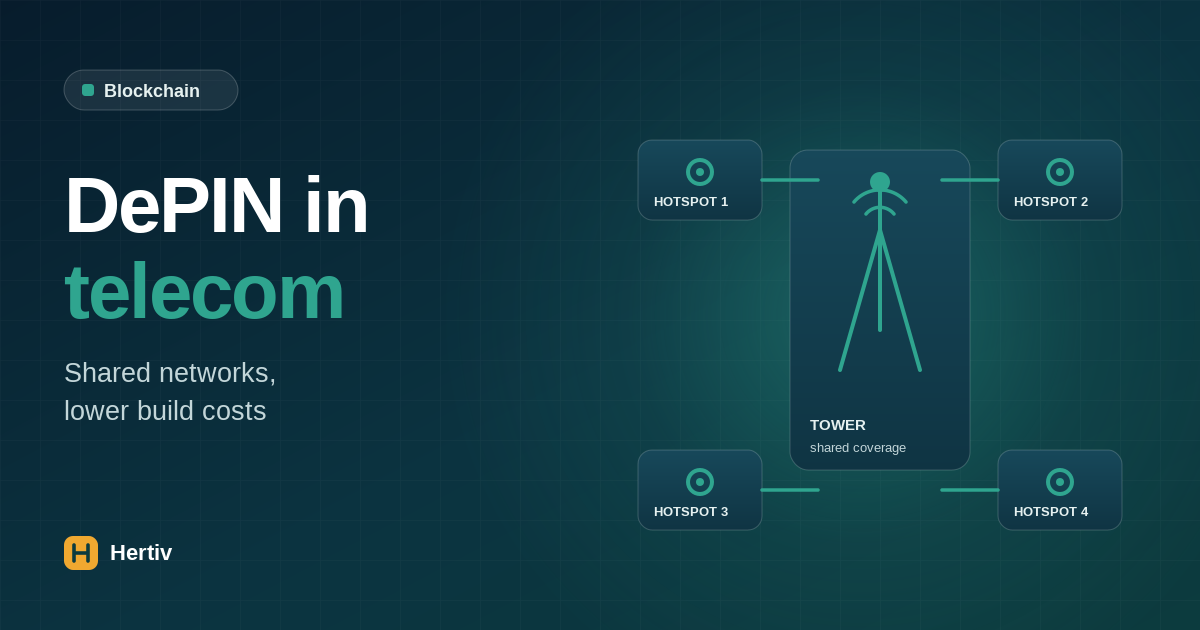
DePIN in telecom is a model where a mobile or internet network is built and run by many independent participants, instead of one operator owning every tower, router and cable. Participants install small devices, such as wireless hotspots or sensors, and are rewarded with tokens for providing coverage or carrying data.
The name stands for decentralised physical infrastructure networks. The idea is simple: the physical work of running a network is spread across many owners, while a blockchain records who provided what and pays them fairly. The operator role shifts from owning hardware to writing the rules and software that keep the network honest.
This model is still early, and it does not replace the big carriers in most places. It works best where coverage is patchy, where demand is uneven, or where a community wants connectivity that a large operator has not yet built. You can see the wider pattern in the main DePIN use cases, which range from wireless networks to mapping and energy.
How does a DePIN telecom network work?
A DePIN telecom network works in four parts: devices, coverage proof, token rewards and the data plane that carries traffic.
- Participants install devices. A hotspot, antenna or small cell is placed on a roof or in a shop and connected to the internet.
- The network checks coverage. Devices prove they are online and can serve users, often by responding to challenges or by reporting signal data.
- Rewards are paid in tokens. The blockchain records each device's contribution and pays out tokens, so the reward follows the work done.
- Users connect and pay. Phones and sensors use the network, and their fees flow back to the participants who provided the coverage.
For a carrier, the interesting part is the cost shift. Instead of paying upfront for towers and crews, the network pays per unit of coverage delivered. That changes the economics of places where traffic is thin, such as rural roads or industrial sites, where a full tower may never pay for itself.
Where does DePIN help telecom most?
DePIN helps telecom most where coverage is expensive to build and hard to maintain, and where demand is too small or too spread out for a traditional build.
| Area | Why DePIN fits | Main limit |
|---|---|---|
| Rural and remote coverage | Residents host hotspots where towers are uneconomic | Backhaul still needs a wired or satellite link |
| IoT sensor networks | Many small devices, low data per device | Coverage gaps if hosts drop out |
| Event and temporary sites | Quick setup without a permanent tower | Short-lived, so rewards must be fast |
| Indoor and campus coverage | Building owners add small cells themselves | Needs agreement with the building owner |
| Disaster and backup links | Mesh of hotspots keeps working if one fails | Power and backhaul can still fail |
The common thread is that the work is spread out and the reward is small per device. A single hotspot earns little, so the model only works when hundreds or thousands of people take part. That is why most DePIN telecom projects start in one city or region and grow outward, rather than launching everywhere at once.
What are the main risks for a telecom team?
The main risks for a telecom team looking at DePIN are token price swings, uneven coverage, and the rules that govern who can run a network.
Token rewards are the engine of the model, and their value can move sharply. If the token falls, hosts may switch their devices off, and coverage can shrink just when users need it. Teams that treat the token as the only payment, rather than one part of a payment mix, are exposed to that swing.
Coverage quality is a second risk. A carrier can plan a tower grid; a DePIN network depends on where people choose to place devices, so coverage can be patchy and hard to guarantee. Service agreements that promise a given signal level are difficult to write when the operator does not control the hardware.
Regulation is the third risk. Spectrum licences, consumer protection and data rules still apply, and a token reward can look like an investment product in some markets. Teams should check the legal position early, as the MiCA regulation shows how token rules are tightening in Europe.
For a carrier, cloud computing in telecom often pairs with DePIN trials, because the core network still runs in the cloud.
Example (hypothetical): a rural coverage pilot
Example (hypothetical): a regional carrier wants coverage along a 40-kilometre valley with 12 small villages. A new tower would cost about $120,000 to build, and the expected traffic would not pay it back for years.
Instead, the carrier runs a DePIN pilot. It offers 60 households a hotspot kit and a token reward worth about $8 a month for keeping the device online and serving traffic. The carrier spends $30,000 on kits, software and support, and the monthly reward bill is 60 times $8, which is $480 a month, or $5,760 a year.
After six months, 48 of the 60 hotspots are online and serving users, and the valley has basic data coverage for the first time. The total first-year cost is $30,000 plus $5,760, which is $35,760, against $120,000 for a tower. The carrier keeps the tower option open for the busiest village, and the pilot gives it real data on where demand actually sits.
What are the common mistakes?
The most common DePIN telecom mistakes are promising coverage the network cannot guarantee, paying rewards that fall with the token, and treating the pilot as a finished product.
- Promising carrier-grade coverage. A DePIN network cannot guarantee the same signal as a planned tower grid. Be honest about what it delivers.
- Paying only in tokens. If the token price drops, hosts leave. Mix token rewards with stable payments or free service.
- Ignoring backhaul. A hotspot still needs an internet link. If the village has no broadband, the hotspot has nothing to share.
- Skipping the legal check. Spectrum, consumer and token rules all apply. Get the position in writing before launch.
- Measuring devices, not users. A thousand hotspots with no users is a map, not a network. Track active users and data carried.
How should a team start a DePIN telecom trial?
A team should start a DePIN telecom trial by picking one small area, setting a clear success measure, and running it for a fixed period.
- Pick one area. Choose a valley, campus or industrial site where coverage is poor and demand is known.
- Set the success measure. Decide what counts as working: active users, data carried, or uptime. Write it down before launch.
- Recruit hosts first. Talk to residents or building owners before buying kits. No hosts, no network.
- Run it for three months. A short pilot shows whether hosts stay online and whether users come.
- Decide on the data. Compare the cost per user with a tower build, and expand only where the numbers work.
Billing and support still matter in a trial. The team that runs the pilot should know how telecom billing software works, because users will still need accounts, usage records and a way to pay.
Key takeaways
- DePIN spreads the physical work of a network across many small hosts, paid in tokens
- Rural areas, IoT sensors and temporary sites are the strongest fits for the model
- Token price swings and patchy coverage are the two biggest risks for a team
- Backhaul, spectrum and consumer rules still apply, even when the network is decentralised
- Start with one small trial area and a clear success measure before expanding
Frequently asked questions
What does DePIN stand for?
DePIN stands for decentralised physical infrastructure networks. It describes projects where many independent participants run physical hardware, such as wireless hotspots, sensors or storage, and are rewarded with tokens for the service they provide. A blockchain records the work and pays the reward.
Is DePIN telecom the same as a normal mobile network?
No. A normal mobile network is planned and owned by one operator, which builds towers and sells service. A DePIN network is built by many hosts who place devices and earn rewards. The operator role shifts to writing the rules, running the software and handling billing and support.
Do users need crypto to use a DePIN network?
Usually not. Users normally pay in ordinary money, through an app or a subscription, while hosts receive token rewards on the other side. The token is mostly a way to pay the people who run the hardware, not something users must buy.
Can DePIN replace a mobile carrier?
Not in most places. DePIN works best as a way to add coverage where a carrier build is too costly, such as rural areas, campuses and temporary sites. Dense cities and high-traffic areas still favour planned towers and fibre, where one operator can guarantee capacity.
What happens if the token price falls?
Hosts earn less, and some may switch their devices off, which can shrink coverage. Teams handle this by mixing token rewards with stable payments, free service or a fixed fee, so the network does not depend on the token price alone.
Is DePIN legal for telecom?
The same telecom rules apply: spectrum licences, consumer protection and data rules do not vanish because a network is decentralised. Token rewards can also fall under financial rules in some markets. Teams should get the legal position in writing before launching a trial.


