What Is Telecom Billing Software, and How Does It Work?
Telecom billing software rates usage, applies charges and produces invoices for phone, internet and mobile services. Learn how it works and what to look for.
On this page
Short answer
Telecom billing software is the system a phone, internet or mobile operator uses to turn usage into bills. It collects call, data and message records, prices each one under the customer's plan, applies taxes and discounts, and produces an invoice. It also handles payments, disputes and account changes, so the operator can charge accurately and the customer can see what each charge is for.
What is telecom billing software?
Telecom billing software is the system that turns a customer's use of phone, mobile data, broadband or messaging services into a bill. It sits between the network, which records what happened, and the customer, who pays for it. Every call, data session, text and subscription change passes through it.
The software has two jobs that matter most. First, it must price usage correctly: a call at peak time, a gigabyte over the allowance, or a roaming day each has a price under the customer's plan. Second, it must keep a clear record, so a disputed charge can be traced back to the exact event that caused it.
Billing is not the same as charging in real time. Many systems rate usage as it happens and hold a running balance, then produce the invoice at the end of the billing period. Prepaid services check the balance before allowing use, while postpaid services bill after the fact. Both shapes need the same core: accurate records, correct prices and a bill the customer can understand.
How does telecom billing work?
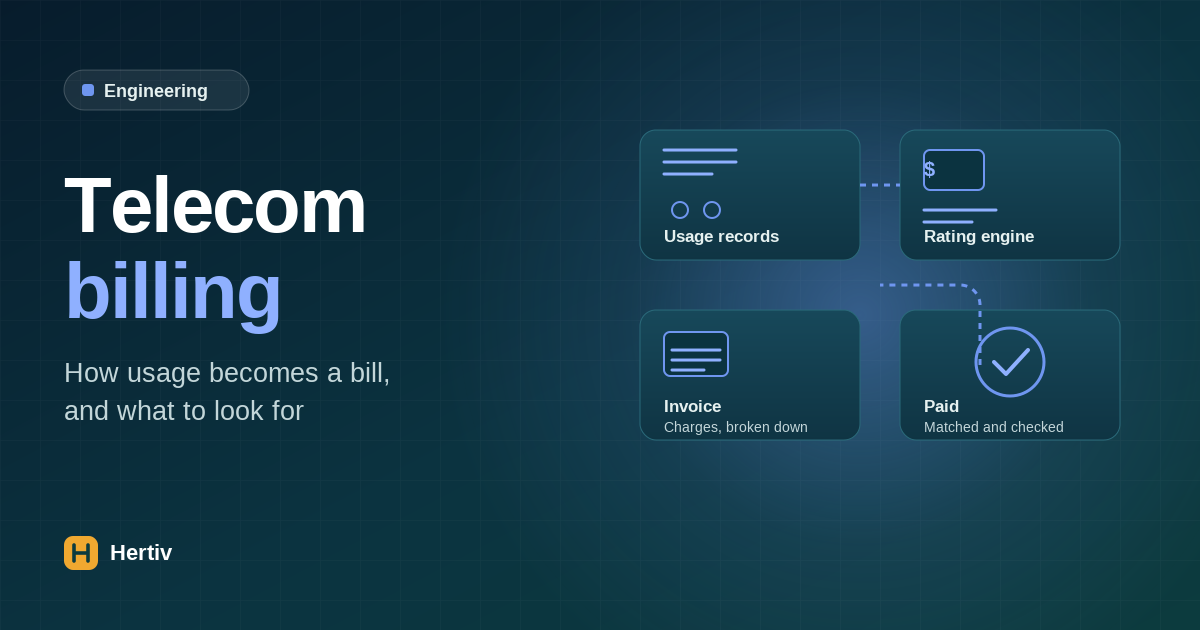
Telecom billing works as a chain of steps, from the network event to the money arriving in the operator's account. Each step has its own job, and a failure in any one of them shows up as a wrong bill or a missed payment.
- Collect usage records. Switches, routers and gateways produce records for calls, data sessions and messages, with time, duration, volume and location.
- Rate the usage. A rating engine prices each record against the customer's plan, including allowances, off-peak rates and roaming rules.
- Apply charges and adjustments. The system adds recurring fees, one-off charges, discounts, taxes and credits, and checks the result against the plan.
- Produce the invoice. Charges are grouped into a bill the customer can read, with a summary and a breakdown by service.
- Collect payment and handle disputes. Payments are matched to invoices, dunning follows late payers, and disputed items are investigated against the original records.
The rating step is where most of the difficulty lives. Plans change constantly, with new bundles, promotions and partner offers, and every change must be reflected in the rating rules without breaking the bills of customers on older plans. That is why operators test rating changes on sample usage before they go live.
What are the main parts of a billing system?
The main parts of a telecom billing system are mediation, rating, invoicing, payments and customer care, each handling one stage of the chain from network record to paid bill.
| Part | What it does | Why it matters |
|---|---|---|
| Mediation | Collects and cleans usage records from the network | Bad records mean wrong bills |
| Rating engine | Prices each record under the plan | The heart of correct charging |
| Product catalogue | Defines plans, bundles and prices | New offers start here |
| Invoicing | Builds the bill and its breakdown | What the customer actually sees |
| Payments and dunning | Takes payment, chases late bills | Turns usage into cash |
| Customer care | Shows charges and handles disputes | Keeps trust when bills are questioned |
These parts usually come from one vendor or from several systems that must agree on the same customer, plan and usage data. When they disagree, the customer sees it first: a charge that does not match the plan, or a payment that does not clear the balance. Keeping one shared record of the customer and the plan is what holds the system together.
That shared record is a data engineering job as much as a billing one, and it is worth treating it that way from the start.
What billing models do telecom operators use?
Telecom operators use prepaid, postpaid, flat-rate, usage-based and bundled billing models, and many operators run several of them at once for different customer groups.
- Prepaid. The customer pays first and uses the balance down. The system must check the balance in real time and stop use when it runs out.
- Postpaid. The customer uses services first and pays at the end of the period. The system must rate usage accurately and invoice on time.
- Flat rate. A fixed monthly price for a set allowance, with extra charges only above it. Simple to explain, and the bill rarely surprises.
- Usage based. The customer pays for what they use, such as minutes, gigabytes or messages. Fair, but the bill varies and needs a clear breakdown.
- Bundled. Phone, broadband and TV sold together at one price. The system must split the revenue between services and handle discounts that span the bundle.
The model shapes the billing system more than the brand of the software does. A prepaid system needs real-time balance checks, while a postpaid system needs strong invoicing and dunning. An operator that sells both needs a system that can do both without keeping two separate customer records. Cloud-hosted billing, run through cloud services, is one way smaller operators avoid building that system themselves.
How do you choose telecom billing software?
You choose telecom billing software by matching it to the services you sell, the volume of usage records you process, and the speed at which you launch new plans.
- List what you sell. Write down every service, plan and bundle, including prepaid and postpaid, and check the system can rate them all.
- Check the rating engine. Ask how a new plan is configured, how long a price change takes, and how rating errors are found and fixed.
- Test with real records. Feed a sample of real usage records through the system and compare the result with the current bills, line by line.
- Check the invoice. Read a sample bill as a customer would. If the charges are hard to follow, disputes will follow.
- Ask about scale and recovery. Find out how many records per day the system handles, how it recovers from a failed run, and how long a full billing cycle takes.
Migration is the hidden cost. Moving years of customer, plan and usage history into a new system takes months of checking, and the old system usually runs in parallel until the new bills are trusted. Budget for that period, and for the staff who will answer the first wave of customer questions. A partner for custom software development can help plan the migration.
Example (hypothetical): billing for a small mobile operator
Example (hypothetical): a small mobile operator has 50,000 subscribers on a plan that costs $20 a month and includes 10 gigabytes of data. In one month, the plan charges alone come to 50,000 times $20, which is $1,000,000.
On top of that, 4,000 subscribers use 2 gigabytes over their allowance, charged at $5 per gigabyte. That is 4,000 times 2 times $5, which is $40,000 in overage charges. The total billed for the month is $1,000,000 plus $40,000, which is $1,040,000.
If 1,500 of those overage charges are disputed and half are found to be rating errors, the operator credits 750 times $10, which is $7,500. The point of the example is that a small error rate in rating still costs real money, and that the credit is only fair if the original usage record can be found and checked.
What are the common mistakes?
The most common mistakes in telecom billing are launching a plan the rating engine cannot price, treating the invoice as an afterthought, and migrating history without checking it.
- Rating rules that lag the offer. A promotion that the billing system cannot price becomes a manual workaround, and manual work creates errors.
- Bills customers cannot read. A bill that hides the reason for a charge creates disputes, and disputes cost more than the charge itself.
- Skipping the parallel run. Switching off the old system before the new bills are checked line by line is how a billing error becomes a public problem.
- No audit trail. If a charge cannot be traced to a usage record, a rating rule and a plan, it cannot be defended.
- Ignoring dunning. Late payment handling is part of billing, not an afterthought, and weak dunning turns small debts into write-offs.
Key takeaways
- Telecom billing turns network usage records into accurate, readable bills
- Rating is the hard part: plans change often and every change must price correctly
- Prepaid needs real-time balance checks; postpaid needs strong invoicing and dunning
- Test a new system on real usage records before switching off the old one
- A bill the customer cannot follow creates disputes that cost more than the charge
Frequently asked questions
What is the difference between prepaid and postpaid billing?
In prepaid billing the customer pays first and the system checks the balance before allowing use, stopping service when the balance runs out. In postpaid billing the customer uses services first and pays at the end of the period, so the system rates usage and invoices afterwards. The two models need different strengths: real-time checks for prepaid, accurate invoicing and dunning for postpaid.
What is rating in telecom billing?
Rating is the step that prices each usage record against the customer's plan. It takes a call, data session or message, looks up the plan's rates, allowances and time rules, and works out the charge. A rating engine must handle new plans, promotions and roaming rules without breaking the bills of customers on older plans.
What is mediation in a billing system?
Mediation collects usage records from switches, routers and gateways, cleans them, and passes them to the rating engine in a standard form. Network equipment produces records in many formats, and mediation turns them into one consistent stream. If mediation drops or duplicates records, the bill will be wrong even if the rating rules are right.
How do telecom operators handle billing disputes?
They trace the disputed charge back to the original usage record, the rating rule that priced it and the plan the customer was on. If the record or the rule is wrong, the charge is credited. A good billing system keeps that audit trail for every charge, so a dispute can be settled from the records rather than from memory.
Can one billing system handle prepaid and postpaid together?
Yes, many modern billing systems support both, but they must keep one shared customer and plan record so the two models agree. The prepaid side needs real-time balance checks, while the postpaid side needs invoicing and dunning. Operators that run two separate systems often find the same customer billed twice or not at all.
Why do telecom bills have so many line items?
Because a bill must show the plan fee, each type of usage, overage charges, discounts, taxes and one-off fees separately, so the customer can check each one. A single total hides errors. A clear breakdown is also what lets the operator's support team answer a question about a charge without guessing.


