AI Agents in Telecom: What They Do and Where They Fit
AI agents in telecom solve billing queries, spot network faults, schedule repairs and flag fraud. Here is how they work and what operators need first.
On this page
Short answer
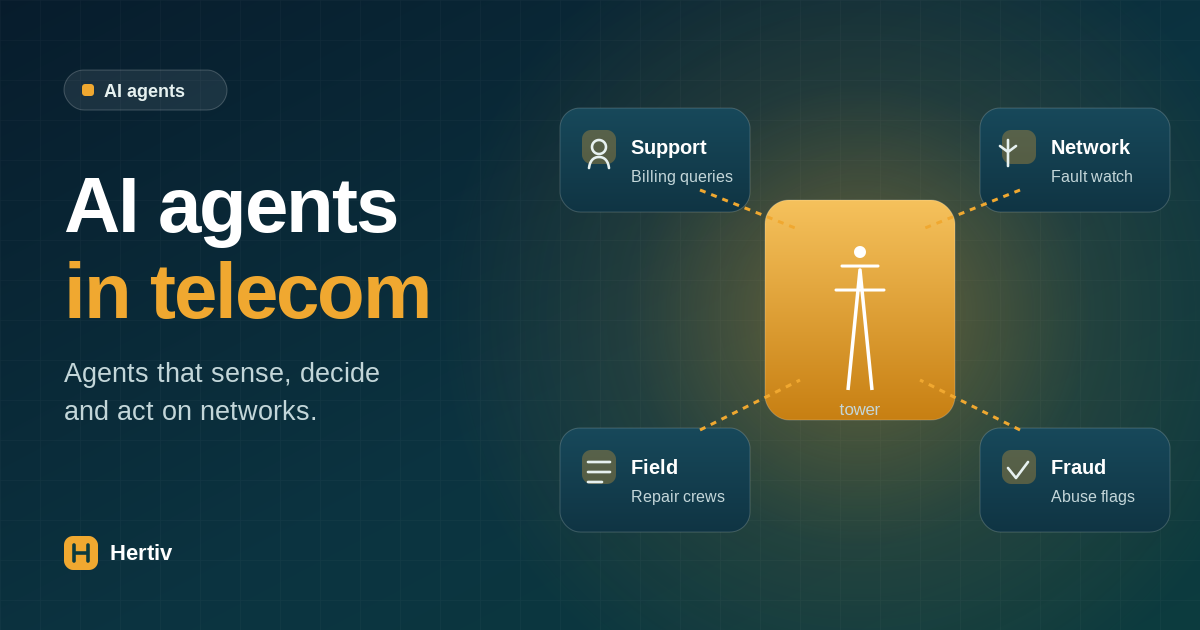
AI agents in telecom are software systems that sense a problem or a request, decide what to do, and act on it across a telecom operator's networks and systems. They work in customer support, network operations, field service, sales and fraud detection, and they are useful because they can watch thousands of signals at once and act on the ones that matter.
What are AI agents in telecom?
AI agents in telecom are software systems that sense a problem or a request, decide what to do, and act on it across a telecom operator's networks and systems. Unlike a chatbot that only answers questions, an agent can check a network, open a ticket, change a setting or order a repair.
Telecom operators run large, complex networks with millions of customers, so they are a natural fit for agents. An agent can watch thousands of signals at once and act on the ones that matter, while a human team would need hours to spot the same pattern.
| Area | What the agent does | Who benefits |
|---|---|---|
| Customer support | Solves billing and service queries end to end | Customers and support teams |
| Network operations | Spots faults and reroutes traffic | Network engineers |
| Field service | Schedules repairs and dispatches crews | Technicians and customers |
| Sales and retention | Spots churn risk and offers a plan | Sales teams |
| Fraud and security | Flags unusual usage and blocks abuse | Security teams |
An agent is only as good as the systems it can reach. If it cannot read the billing system, the network monitor and the ticketing tool, it will answer like a chatbot instead of acting like an agent.
How do AI agents work in a telecom network?
An AI agent in telecom works in a loop: it reads data from network monitors, billing systems and customer records, decides what action fits the rules it was given, takes that action through a tool, and then checks whether the action worked.
The loop runs on guardrails. An agent may be allowed to restart a router or credit a small bill on its own, but a large credit or a network-wide change needs a human to approve it. Those limits are set in advance and logged, so every action can be traced back to a rule and a person.
Agents usually work with a model that plans the steps, tools that connect to real systems, and a memory of what has already been tried. If the first fix does not work, the agent can try the next step in its plan or hand the case to a human with a full record of what happened.
The hardest part is data. Telecom data lives in many old systems with different formats, and an agent that reads stale or wrong data will act on it. Cleaning up the data and the system connections is usually most of the project, not the agent itself. How to build an AI proof of concept covers how to test an agent on a small slice before scaling it.
Where are AI agents used in telecom today?
AI agents in telecom are used most in customer support, network operations, field service, sales and fraud detection. Each area has clear tasks, measurable outcomes and data the agent can read, which makes it a good place to start.
- Customer support. Agents handle billing questions, plan changes and service checks end to end, and pass the hard cases to humans with a full history attached.
- Network operations. Agents watch cell towers and core network alarms, spot patterns that point to a fault, and reroute traffic or open a ticket before customers notice.
- Field service. Agents group nearby faults, book the right crew and parts, and tell customers when a technician will arrive.
- Sales and retention. Agents spot customers whose usage or complaints suggest they may leave, and offer a plan or a fix that fits their history.
- Fraud and security. Agents watch for unusual usage, such as sudden international calls, and block or flag the account before the bill grows.
Support is usually the first area to automate, because the volume is high and the outcome is easy to measure. Network operations follows once the agent has proved it can act safely on live systems.
What do telecom operators need before deploying agents?
A telecom operator needs clean data, connected systems, clear guardrails and a way to measure results before deploying AI agents. Without those four, an agent will guess, act on stale data, or make changes nobody can explain.
- Connect the systems. Billing, network monitoring, ticketing and customer records must all be reachable through safe, logged interfaces.
- Clean the data. Fix duplicate customers, stale network records and missing fields, since an agent will act on whatever it reads.
- Set the guardrails. Decide which actions an agent can take alone, which need approval, and what it must never do, such as changing a tariff for a whole region.
- Start with one use case. Pick a narrow job with a clear outcome, such as billing queries, and prove it works before adding network changes.
- Measure and review. Track resolution rate, time saved, cost and customer satisfaction, and review agent actions weekly at first.
Operators that skip the data and guardrail work usually end up with an agent that answers questions but cannot act. That is a chatbot with a new name, not an agent, and it rarely saves much time. For the wider agent picture, see AI agents use cases across industries.
Example (hypothetical): an agent that fixes a billing complaint
Example (hypothetical): a telecom customer calls because the monthly bill is $30 higher than usual. An AI agent takes the call, checks the billing system, and finds a roaming charge from a trip the customer took last month.
The agent explains the charge, checks the customer's plan, and finds a roaming add-on that would have cost $10 instead of $30. It offers to credit the $20 difference and add the roaming pack to the plan for future trips.
The customer accepts. The agent applies the $20 credit, adds the pack, and logs the whole case. The call takes 4 minutes instead of the 12 minutes a human agent usually needs, and the customer keeps the plan instead of looking for a cheaper operator. The operator counts the case as resolved only if the credit appears on the next bill, which the agent checks the following day.
What are the risks of AI agents in telecom?
The risks of AI agents in telecom are wrong actions on live networks, billing errors, privacy breaches and customer trust. An agent that can change a network setting or credit a bill can also do real damage if it acts on bad data or a bad rule.
- Wrong network actions. An agent that restarts the wrong equipment or reroutes traffic badly can cause an outage for thousands of customers.
- Billing mistakes. A wrong credit or charge is hard to undo and easy for customers to notice, so billing actions need tight limits.
- Privacy. Agents read customer records, call logs and location data, so access must be limited to what each job needs.
- Over-trust. Staff can start accepting agent actions without checking them, which lets small errors grow into big ones.
- Regulation. Telecom is regulated, and automated decisions that affect customers may need to be explainable to a regulator.
Guardrails and logs are the answer to most of these risks. Every action should be logged, reversible where possible, and reviewed until the agent has proved itself on that exact job.
What are the common mistakes?
The most common mistakes are deploying an agent without connected systems, giving it too much freedom too soon, and measuring the wrong thing.
- No system access. An agent that cannot reach billing or network systems can only answer questions, not solve problems.
- Too much freedom. Letting an agent change network settings or issue large credits on day one invites a costly error.
- Dirty data. An agent that reads stale records will act on them, and the customer pays for the mistake.
- Measuring call deflection only. If customers call back an hour later, the agent did not resolve anything, whatever the dashboard says.
- Skipping the human handoff. Hard cases need a human with the full history, not a customer starting over.
Telecom operators that succeed with agents start narrow, connect the systems first, and grow the agent's freedom only as it proves itself. AI agent development covers how these systems are built and rolled out.
Key takeaways
- An AI agent acts on systems; a chatbot only answers questions
- Support, network operations and field service are the best places to start
- Agents need connected systems, clean data, guardrails and measurement
- Start narrow with one use case and grow freedom only as the agent proves itself
- Every action should be logged, reversible and reviewed until trust is earned
Frequently asked questions
What is the difference between an AI agent and a chatbot in telecom?
A chatbot answers questions from a script or a knowledge base. An AI agent goes further: it checks billing or network systems, decides what action to take, and carries it out, such as crediting a bill or opening a repair ticket. The difference is the ability to act on real systems.
Can AI agents fix network faults on their own?
They can handle routine faults, such as rerouting traffic around a failed link or restarting a device, when the rules allow it. Larger changes, such as a network-wide reconfiguration, usually need a human to approve them. Guardrails decide which actions an agent can take alone.
Do AI agents replace telecom support staff?
They replace routine work, not people. Agents handle common billing and service queries end to end, which frees human staff for hard cases, angry customers and complex faults. Most operators keep humans in the loop for anything unusual or high value.
What data do telecom AI agents need?
They need billing records, network monitoring data, ticketing history and customer records, all reachable through safe, logged interfaces. Clean data matters more than the model itself: an agent that reads stale or wrong data will act on it, and the customer pays for the mistake.
How do telecom operators measure agent success?
They track resolution rate, time saved, cost per case, customer satisfaction and repeat contacts. A case counts as resolved only if the customer does not call back about the same problem. Call deflection alone is a poor measure, since it hides customers who gave up.
Are AI agents in telecom safe for customer privacy?
They can be, if access is limited to what each job needs and every action is logged. Agents read sensitive records, so operators must control who and what the agent can see, keep the data inside approved systems, and be able to explain automated decisions to a regulator.


