Tax Form Tokenization: How Tax Forms Become Tokens
Tax form tokenization turns a W-2 or 1099 into a verifiable token on a blockchain, so the form can be checked without passing the full document around.
On this page
Short answer
Tax form tokenization is the process of representing a tax form, such as a W-2 or a 1099, as a token on a blockchain. The token does not hold the form itself. It holds a fingerprint of the form plus a pointer to where the form is stored, so anyone with permission can check that the form is real and unchanged, without emailing copies of sensitive documents.
What is tax form tokenization?
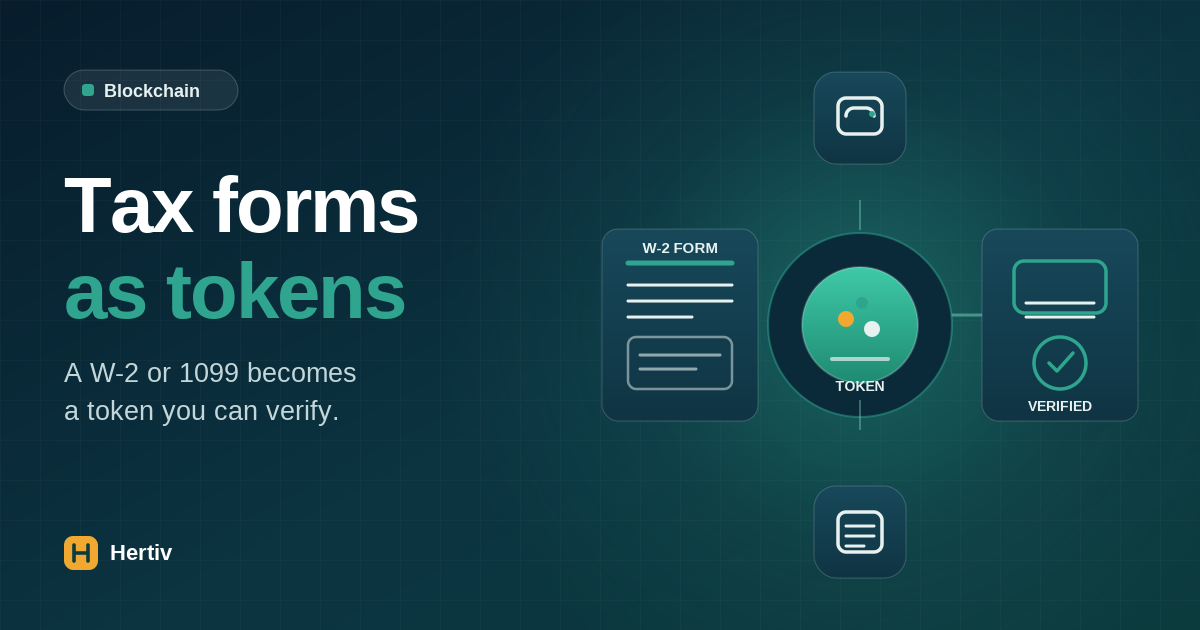
Tax form tokenization is the process of turning a tax form, such as a W-2 or a 1099, into a token on a blockchain. The token acts as a receipt for the form: it records that a specific form exists, who issued it, and a fingerprint of its contents, so the form can be checked later without sending the document itself.
The form itself is almost never stored on the chain. Tax forms contain names, addresses, tax identification numbers and income figures, and a public ledger is the wrong place for that data. Instead, the full form stays in a private system, and the token holds a hash of the form, which is a short string made from its contents. If anyone changes even one figure, the hash changes, so the token no longer matches.
This is a narrow use of tokenization. It does not turn a tax form into an asset that can be bought or sold, and it does not change what the form means for tax purposes. It is a way to prove that a form is genuine and unchanged, as how tokenization works explains for other document types.
What does a tokenized tax form contain?
A tokenized tax form splits into two parts: a small record on the chain and the full form kept off the chain. The split is what keeps the private data private while still giving everyone a shared proof they can check.
| Part | What it holds | Where it lives |
|---|---|---|
| Token | Form type, issuer, tax year, hash of the form | On the chain |
| Form file | Names, tax IDs, income and withholding figures | Private storage |
| Access rule | Who may view the form and for how long | Smart contract or access list |
| Receipt | Time the token was issued and by whom | On the chain |
| Status | Issued, corrected or replaced | On the chain |
The hash is the key piece. It is made from the exact contents of the form, so a tax preparer can recompute it from a copy of the form and compare it with the hash on the token. A match means the copy is the same form the issuer signed. A mismatch means something changed and the form needs checking.
Corrections get their own token rather than editing the old one. If a W-2 is corrected, the issuer creates a new token for the corrected form and marks the old token as replaced. The chain keeps the full history, so a reviewer can see that a correction happened and which version is current.
How does tax form tokenization work?
Tokenizing a tax form follows the same steps as tokenizing other documents, with extra care around privacy. The issuer prepares the form, stores it privately, and then writes a token that points to it.
- The employer or payroll firm prepares the tax form in the usual way and stores the file in a private system.
- The system computes a hash of the form file and records the form type, tax year and issuer.
- A token is created on the chain holding the hash, the form type, the tax year and the issuer identity.
- The recipient gets a link or a reference to the token, not a copy of the form by email.
- When a tax preparer or auditor needs the form, they fetch the file from private storage with permission.
- The preparer recomputes the hash and compares it with the token to confirm the form is unchanged.
Access control matters more than the token itself. The token is useless if anyone can fetch the form file, and it is also useless if the people who need the form cannot get access in time. Most designs use a permissioned chain or a private network, so only employers, payroll firms, tax software and auditors take part.
The same pattern appears in other tokenization work, such as real estate tokenization, where the token proves ownership of a document or an asset while the detailed records stay off the chain.
Why would anyone tokenize a tax form?
Tax forms are copied, emailed and retyped many times between employer, employee, preparer and auditor, and each copy is a chance for an error or a leak. A token gives every party one shared reference they can check instead of trusting the latest email attachment.
The clearest gain is verification. A tax preparer who receives a form can check the token in seconds and know the form came from the stated issuer and has not changed since it was issued. That removes a common source of delay: a preparer chasing an employer to confirm that a form is the final version.
Fraud is the other driver. A fake W-2 or 1099 is hard to spot from the paper alone, but a token signed by the issuer is hard to fake. If the token is missing or the hash does not match, the preparer knows to ask questions before filing.
Tax software that handles these forms, such as the tools in crypto tax software for enterprises, faces the same problem of trusting documents that arrive from many sources.
There is also an audit benefit. Because the chain records when each token was issued and corrected, an auditor can trace the history of a form without digging through email threads. That does not replace the audit itself, but it makes the trail easier to follow.
What are the limits and risks?
Tax form tokenization is still an early idea, and it has real limits. The first is that a token is only as good as the issuer. If an employer issues a token for a wrong form, the chain records the wrong form faithfully. Tokenization proves a form is unchanged, not that it is correct.
Privacy is the second limit. A hash does not reveal the form, but the token still shows that a form exists, who issued it and for which tax year. On a public chain, that metadata is visible to everyone. That is why most designs use a private or permissioned chain, where only approved parties can see the tokens.
Regulation is the third limit. Tax authorities set the rules for how forms are filed and kept, and a token does not change those rules. A business that tokenizes its forms still has to meet the filing, record-keeping and privacy rules that apply in its country. Anyone planning this should check the rules first, as cryptocurrency tax basics shows for a related area where the rules are still catching up.
Key management is a practical risk too. If the issuer loses the keys that sign tokens, it cannot issue new ones until access is restored. If an employee loses access to their forms, they need a clear way to get a new copy. A design that ignores recovery will fail the first time someone changes jobs or loses a phone.
Example (hypothetical): a payroll firm tokenizes 1099 forms
Example (hypothetical): a payroll firm prepares 1099 forms for 500 contractors. In the old process, the firm emails 500 PDFs, and about 40 contractors reply that the form never arrived or that the figures look wrong, so staff spend time resending and checking each case.
With tokenization, the firm stores the 500 forms in its private system and issues 500 tokens, one per form. Each contractor gets a link to their token. A contractor who needs the form fetches it from the firm's portal, and the portal checks the hash against the token before showing it.
Suppose the firm spends $12,000 building the token system and $300 a month, or $3,600 a year, running it. If the old process cost $20 per contractor in staff time for resends and checks, that is 500 times $20, or $10,000 a year. If tokenization cuts that work by half, the firm saves $5,000 a year, so the $12,000 build cost is recovered in two and a half years: $12,000 divided by $5,000 is 2.4.
The saving is only real if contractors actually use the portal, so the firm should pilot with 50 contractors first.
The pilot also tests the correction flow. If 10 of the 50 pilot forms need a correction, the firm issues 10 new tokens and marks 10 old tokens as replaced. The chain then shows 60 tokens for 50 contractors, and the portal shows only the current version to each contractor.
Common mistakes
The most common mistake is putting the form itself on the chain. Tax forms contain tax identification numbers and income figures, and a public ledger never forgets. The form must stay in private storage, with only the hash and basic facts on the chain.
Another mistake is treating the token as proof that the form is correct. A token proves the form has not changed since it was issued, nothing more. If the figures were wrong at the start, the token records a wrong form. Verification of the figures still needs a person who knows the payroll.
A third mistake is skipping the correction flow. Forms get corrected, and a system with no way to mark a token as replaced will leave old and new versions side by side with no way to tell which is current. Build the correction flow before issuing the first token.
Finally, do not build for one tax year only. Tax forms repeat every year, so the system should handle a new set of tokens each year and keep the history searchable. A pilot that works for one year but cannot add the next year will need rebuilding just as it starts to pay off.
Key takeaways
- Tax form tokenization turns a W-2 or 1099 into a token that proves the form is genuine and unchanged.
- The form itself stays in private storage; only a hash and basic facts go on the chain.
- A matching hash tells a preparer the copy is the same form the issuer signed.
- Corrections get a new token, and the old token is marked as replaced.
- A token proves a form is unchanged, not that its figures are correct.
Frequently asked questions
What is a tokenized tax form?
A tokenized tax form is a tax form represented by a token on a blockchain. The token holds a hash of the form, the form type, the tax year and the issuer, while the full form stays in private storage. The token lets a preparer check that the form is real and unchanged.
Does the token contain my tax details?
No. A well-designed token holds only a hash of the form plus basic facts such as form type and tax year. Names, tax identification numbers and income figures stay in private storage. The hash lets anyone check a copy of the form without revealing its contents.
Can a tokenized tax form be corrected?
Yes. If a form needs a correction, the issuer creates a new token for the corrected form and marks the old token as replaced. The chain keeps the history, so a reviewer can see that a correction happened and which version is current.
Does tokenization change how I file taxes?
No. Tokenization changes how a form is shared and checked, not what the form means for tax purposes. The form still has to be filed and kept according to the tax rules that apply where you live and work.
Is a public blockchain safe for tax forms?
A public chain is a poor fit because the token still reveals that a form exists, who issued it and for which tax year. Most designs use a private or permissioned chain, so only employers, payroll firms, tax software and auditors can see the tokens.
Who benefits most from tax form tokenization?
Payroll firms, large employers and tax preparers benefit most, because they handle many forms and spend time checking versions and chasing missing copies. A single shared reference cuts that work. Small employers with a handful of forms gain less.


