How to Build a Stablecoin Remittance Platform for Casinos
A stablecoin remittance platform moves casino payouts in minutes, but it needs licensed rails, identity checks and a clear settlement model. How to build one.
On this page
Short answer
A stablecoin remittance platform for casinos is software that lets a casino operator send player winnings, affiliate commissions and supplier payments in stablecoins instead of bank wires. It cuts settlement from days to minutes and lowers transfer fees, but it only works with a gambling licence, anti-money-laundering checks and a stablecoin the operator can redeem for cash.
What is a stablecoin remittance platform for casinos?
A stablecoin remittance platform for casinos is software that moves money between a casino operator and the people it pays, using a stablecoin instead of a bank wire. The operator holds player winnings, affiliate commissions and supplier payments in a treasury wallet, and sends them to wallets owned by players, affiliates or suppliers, who can then convert the stablecoin to local currency.
The point is speed and reach. A bank wire to another country can take days and pass through several banks, each taking a fee. A stablecoin transfer settles in minutes on the blockchain and costs a small network fee, which matters when a casino pays out thousands of winners and affiliates every month. The operator still needs a way to turn stablecoins back into bank money, which is where an off-ramp partner comes in.
This is a payments platform with a casino use case, not a casino game. The hard parts are the licence, the identity checks and the treasury controls, not the game itself. A stablecoin remittance guide for startups covers the general pattern, while this article covers what changes when the sender is a licensed casino.
How does a casino remittance payment move?
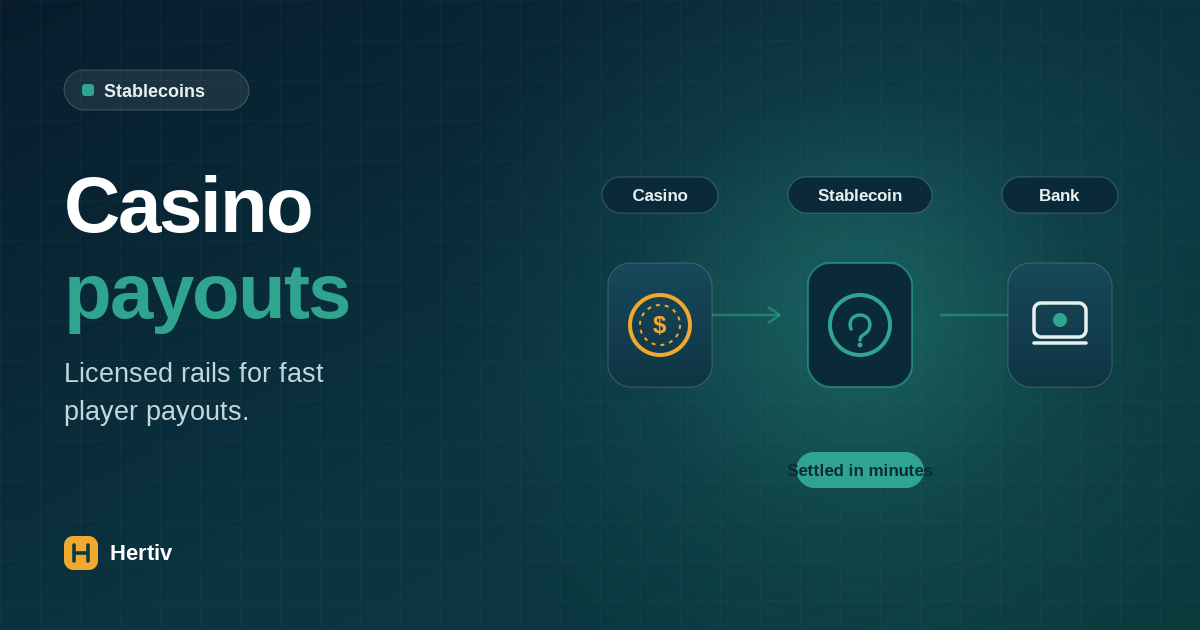
A casino remittance payment moves in five stages, from the operator's treasury to the recipient's bank account. The stablecoin leg is the fast part; the slow parts are the checks at each end.
| Stage | What happens | Who checks it |
|---|---|---|
| 1. Payout request | Player, affiliate or supplier asks for payment | Casino finance team confirms the amount owed |
| 2. Identity check | Recipient identity and wallet are screened | Compliance team and screening software |
| 3. Stablecoin transfer | Stablecoins move from treasury wallet to recipient wallet | Blockchain confirms the transfer in minutes |
| 4. Conversion | Recipient converts the stablecoin to local currency | Off-ramp partner or exchange |
| 5. Record and report | Payment is logged for audit and reporting | Finance and compliance teams |
The identity check is the stage that decides whether the payment is legal. Casinos must know who they are paying, screen recipients against sanctions lists and watch for patterns that suggest money laundering, such as many small payouts to the same wallet. A payment that skips this stage can cost the operator its licence, however fast the transfer itself was.
What does the platform need to include?
The platform needs six parts: wallets, identity checks, a treasury desk, a ledger, a compliance screen and reporting. Each part has one job, and a weak part puts the whole platform at risk.
| Part | What it does | What breaks without it |
|---|---|---|
| Treasury wallets | Hold stablecoins and release payouts | Funds sit in one wallet with no controls |
| Identity checks | Verify recipients and screen sanctions lists | Payments go to people the casino cannot name |
| Payment ledger | Record every payout with its reason | Audits fail because the trail is missing |
| Conversion desk | Turn stablecoins into bank money and back | Stablecoins pile up with no way to spend them |
| Limit controls | Cap payout sizes and flag unusual patterns | One bad payout can drain the treasury |
| Reporting | Produce records for regulators and auditors | Compliance reports take weeks to assemble |
The treasury wallet design deserves the most care. A single wallet with one key is a single point of failure, so operators use multi-signature wallets, where two or three approvals are needed before funds move, and keep most funds in a cold wallet that is not connected to the internet. Daily payout limits add a second layer, so a mistake or a breach can only move one day's worth of funds.
What licences and compliance rules apply?
A stablecoin remittance platform for casinos needs a gambling licence first, then the payment rules that apply to moving money. The gambling licence comes from the jurisdiction where the casino operates, and it sets the rules for who the casino can pay, what records it must keep and how it must handle player funds.
On the payments side, the operator must run anti-money-laundering checks on recipients, screen them against sanctions lists and keep records that an auditor can follow from a payout request to the blockchain transfer. Many jurisdictions also apply the travel rule, which requires payment providers to share sender and recipient details with each other for transfers above a threshold.
The stablecoin itself matters too: operators should use a stablecoin with clear reserves and a redemption route, so the coins can be turned back into bank money when needed. A stablecoin guide explains how the main stablecoins are backed and redeemed.
The rules differ by country, and they change often. An operator should get legal advice in each market it pays into before launching, rather than assuming the rules from one market apply everywhere. Launching in a market without checking its rules is the fastest way to lose a licence in another market, because regulators share information about operators that cut corners.
How do you build it, step by step?
You build a stablecoin remittance platform for casinos by sorting the licence and the money flow first, then building the software around them. The code is the easy part; the licence and the banking relationships take the longest.
- Confirm the licence covers payouts. Check that the gambling licence allows stablecoin payouts to players, affiliates and suppliers in each market, and note any markets it does not cover.
- Choose the stablecoin and chain. Pick a stablecoin with clear reserves and a redemption route, on a chain with low fees and fast confirmation, and confirm the off-ramp partner supports both.
- Set up treasury wallets. Use multi-signature wallets with daily limits, keep most funds cold, and write down who can approve a transfer and how much each approver can move.
- Build the identity and screening checks. Connect identity verification and sanctions screening to the payout flow, so no payment can move before the checks pass.
- Build the payout flow. Connect the casino's player and affiliate systems to the treasury, so approved payouts are queued, checked and sent without manual copying.
- Add the ledger and reporting. Record every payout with its reason, recipient and blockchain reference, and build the reports regulators and auditors will ask for.
- Test with small amounts. Run real payouts at small values for several weeks, check the ledger against the blockchain, and fix the gaps before raising the limits.
Testing with small amounts is the step that saves operators from the expensive mistakes. A wrong wallet address, a missing identity check or a ledger entry that does not match the chain is cheap to fix at $100 a payout and costly at $100,000. For the stablecoin side of the build, launching a stablecoin covers how stablecoins themselves are set up and backed.
Example: a casino group pays affiliates in stablecoins
Example (hypothetical): a casino group pays 1,200 affiliate commissions a month, averaging $850 each. That is 1,200 times $850, which is $1,020,000 a month in affiliate payouts, sent to partners in many countries.
By bank wire, each payout costs about 3 percent in fees and bank charges, which is about $30,600 a month, and takes two to five days to arrive. On a stablecoin platform, the transfer fee is about 0.5 percent, which is about $5,100 a month, and the payment arrives in minutes. The saving is about $25,500 a month, or about $306,000 a year, before counting the cost of building and running the platform.
The group also gains a clear audit trail, because every payout has a blockchain reference tied to an affiliate record. The saving is real, but it only holds if the identity checks and the off-ramp work smoothly.
If affiliates cannot convert the stablecoin to local currency easily, they will ask to go back to wires, and the saving disappears. The numbers are hypothetical, and real fees depend on the chain, the stablecoin and the off-ramp partner.
What are the common mistakes?
The most common mistakes with casino stablecoin remittance platforms are launching without the right licence, skipping identity checks on recipients, and holding stablecoins with no way to convert them back to bank money.
- Paying into markets the licence does not cover. A licence in one country does not cover payouts everywhere. Check each market before sending the first payment.
- Skipping recipient checks. Paying a wallet without knowing who owns it is the fastest route to a money-laundering finding. Screen every recipient, every time.
- One wallet, one key. A single-key treasury wallet is a single point of failure. Use multi-signature wallets and daily limits from day one.
- No off-ramp plan. Stablecoins that cannot be converted to bank money pile up in the treasury. Confirm the redemption route before accepting the first deposit.
- A ledger that does not match the chain. If the internal records and the blockchain disagree, audits fail. Reconcile the ledger against the chain daily, not monthly.
Key takeaways
- A stablecoin remittance platform moves casino payouts in minutes instead of days
- The gambling licence, identity checks and treasury controls matter more than the code
- Use multi-signature wallets, daily limits and a cold wallet for most funds
- Every recipient must be screened against sanctions lists before payment
- Confirm the stablecoin redemption route before accepting the first deposit
- Test with small payouts for weeks before raising the limits
Frequently asked questions
Why would a casino pay out in stablecoins?
Stablecoins settle in minutes and cost less in fees than international bank wires, which matters when a casino pays thousands of winners and affiliates every month. They also reach countries where bank wires are slow or costly, and every payment leaves a clear record on the blockchain.
Is it legal for a casino to pay in stablecoins?
It depends on the gambling licence and the rules in each market the casino pays into. Some licences allow stablecoin payouts, others do not, and payment rules such as anti-money-laundering checks still apply. Operators should get legal advice in each market before launching.
Which stablecoin should a casino use for payouts?
Use a stablecoin with clear reserves, a published redemption route and support from the off-ramp partner that converts it to bank money. The chain matters too: low fees and fast confirmation keep small payouts worth sending. Check both before choosing.
How do casinos check who they are paying?
Casinos verify the recipient's identity, screen them against sanctions lists and watch for unusual patterns, such as many small payouts to one wallet. These checks run before the payment is sent, and the results are kept with the payout record for audit.
What happens if a payout goes to the wrong wallet?
Blockchain transfers cannot be reversed, so a wrong address usually means the money is lost. Platforms reduce the risk by checking addresses before sending, starting with small test payouts and requiring two approvals for large amounts.
Do players need a crypto wallet to be paid?
Yes, the player needs a wallet that can receive the stablecoin on the chain the casino uses. Many casinos help players set one up, and some offer an off-ramp that converts the stablecoin to local currency so the player never has to handle crypto directly.


