Stablecoin Remittances for Startups: How They Work
Stablecoin remittances let startups pay contractors abroad in minutes instead of days. Learn how the payment moves, what it costs, and what compliance requires.
On this page
Short answer
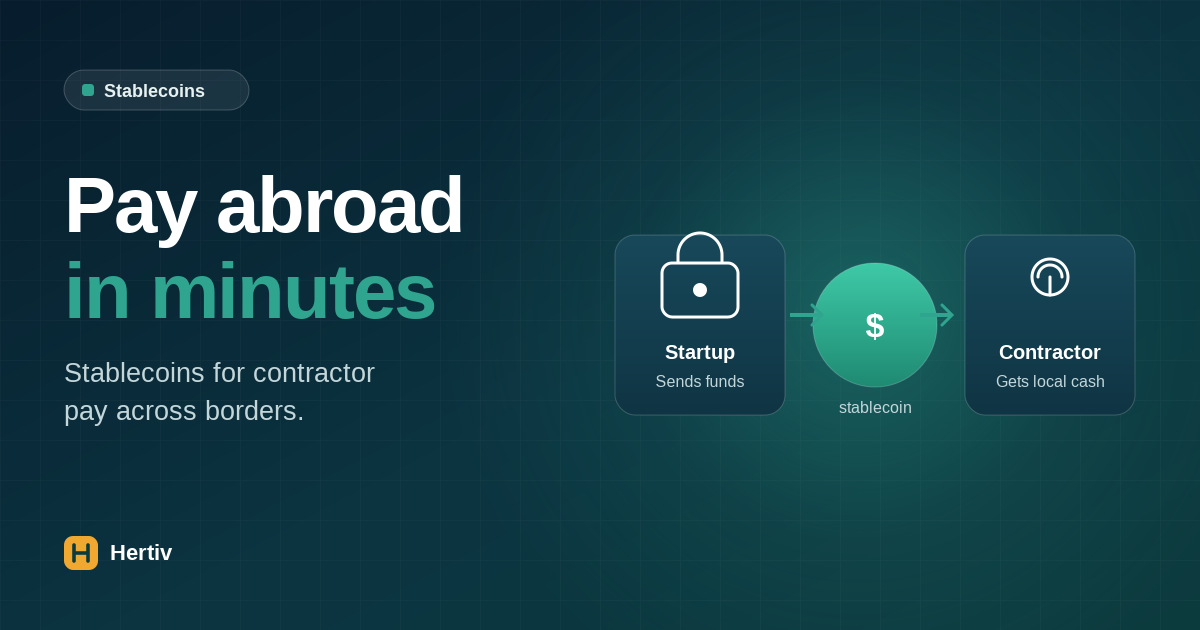
Stablecoin remittances are cross-border payments made with a token designed to hold a steady value against a currency such as the US dollar. A startup sends stablecoins to a contractor or supplier abroad, and the receiver converts them into local currency, often in minutes rather than days.
What are stablecoin remittances?
Stablecoin remittances are cross-border payments made with a stablecoin, which is a token designed to hold a steady value against a currency such as the US dollar. A startup sends stablecoins to a contractor or supplier abroad, and the receiver converts them into local currency.
The payment rides on a blockchain instead of the correspondent banking network, so it can settle in minutes rather than days and outside banking hours. That speed is the main reason startups use them for contractor pay, supplier invoices and support for staff in other countries.
| Method | Typical speed | Typical cost | Best for |
|---|---|---|---|
| Stablecoin transfer | Minutes | Network fee plus conversion spread | Regular contractor and supplier pay |
| Bank wire | 1–5 business days | Flat wire fee plus FX margin | Large one-off payments |
| Money transfer service | Minutes to a day | Fee plus FX margin | Small one-off personal sends |
| Payroll platform | 1–3 business days | Monthly fee plus per-payment fee | Full-time staff with benefits |
Stablecoin remittances suit startups with remote contractors, not every payment a company makes. Full-time staff usually need a payroll platform, and large one-off supplier payments may still suit a bank wire. For the business case behind stablecoin payments, read stablecoin payments for business.
How does a stablecoin payment move?
A stablecoin payment moves in four steps: the startup buys or holds stablecoins, sends them to the receiver's wallet address, the receiver converts them to local currency, and the receiver withdraws to a bank account or spends them directly.
The first step is funding. The startup holds a stablecoin balance, bought through an exchange or a payment provider, and keeps it in a wallet the finance team controls. The wallet should use multi-signature approval, so no single person can move funds alone.
The second step is the transfer. The finance team sends the payment to the contractor's wallet address on the agreed chain, and the transfer settles once the chain confirms it, usually within minutes. The transaction record is public on the chain, which gives both sides a shared receipt.
The third step is the off-ramp. The receiver converts the stablecoins to local currency through an exchange or a local provider, and the conversion spread is the main cost after the network fee. The receiver should check the spread before accepting a payment method, because it varies by country and provider.
Which stablecoins do startups use?
Most startups use one of the two large dollar stablecoins, USDC or USDT, because they are the most widely accepted by exchanges, wallets and off-ramp providers. A stablecoin that the receiver cannot easily convert is no use, however cheap the transfer is.
The choice usually comes down to the receiver's country and the chain you use. USDC is common on Ethereum and Solana, while USDT is common on Tron and Ethereum, and the cheapest chain for a given payment is the one where both sides can send and receive without extra conversion.
Chain choice matters for fees. Sending on a busy chain can cost several dollars per payment, while sending on a low-fee chain can cost cents, and that difference adds up across dozens of monthly payments. The chain should be agreed with the receiver in advance, because a payment sent on the wrong chain can be hard to recover.
Some teams hold a small balance of each stablecoin so they can pay each contractor on that person's preferred chain and coin. That adds bookkeeping, so keep the list of accepted coins short and written down in your payments policy.
What does compliance require?
Compliance is the part of stablecoin remittances that startups most often under-budget. Paying contractors across borders is a regulated activity in many countries, and the rules cover who you pay, how you record it, and what you report.
At minimum, you need to know who you are paying. That means identity checks on contractors, screening against sanctions lists, and records of each payment: who received it, how much, for what work, and on which chain. A payment provider can handle much of this, but the responsibility stays with your company.
Tax treatment varies by country and by whether the receiver is a contractor or an employee. Paying an employee in stablecoins can create payroll and tax duties that a contractor payment does not, so get advice before you pay staff this way rather than after a tax authority asks.
Some countries restrict crypto payments or require a licensed provider, so check the rules in each country where you pay people. A licensed provider costs more than a direct wallet transfer, but it also carries the compliance work that a small team cannot do alone.
Example (hypothetical): paying 12 contractors abroad
Example (hypothetical): a startup pays 12 contractors abroad $1,500 each per month, a total of $18,000 a month. It compares bank wires with stablecoin payments over one month.
By bank wire, each payment costs a $30 wire fee plus a currency conversion margin of about 2 percent on $1,500, which is $30. That is $60 per payment, or $720 for 12 payments, and the money takes two to four business days to arrive.
By stablecoin, each payment costs a network fee of about $1 plus a conversion spread of about 1 percent on $1,500, which is $15. That is $16 per payment, or $192 for 12 payments, and the money arrives in minutes. The saving is $720 minus $192, which is $528 a month, or $6,336 a year.
The saving is real, but it is not the whole story. The startup still pays for a licensed provider, wallet controls and bookkeeping, and those costs come out of the $528. The team keeps the stablecoin method because the speed and the saving both help, not because the transfer itself is free.
What are the common mistakes?
The most common stablecoin remittance mistakes are sending on the wrong chain, ignoring the off-ramp spread, and treating contractor pay as if it had no compliance duties.
- Wrong chain or address. A payment sent to the wrong chain can be lost. Confirm the chain and address before the first payment, and test with a small amount.
- Ignoring the spread. The network fee is small, but the conversion spread is the real cost. Quote the receiver's final amount, not the amount you sent.
- One person controls the wallet. Use multi-signature approval so no single person can move company funds alone.
- No payment records. Keep a record of every payment, receiver and purpose, because auditors and tax authorities will ask.
- Paying employees like contractors. Employee pay in stablecoins can create payroll duties. Get advice before you start.
If you plan to issue your own stablecoin rather than use an existing one, read how to launch a stablecoin first, because that is a different project with its own rules.
How do you start in five steps?
You start stablecoin remittances with a small, controlled pilot, not by moving all contractor pay at once. A pilot shows the real cost and the real friction before the whole company depends on it.
- Pick three contractors. Choose people in countries with good off-ramps and ask which stablecoin and chain they prefer.
- Choose a licensed provider. Use a provider that handles identity checks, sanctions screening and records, and check its fees on its own pricing page.
- Set wallet controls. Use a multi-signature wallet, write down who approves payments, and set a per-payment limit that needs a second approver.
- Run one pay cycle. Pay the three contractors, record the full cost including the spread, and ask each one what they actually received and how long it took.
- Decide on the numbers. Compare the pilot cost and speed with bank wires, then extend the method only where it clearly wins.
Keep bank wires as a fallback while the pilot runs. A payment method that works for three contractors may still fail in a country with a weak off-ramp, so do not close the old route until the new one has proven itself. A stablecoin vs CBDC comparison can also help you explain the choice to finance and legal colleagues.
Key takeaways
- Stablecoin remittances move money on a blockchain, so they settle in minutes instead of days
- The real cost is the off-ramp conversion spread, not the network fee, so quote the receiver's final amount
- USDC and USDT are the usual choices, picked by which coin and chain the receiver can convert easily
- Compliance still applies: identity checks, sanctions screening and payment records are your responsibility
- Start with a three-contractor pilot, measure the full cost, and keep bank wires as a fallback
Frequently asked questions
What is a stablecoin?
A stablecoin is a token designed to hold a steady value against a currency, usually the US dollar, by holding reserves or using an algorithm. Unlike other crypto tokens, its price is meant to stay near one dollar, which is why it works for payments rather than speculation.
Are stablecoin remittances legal?
In most countries, yes, but the rules vary. You must check the rules in each country where you pay people, use identity checks and sanctions screening, and keep payment records. Some countries restrict crypto payments or require a licensed provider.
How fast is a stablecoin payment?
The blockchain transfer itself usually settles in minutes. The full time depends on the off-ramp: converting to local currency and withdrawing to a bank account can take minutes or hours, depending on the provider and the country.
What does a stablecoin payment cost?
The main costs are the network fee, which is usually small, and the conversion spread when the receiver changes the stablecoin into local currency. The spread varies by country and provider, so ask the receiver what they actually receive before comparing costs.
Can I pay full-time employees in stablecoins?
It is possible in some countries, but it can create payroll and tax duties that contractor payments do not. Get tax advice for each country before paying employees this way, and use a payroll platform where the rules require it.
What happens if I send to the wrong address?
A payment sent to the wrong chain or address can be very hard to recover, because blockchain transfers cannot be reversed. Always confirm the chain and address with the receiver, and test a new payment route with a small amount first.


