How Enterprises Use Stablecoins for Payments
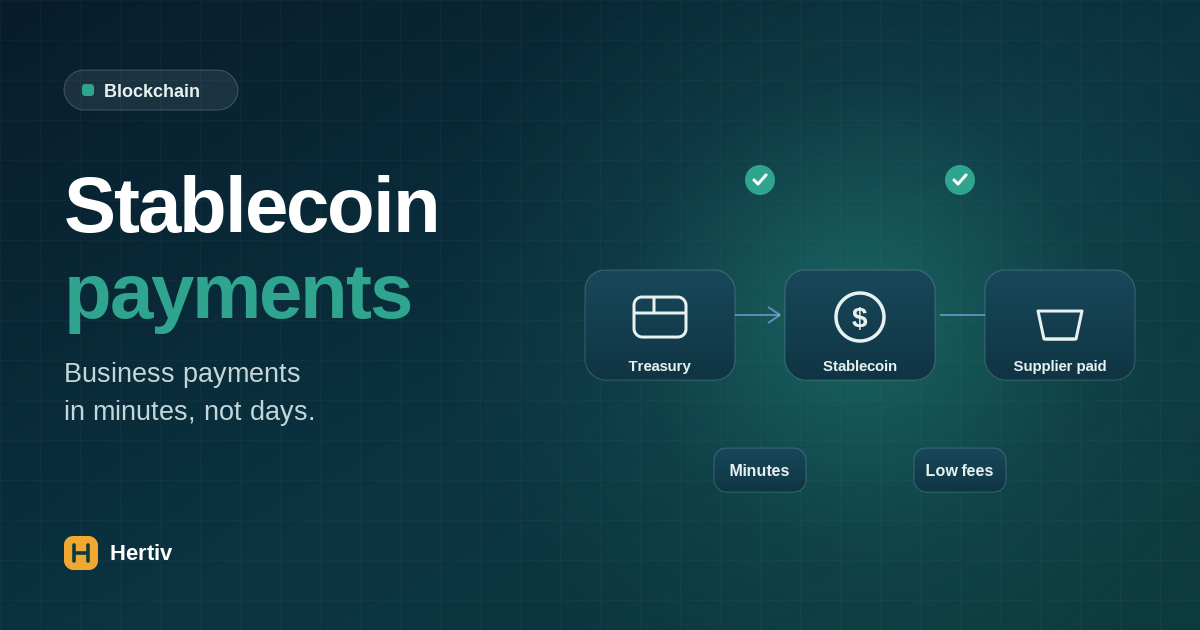
Enterprises use stablecoins to pay suppliers and settle cross-border invoices in minutes instead of days. The win is speed and lower cost, not the token itself.
On this page
Short answer
Stablecoin enterprise payments are business payments made with stablecoins, crypto tokens designed to hold a steady value against a currency such as the US dollar. A company uses them to pay a supplier, settle an invoice or move funds between its own accounts, usually because the payment arrives in minutes and costs less than a bank wire.
What are stablecoin enterprise payments?
Stablecoin enterprise payments are payments a business makes or receives in stablecoins instead of through a bank wire or card network. The most used stablecoins are pegged to the US dollar and backed by reserves of cash or short-term government bonds, so one token is meant to stay worth about one dollar.
The payment works like this: the payer converts local currency into stablecoins, sends them to the payee's wallet or to a payment provider, and the payee converts them into local currency or keeps them for the next payment. The transfer itself settles on a blockchain in minutes, at any hour, including weekends when banks are closed.
That speed is the main attraction. A cross-border wire can take one to five working days and pass through several banks, each taking a fee. A stablecoin payment moves in one step, and the fee is the network cost plus the provider's spread. For a company that pays suppliers in several countries, that difference adds up quickly.
It is not a replacement for banking. Most companies still hold their working cash in banks and use stablecoins for specific routes, such as paying a supplier in a country with slow banking or moving funds between subsidiaries. For the rails that carry these payments, see how stablecoin payment rails work.
Why do enterprises use stablecoins to pay?
Enterprises use stablecoins for three reasons: speed, cost and access. A payment that settles in minutes helps a supplier ship sooner, and a lower fee matters when the company makes many payments a month. In markets where banking is slow or currency controls apply, a stablecoin route can be the only practical way to pay on time.
Speed shows up in working capital. When a payment takes days to arrive, the supplier waits before shipping, and the buyer holds stock longer than needed. When the payment arrives the same day, the order moves sooner and both sides plan better. For treasury teams, the same speed helps move funds between subsidiaries at the end of the month without waiting for banking hours.
Cost is the second reason. A wire can cost $25 to $50 per payment plus a currency spread, while a stablecoin transfer costs a small network fee plus the provider's margin. The saving is largest on frequent, mid-size payments, such as paying a supplier $5,000 every week. On very large payments the wire can still be cheaper, because the spread on converting a large sum can outweigh the wire fee.
Access is the third. Some suppliers and contractors prefer to be paid in stablecoins because their local banking is slow or their currency is unstable. Offering that option can win a supplier or keep a contractor who would otherwise leave. That is a business reason, not a technology one, and it is often the reason a finance team starts looking at stablecoins at all.
Which payment routes do enterprises use?
Enterprises use four routes: direct wallet payments, payment gateways, treasury settlement and payroll. Each one fits a different kind of payment, and most companies start with one and add others later.
| Route | Best for | How it works |
|---|---|---|
| Direct wallet payment | Paying a crypto-native supplier | Company sends stablecoins from its wallet to the supplier's wallet |
| Payment gateway | Receiving payment from customers | Gateway accepts stablecoins and settles in fiat or coins |
| Treasury settlement | Moving funds between subsidiaries | Stablecoins move between company wallets, then convert locally |
| Payroll | Paying remote staff and contractors | Provider pays staff in stablecoins or local currency |
Direct wallet payments are the simplest route and the one with the most control. The company holds the stablecoins, signs the payment and keeps the records. The risk is operational: someone must manage keys, check addresses and reconcile payments, which is new work for a finance team.
Gateways and payroll providers take that work away. A gateway accepts the payment, converts it and settles in the currency the company wants, for a fee. A payroll provider handles tax and compliance for each country. Most enterprises use a provider for at least one route, because the provider carries the wallet security and the regulatory paperwork. For treasury use, see stablecoin treasury settlement.
How does an enterprise start with stablecoin payments?
Starting takes about two to four months for a first route, in five steps. The legal and accounting steps come first, because they decide whether the route is worth running at all.
- Pick one payment route. Choose the payment that hurts most today, such as paying a supplier in one country, and scope the first run to that route only.
- Check the law and the accounts. Confirm the stablecoin and the route are allowed in each country involved, and agree with the accountants how the payments will be recorded and taxed.
- Choose a provider or a custody setup. Decide whether a payment provider handles wallets and conversion, or the company holds its own wallets with a custody provider.
- Set approval and limits. Give the finance team clear rules: who approves a payment, the maximum per payment, and which addresses are allowed. Test the rules on small payments first.
- Run a pilot, then reconcile. Pay a small number of real invoices, check the money arrives, reconcile the records against the bank, and only then widen the route.
The pilot is the step that finds the real problems. Address checks, conversion spreads, settlement timing and reconciliation all behave differently with real money than in a demo. A pilot of a few dozen payments is enough to learn whether the route saves time and money.
Accounting deserves attention from the start. Stablecoins are usually treated as an asset on the balance sheet, and each payment needs a record of the amount, the rate and the counterparty. A provider that exports clean records saves the finance team hours at month end.
What are the risks and rules?
The risks are price, regulation, counterparty and operations. The price risk is small for a well-backed stablecoin but not zero: a stablecoin can lose its peg, and the company should know what backs the token it uses and who audits those reserves.
Regulation is the largest risk. Rules differ by country, and they are changing. The EU's MiCA rules set requirements for stablecoin issuers, the US passed the GENIUS Act in 2025, and the UK's FCA is building its own regime. A company should check the rules in each country where it pays or receives, and keep a record of the advice it relied on.
Counterparty risk is the risk that the issuer, the provider or the exchange fails. The company should check the issuer's reserves and audits, the provider's licence, and whether customer funds are held separately from the provider's own money. Using one provider for everything concentrates that risk, so some companies split routes across two providers.
Operational risk is the everyday kind: sending to the wrong address, a key lost, a payment approved twice. The fix is process, not technology: address allowlists, two-person approval for large payments, and a reconciliation step that catches a payment that did not arrive. For the business-to-business angle, see stablecoins in B2B payments.
Example (hypothetical): paying a supplier in another country
Example (hypothetical): a company buys components from a supplier in another country and pays $50,000 a month. By wire, each payment costs $45 in bank fees plus a 1.5% currency spread, which is $750, so the total cost is $795 a month. The payment takes three working days to arrive, and the supplier ships after the money lands.
By stablecoin, the company converts $50,000 into a dollar-pegged stablecoin for a 0.3% spread, which is $150, plus a network fee of about $5. The total cost is $155 a month, and the payment arrives in minutes. The saving is $640 a month, or $7,680 a year, and the supplier ships two days earlier.
The saving depends on the spread. If the provider charges a 1% spread instead of 0.3%, the conversion costs $500, the total is $505 a month, and the saving falls to $290 a month. The company should compare spreads before choosing a provider, because the spread is usually the largest cost in the whole route.
The example also shows the limit. On a single $5 million payment, a 0.3% spread is $15,000, which is far more than a wire fee. Stablecoin routes usually win on frequent mid-size payments, not on very large ones.
What are the common mistakes?
The most common mistakes are starting with too many routes, ignoring the spread, and treating a stablecoin payment like a wire.
- Starting with every route at once. Supplier payments, payroll and treasury each need different rules. Pick one route, prove it, then add the next.
- Ignoring the conversion spread. The network fee is tiny, but the spread on converting in and out can be the largest cost. Compare providers on spread, not on fees.
- No address checks. A payment sent to the wrong address usually cannot be recovered. Use an allowlist and check the address before every payment.
- Skipping the accounting setup. If the finance team cannot reconcile stablecoin payments at month end, the route creates more work than it saves. Agree the records first.
- Holding large balances in stablecoins. A stablecoin is a payment tool, not a bank account. Convert what is not needed soon, and keep the balance small.
- Assuming the rules are settled. Stablecoin regulation is changing in most markets. Review the rules each year, not just at the start.
Key takeaways
- Enterprises use stablecoins for supplier payments, treasury moves and payroll where speed or access matters
- A stablecoin payment settles in minutes, while a cross-border wire can take days
- The conversion spread is usually the largest cost, so compare providers on spread
- Start with one payment route, pilot it with real invoices, then widen it
- Check the rules in each country and keep stablecoin balances small
Frequently asked questions
What is a stablecoin payment?
It is a business payment made in a stablecoin, a crypto token designed to hold a steady value against a currency such as the US dollar. The payer converts local currency into stablecoins, sends them on a blockchain, and the payee converts them back or keeps them for the next payment.
Why would a company pay in stablecoins?
The main reasons are speed, cost and access. Payments settle in minutes at any hour, the fee is usually lower than a wire on frequent mid-size payments, and the route works in markets where banking is slow.
Are stablecoin payments legal?
It depends on the country. The EU's MiCA rules, the US GENIUS Act of 2025 and the UK's FCA regime all set requirements for stablecoins. A company should check the rules in each country involved before starting.
What does a stablecoin payment cost?
The network fee is usually a few dollars or less. The larger cost is the conversion spread, typically a fraction of a percent, which depends on the provider. On very large payments a bank wire can still be cheaper.
Do companies hold stablecoins long term?
Usually not. Most companies treat stablecoins as a payment tool, convert what they do not need soon, and keep balances small. Holding a large balance adds price and counterparty risk for no benefit.
How do I start with stablecoin payments?
Pick one payment route, check the law and the accounting treatment, choose a provider or custody setup, set approval rules and limits, then run a pilot with a small number of real invoices before widening the route.


