Software Risk Management: How Teams Spot Trouble Early
Software risk management lists what could go wrong, scores each risk, and acts before it becomes a delay or an outage. A weekly process any small team can run.
On this page
Short answer
Software risk management is the practice of listing what could go wrong, scoring each risk by how likely it is and how much damage it would do, and then acting on the highest scores first. It covers technical risks such as weak requirements and fragile integrations, plus schedule, security and team risks. The goal is to see the big risks early enough to change course cheaply.
What is software risk management?
Software risk management is the practice of listing what could go wrong in a software project, scoring each risk by how likely it is and how much damage it would do, and then acting on the highest scores first. It is a routine, not a one-off document, and it runs for the whole life of the project.
A risk is anything uncertain that could hurt the outcome: a key library with no maintainer, a requirement nobody has confirmed, a deadline set before the scope is known. The point is to find these early, while fixing them is still cheap.
| Risk type | Example | What it threatens |
|---|---|---|
| Requirements | A feature nobody confirmed with users | Rework, missed deadlines |
| Technical | A library with no maintainer | Outages, security holes |
| Schedule | A deadline set before scoping | Rushed work, cut corners |
| Security | Secrets stored in the codebase | Breach, lost trust |
| Team | One person holds key knowledge | Delays if they leave |
| Vendor | A supplier changes its pricing | Budget overrun |
The list does not need to be long. Ten honest risks, reviewed weekly, beat a fifty-row spreadsheet that nobody opens.
How do you find risks before they bite?
Risks hide in assumptions, so the best way to find them is to ask what the plan assumes and what happens if the assumption is wrong. Walk through the plan with the team and ask, for each step, what could break it.
Three sources find most risks. Past projects show what went wrong before. The backlog shows what is unclear or untested. And the team itself knows the fragile parts, because they are the ones who work around them every day.
- Review the last two releases and list what caused delays or hotfixes.
- Read the backlog for items with no owner, no acceptance criteria or no test plan.
- Ask each team member for the one thing they worry about most, in private if needed.
Write each risk as a plain sentence: what could happen, and what it would cost. A system testing pass before release often surfaces the risks the list missed, because tests show where the software actually breaks.
How do you score a risk?
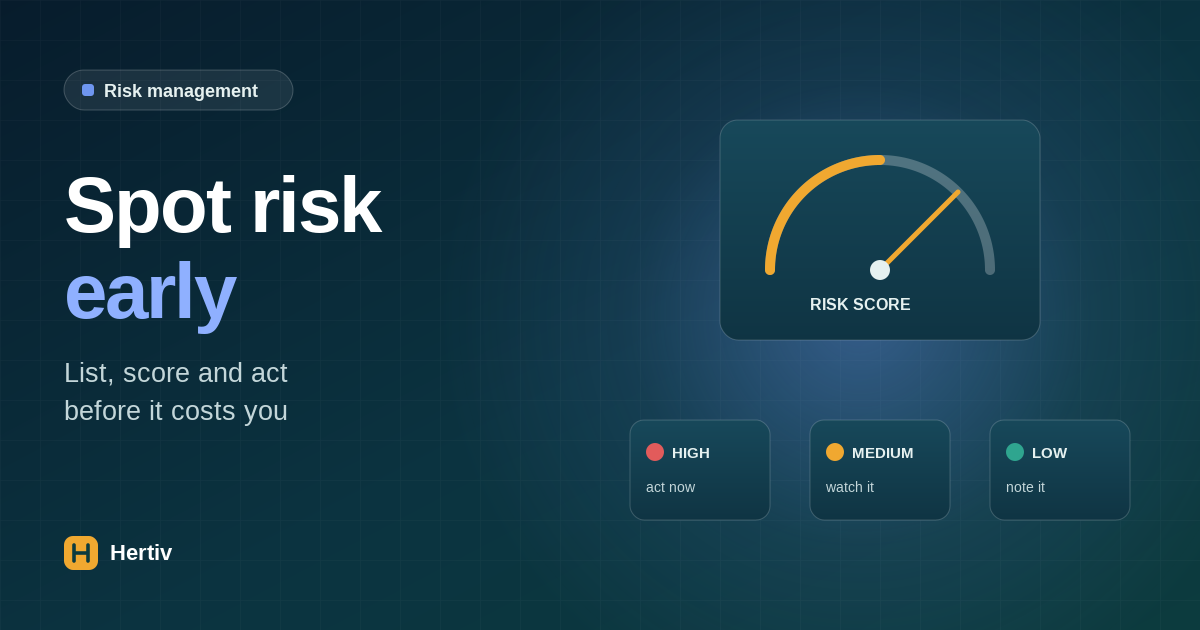
Score each risk on two scales from 1 to 5: how likely it is, and how much damage it would do. Multiply the two numbers, and the highest scores go to the top of the list.
A risk with likelihood 4 and impact 5 scores 20, and it deserves a plan this week. A risk with likelihood 1 and impact 2 scores 2, and it can wait. The numbers are rough, and that is fine; their job is to order the list, not to predict the future.
| Score | Meaning | What to do |
|---|---|---|
| 15 to 25 | High | Act now, with an owner and a date |
| 8 to 14 | Medium | Watch it, and plan a response |
| 1 to 7 | Low | Note it and move on |
Rescore the list every week. A risk that was low in January can be high in March, and a risk you fixed should leave the list, not sit there forever.
What do you do about a high risk?
Every high risk needs one of four responses, and someone has to own it. Avoid the risk by changing the plan, reduce it by adding a check or a fallback, transfer it by sharing it with a vendor or insurer, or accept it and write down why.
Avoiding is often cheapest. If a library has no maintainer, pick a different one before you build on it. Reducing is next: add automated tests around the fragile integration, or keep a backup of the data it touches.
Transfer works for some risks. A vendor uptime promise or an insurance policy moves the cost, though not the blame. Accepting is fine for small risks, as long as the decision is written down and the team knows about it. Testing is one of the cheapest ways to reduce risk, which is why teams pair risk reviews with software testing methodologies that catch failures early.
Example: a team scores its release risks
Example (hypothetical): a six-person team lists 12 risks before a release. The top risk is a payment integration with no sandbox: likelihood 4, impact 5, score 20. The next is a single developer who knows the billing code: likelihood 3, impact 4, score 12.
The team spends two days building a sandbox test for the payment flow and one day pairing a second developer on the billing code. That is 3 days of work against a risk that could have cost a week of downtime and a lost customer.
After the release, the list drops from 12 risks to 7, and the top score falls from 20 to 9. The team did not remove risk; it moved the biggest items down the list before they could bite.
What are the common mistakes?
The most common mistakes are writing the list once, scoring by gut feel alone, and assigning risks to nobody.
- A list nobody reviews. A risk register that is written in January and never opened again is decoration.
- Scores with no scale. If likelihood 4 means different things to different people, the ranking is noise.
- Risks with no owner. A risk owned by the team is owned by nobody.
- Hiding bad news. A risk list that only holds safe items is worse than no list, because it looks like the project is safe.
- Fixing low risks first. Easy risks feel productive, but the high scores are the ones that hurt.
How do you keep the risk list alive?
A risk list stays alive if it is short, visible and reviewed on a fixed day. Keep it to the top ten risks, show it in the weekly team meeting, and spend ten minutes on it: what changed, what is new, and what is done.
Link each risk to the work that fixes it. If a risk has no ticket, it will not get fixed, because nobody's week includes it. Close risks that are gone, and say so out loud, so the team sees the list shrinking.
Once a month, step back and ask whether the list still matches reality. New vendors, new regulations and new team members all bring new risks, and the list should grow with them. Teams that run CI/CD pipelines can tie risk checks to releases, so a risky change is flagged before it ships, not after.
Key takeaways
- Software risk management is a weekly routine: list, score, act, repeat
- Score each risk by likelihood times impact, on a 1 to 5 scale for each
- Every high risk needs one response: avoid, reduce, transfer or accept
- A risk with no owner and no date is not being managed
- Keep the list short, visible and tied to real tickets
Frequently asked questions
How many risks should a project list hold?
Ten is a good working size. A list of ten honest risks that the team reviews every week is more useful than a fifty-row spreadsheet nobody opens. Move fixed risks off the list and add new ones as they appear.
Who should own the risk list?
One person should own the list itself, usually the team lead or project manager, and each risk should have its own owner too. The list owner keeps it current; the risk owner is the person who acts on that risk.
How often should risks be reviewed?
Weekly is enough for most teams, in the regular team meeting, for about ten minutes. Once a month, take a longer look and ask whether the list still matches reality, because vendors, rules and team members change.
What is the difference between a risk and an issue?
A risk is something that might happen; an issue is something that already happened. Risks are scored and planned for, issues are fixed. When a risk turns into an issue, move it off the risk list and onto the work backlog.
Do small teams need formal risk management?
They need the habit, not the paperwork. A short list, a weekly ten-minute review and an owner per risk is enough for a team of five. The formal part matters only when the project is large or regulated.
Can risk management stop a project from failing?
No, but it makes failure less likely and cheaper. The goal is to see the big risks early, while changing course is still cheap. A project with a live risk list still fails sometimes, but it rarely fails by surprise.


