Smart Contracts in Music: How Royalties Get Paid
Smart contracts in music split royalties automatically the moment money arrives. Here is how they work, what they fix and where they still fall short.
On this page
Short answer
A smart contract in music is a program on a blockchain that holds the royalty split for a track and pays each rights holder automatically when money arrives. It replaces the chain of intermediaries that currently reports, reconciles and distributes royalties, and it leaves a public record of every payment that any rights holder can check.
What are smart contracts in music?
A smart contract in music is a program stored on a blockchain that carries out the terms of a deal by itself. For a song, the deal is the royalty split: who gets paid, how much, and when. Once the split is written into the contract, every payment that enters the contract is divided and sent to the rights holders' wallets without anyone filing a report or chasing a payment.
The contract works on a simple rule: if a payment event happens, then pay out the agreed shares. The event can be a sale, a stream count threshold, a sync fee for film or advertising, or a resale of a music NFT. The contract does not argue, forget or delay; it follows the split exactly as written, every time.
The blockchain ledger adds the second half of the value. Every payment, every split and every rights transfer is recorded on-chain and can be checked by anyone with the address. An artist can see exactly when and how they were paid, instead of waiting for a quarterly statement that may or may not match the streams.
How do music royalties work today?
Music royalties today move through a chain of hands, and each hand takes time and a margin. A stream on a major platform does not pay the artist directly; the money passes through the platform, a rights organisation, a publisher, a distributor and a label before it reaches the people who made the song.
The table below shows the path a royalty payment usually follows, and what slows it down at each step.
| Step | Who handles it | What slows it down |
|---|---|---|
| Streaming or sale | Streaming platform or store | Reports arrive weeks after the plays |
| Rights reporting | Rights organisation | Matching plays to works takes months |
| Publishing share | Publisher | Separate accounting for writers |
| Distribution | Distributor or label | Recoupment and quarterly statements |
| Payment to artist | Label or distributor | Payments can arrive many months later |
The delay is the problem smart contracts attack. Performance royalties through rights organisations can take many months to arrive, and a royalty that passes through several organisations in different countries has to be reconciled at each step. Each reconciliation is a chance for a payment to be delayed, reduced or lost, and the artist has no single record to check against.
The split is the other problem. A song can have a songwriter, a performer, a producer and a label, each with a different share, and the shares change when a sample or a remix is involved. Recomputing those shares by hand for every payment is slow and error-prone, which is why splits are usually settled in advance and then applied by people reading spreadsheets.
How does a smart contract split a royalty?
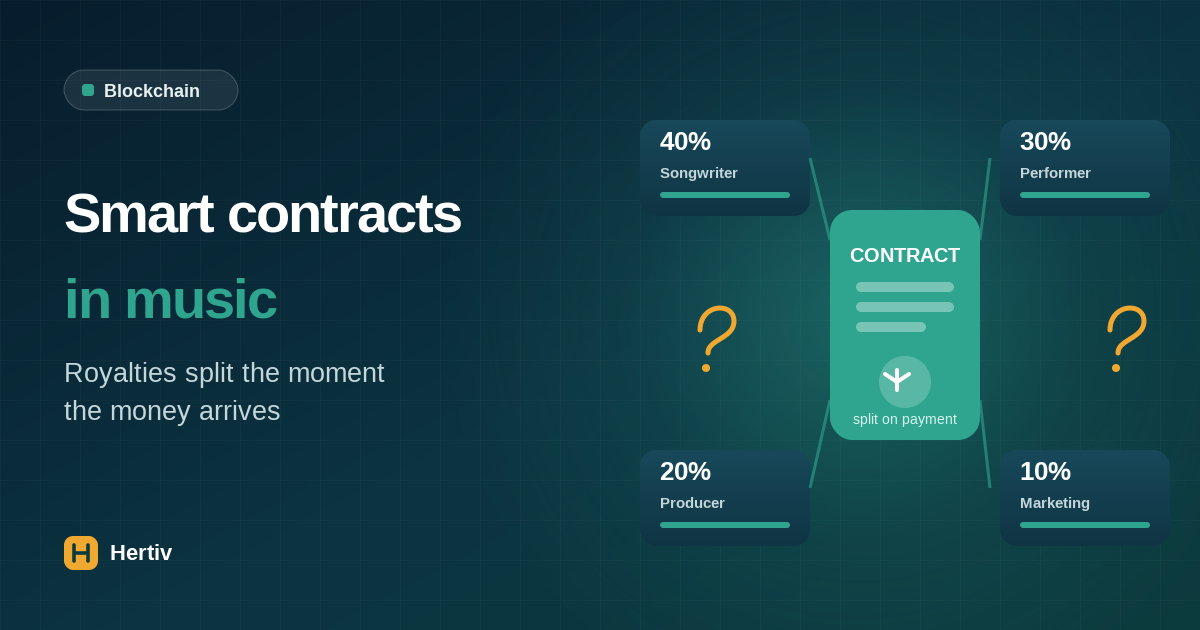
A smart contract splits a royalty by holding the shares as code and running them on every payment. The team writes the split once — each rights holder's wallet address and percentage — and the contract applies it to every payment that arrives, whether it is a sale, a licence fee or a resale.
The table below shows an example split for one track, with four rights holders sharing the revenue.
| Rights holder | Share | On a $2,000 sale |
|---|---|---|
| Songwriter | 40% | $800 |
| Performer | 30% | $600 |
| Producer | 20% | $400 |
| Marketing | 10% | $200 |
The split runs at the moment the money arrives, so there is no waiting for a reporting period and no manual reconciliation. The same contract can also handle a resale: if the track sells again, the contract takes the agreed resale royalty and splits it the same way, so the original creators keep earning from later sales.
Derivative works get the same treatment. When one artist samples or remixes another, the contract can route a share upstream to the original creator automatically, so the original is paid on every use of the derivative without a new negotiation. For the token side of the same idea, see how tokenization of IP assets works.
What can smart contracts do beyond royalties?
Smart contracts in music go beyond royalty splits. They can handle licensing, ticketing, fan shares and direct sales, and each use replaces a manual process with code that runs the same way every time.
- Licensing and sync. A contract can hold the licence terms for a track and release payment when a film, advert or game uses it, with the split applied at once.
- Ticketing. A ticket sold as a token can carry rules about resale price and a royalty back to the artist on each resale, which paper tickets cannot enforce.
- Fan shares. Platforms such as Royal let fans buy tokens that represent a share of a track's future streaming royalties, so fans become stakeholders in the song.
- Direct sales. On Audius, a decentralised streaming platform that moved from Ethereum to Solana, artists sell directly to fans and keep 90% of the revenue on direct sales, with the platform taking 10%.
- Collaborator splits. On Sound.xyz, an artist sets collaborator splits when minting a track, and the contract divides each sale between the collaborators automatically.
The limits matter as much as the uses. A platform that tokenises traditional streaming royalties still waits on the distributor's schedule, because the upstream royalty still flows through the streaming platform and its distributors. The contract speeds up the split, but it cannot speed up money that has not arrived yet.
For the NFT side of music, see what NFT token gating is.
For where music NFTs are traded, see NFT marketplace use cases.
How to use smart contracts for a music release, step by step
Using smart contracts for a music release takes a team through six steps, from the rights map to the first payout. The rights work comes first, because the contract can only pay out shares that are agreed and recorded.
- Map the rights. List every rights holder, their share and their wallet address. Get the split in writing before any code is written.
- Pick the chain and standard. Choose a chain with low fees for small payments, and a token standard that fits the release, such as ERC-721 for one-of-one tracks or ERC-1155 for editions.
- Write the split contract. Encode the shares, the payment triggers and the resale royalty. Keep the logic simple and use audited code where it exists.
- Test on a testnet. Run sales, splits and resales on a test network with the real shares, and check that every wallet receives the right amount.
- Release and mint. Mint the track, set the price and publish the contract address so buyers and rights holders can check it.
- Watch the payouts. Check the first real payments against the agreed split, fix any address or share error, and keep a record for tax and accounting.
For the build side, see smart contract development.
The audit step is worth treating as part of the build, not an extra. A contract that holds other people's money should be reviewed by someone other than the person who wrote it, before the first real payment flows through it.
Example (hypothetical): a four-way split on one sale
Example (hypothetical): four collaborators release a track and sell it for $2,000 through a smart contract. The agreed split is 40% to the songwriter, 30% to the performer, 20% to the producer and 10% to marketing.
The contract divides the sale at once: the songwriter receives $2,000 x 40% = $800, the performer receives $2,000 x 30% = $600, the producer receives $2,000 x 20% = $400, and marketing receives $2,000 x 10% = $200. The four shares add up to $800 + $600 + $400 + $200 = $2,000, so nothing is left unaccounted for.
The track sells again on the secondary market for $3,000, and the contract carries a 5% resale royalty. The royalty is $3,000 x 5% = $150, and it is split the same way: $60 to the songwriter, $45 to the performer, $30 to the producer and $15 to marketing, which adds up to $150.
The lesson is that the contract only pays out what was agreed. A split that is wrong in the contract is wrong on every sale, so the rights map and the test run matter more than the code itself.
What are the common mistakes?
The most common mistakes teams make with smart contracts in music are writing the split before agreeing it, skipping the audit, and promising instant payment on money that has not arrived.
- Coding before agreeing. A split written into a contract is hard to change. Agree the shares and get them in writing first, then write the code.
- Skipping the audit. A contract that holds other people's royalties needs an independent review before the first real payment, not after the first error.
- Promising instant streaming payouts. Tokenised streaming royalties still wait on the distributor's schedule. Only direct sales settle at once.
- Wrong wallet addresses. A payment sent to the wrong address cannot be recalled. Check every address on a testnet first.
- No plan for disputes. A contract cannot judge who wrote a song. Keep a dispute process outside the code for ownership claims.
- Ignoring tax and accounting. On-chain payments are still income. Rights holders need records they can hand to an accountant.
Key takeaways
- Royalties split the moment money arrives
- The ledger is a public payment record
- Direct sales settle at once; streaming waits
- Agree the split before writing the code
- Audit before the first real payment
Frequently asked questions
What is a smart contract in music?
A smart contract in music is a program on a blockchain that holds the royalty split for a track and pays each rights holder automatically when money arrives. It replaces manual reporting and reconciliation, and it leaves a public record of every payment that any rights holder can check.
Do artists get paid faster with smart contracts?
For direct sales, yes: the contract pays out the moment the sale lands, with no reporting period in between. For streaming royalties, the payment still waits on the distributor's schedule, because the upstream money flows through the streaming platform first.
What is Audius?
Audius is a decentralised music streaming platform that moved from Ethereum to Solana. Artists upload and sell directly to fans, and on direct sales they keep 90% of the revenue, with the platform taking 10%. It is the most widely used live example of blockchain music infrastructure.
Can fans own a share of a song?
Yes. Platforms such as Royal let fans buy tokens that represent a share of a track's future streaming royalties. Token holders receive their share when the royalties arrive, and the artist keeps the rest. The split is written into the contract.
Do smart contracts replace record labels?
No. A smart contract replaces the payment and reporting work, not the work a label does: funding, marketing, distribution and artist development. An independent artist can use contracts to get paid directly, but the label's other roles still need someone to do them.
What happens if the royalty split is wrong?
The contract will pay out the wrong shares on every sale, because it follows the code exactly. That is why the split must be agreed in writing first and tested on a test network with the real shares before the first real payment flows through it.


