The Seven Layers of the Metaverse, Explained
Jon Radoff's seven-layer model maps the metaverse value chain from chips and networks to the experiences people pay for. Here is what each layer covers.
On this page
Short answer
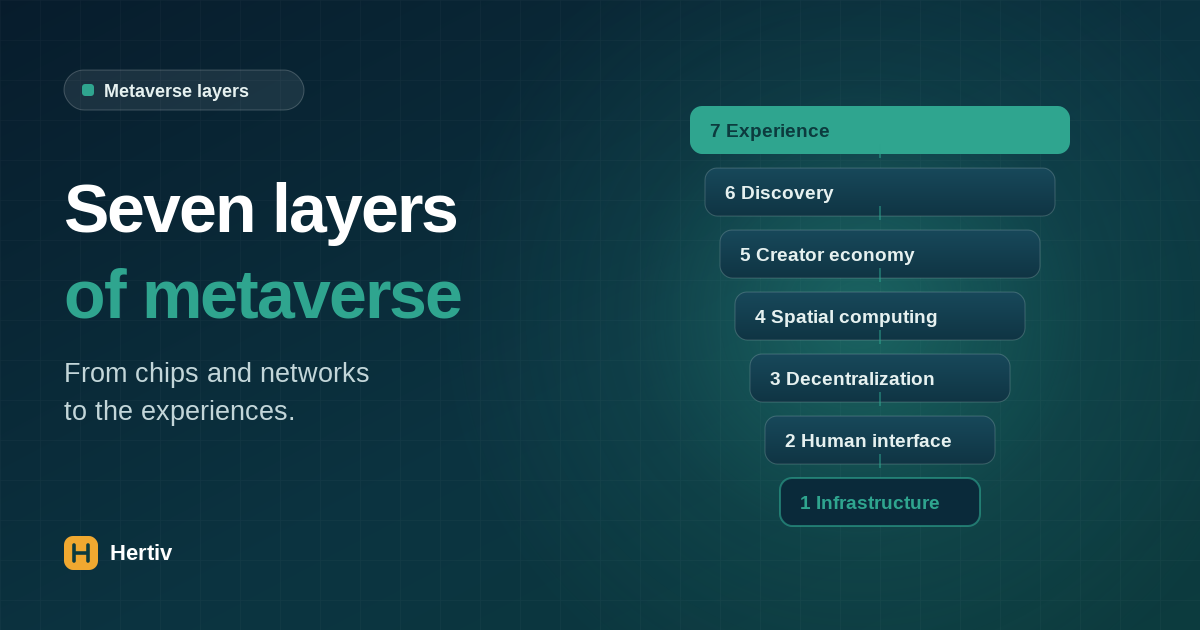
The seven layers of the metaverse are the stages of Jon Radoff's value-chain model: infrastructure, human interface, decentralization, spatial computing, creator economy, discovery and experience. The model reads from the bottom up, with each layer depending on the ones below it, and the experience layer at the top is the part users actually see and pay for.
What are the seven layers of the metaverse?
The seven layers of the metaverse are a value-chain model proposed by game designer and entrepreneur Jon Radoff in 2021. It breaks the metaverse into seven layers, from the hardware and networks at the bottom to the games, concerts and shopping trips at the top.
The model is a way to sort out who does what. A company making graphics chips sits in a different layer from a company building a virtual concert hall, and the model shows how the two depend on each other. The bottom layers are the foundation; the top layer is the reason anyone shows up. For the basic definition, see what the metaverse is.
| Layer | What it covers | Examples |
|---|---|---|
| 1. Infrastructure | Chips, networks, cloud, materials | GPUs, 5G, cloud data centres |
| 2. Human interface | Devices people use to enter | VR headsets, smart glasses, phones |
| 3. Decentralization | Open, shared ownership and rules | Blockchains, edge computing, AI agents |
| 4. Spatial computing | Software that puts things in 3D | 3D engines, mapping, gesture tracking |
| 5. Creator economy | Tools to make and sell content | Design tools, asset markets, payments |
| 6. Discovery | How people find experiences | Stores, search, social curation, ads |
| 7. Experience | What people actually do there | Games, concerts, shopping, work |
Radoff lists the layers in the order people experience them, from experience down to infrastructure, but the dependency runs the other way. Nothing in the top layers works without the layers below it, and a weak layer limits everything above it.
What is the infrastructure layer?
The infrastructure layer is the physical foundation of the metaverse: semiconductors, networking, cloud computing and the materials that make devices possible. It includes graphics processors, 5G and Wi-Fi networks, cloud data centres, and the tiny sensors and motors inside headsets and controllers.
This layer sets the hard limits. A virtual world can only be as detailed as the chips rendering it and as responsive as the network carrying it. Slow networks mean lag, and lag in a headset makes people feel ill, so the infrastructure layer decides whether an experience is usable at all.
Most of the money in this layer goes to a small number of chip and cloud companies, and the work is capital heavy. A startup rarely builds here; it builds on top of it. The practical point for anyone planning a metaverse project is to check what the target devices and networks can actually do before promising a rich 3D world.
What is the human interface layer?
The human interface layer is the hardware people use to enter the metaverse: phones, VR headsets, smart glasses, haptic gloves and, further out, neural interfaces. It is the layer between a person's senses and the virtual world.
Each device trades immersion against convenience. A phone is always in a pocket but shows a flat screen; a VR headset is immersive but heavy and tiring to wear for long. Smart glasses aim for the middle ground, putting digital images over the real world without blocking it.
This layer is still changing fast. Headsets get lighter and sharper each year, and hand tracking and voice control are replacing controllers for many tasks. When choosing a platform for a metaverse project, the interface layer is the first practical question: what device will your users actually own and wear?
What does the decentralization layer do?
The decentralization layer is the part of the model that moves ownership and control away from single companies and toward open, shared systems. It covers blockchains, edge computing, microservices and AI agents that run without a central operator.
The idea is that no one company should own the whole metaverse. A user should be able to carry an avatar, an item or a payment from one world to another, and that needs shared standards and shared ledgers rather than one company's database. Blockchains record who owns a digital item, and edge computing spreads the work across many small servers instead of one central one.
This layer is the most debated part of the model. Centralized platforms can move faster and offer a smoother experience, while open systems offer portability and user ownership. Most real projects mix the two, using a central service for the experience and open standards for the assets. The choice shapes who controls the economy built on top.
What is spatial computing?
Spatial computing is the software that brings objects into three dimensions and lets people interact with them. It includes 3D engines, spatial mapping, gesture recognition and the AI that helps the system understand where things are in a room.
Where the human interface layer is the hardware, spatial computing is the software that makes the hardware useful. A 3D engine draws the world, mapping builds a model of the physical room so virtual objects can sit on real tables, and gesture tracking turns a wave of the hand into a command.
This layer is where game engines such as Unity and Unreal do most of their work, and it is also where digital twins live: virtual copies of factories, buildings or cities that mirror the real thing. For the building blocks view, see the building blocks of the metaverse.
What are the creator economy and discovery layers?
The creator economy layer is everything that helps people make things for the metaverse and earn from them: design tools, animation systems, asset markets, payment rails and workflows for selling digital goods. Without it, a virtual world is a place you visit; with it, it is a place people build a living in.
The discovery layer is how people find experiences in the first place: app stores, search, social feeds, ratings, advertising and word of mouth. A brilliant virtual concert that nobody can find is a failure, so discovery decides which experiences get an audience.
The two layers feed each other. Creators make the experiences, and discovery brings the audience that pays the creators. Platforms that make creation easy but discovery hard end up full of empty worlds, while platforms with strong discovery but weak tools end up with a few polished experiences and little variety. The healthiest ecosystems invest in both.
What is the experience layer?
The experience layer is the top of the model and the part users actually care about: games, social hangouts, live concerts, virtual shops, classrooms and workplaces. It is the reason the other six layers exist, and the only layer most users ever think about.
An experience succeeds when it gives people a reason to return. Games offer play, concerts offer a shared moment, shops offer goods you cannot get elsewhere, and workplaces offer a meeting that feels more present than a video call. The technology below matters only in how it serves that feeling.
Companies often start here, with a single experience, and work downward only as far as they need to. A virtual travel experience, for example, can be built on existing engines and headsets without touching the infrastructure layer at all. See the metaverse in the travel industry for one sector's approach.
Example (hypothetical): a virtual concert venue
Example (hypothetical): a team builds a virtual concert venue for a music festival. It starts at the experience layer with a live show, adds a discovery layer with a store listing and social posts, and gives artists creator-economy tools to sell virtual merchandise.
For the launch night, 20,000 people attend. Suppose 5% of them buy a virtual item priced at $40. That is 20,000 x 5% = 1,000 buyers, and 1,000 x $40 = $40,000 in sales. The artists keep 90% after a 10% creator fee of $4,000, and the platform takes a 5% fee of $2,000, leaving $40,000 - $4,000 - $2,000 = $34,000 for the artists.
The lesson is that the top layers decide the revenue, but the bottom layers decide whether the show works. If the venue's spatial computing cannot handle 20,000 avatars at once, or the human interface devices cannot render the stage, the sales never happen. Plan the experience first, then check each layer below it.
What are the common mistakes?
The most common mistakes with the seven-layer model are treating it as a checklist, building a layer nobody needs, and forgetting that the layers depend on each other.
- Treating the model as a ladder. The layers are a map, not a sequence. You do not have to build infrastructure before you can build an experience.
- Building in the wrong layer. A team that builds a new 3D engine when an existing one would do wastes the budget that should have gone to the experience.
- Ignoring the layer below. A rich experience on weak infrastructure lags, and users leave. Check device and network limits early.
- Forgetting discovery. A finished world with no way for people to find it stays empty. Budget for discovery from the start.
- Assuming decentralization is free. Open ownership adds cost and complexity. Use it where portability matters, not everywhere by default.
- Copying the model without the context. Radoff's model describes a value chain, not a product plan. Adapt it to the project, and drop layers that do not apply.
Key takeaways
- The seven layers run from chips to experiences
- Infrastructure sets the limits; the experience layer is why users show up
- Decentralization is about shared ownership, not just blockchains
- Creators and discovery feed each other
- Plan the experience first, then check each layer below it
Frequently asked questions
What is Jon Radoff's seven-layer model?
Jon Radoff's seven-layer model is a value-chain framework for the metaverse, published in 2021. It sorts the metaverse into infrastructure, human interface, decentralization, spatial computing, creator economy, discovery and experience, with each layer depending on the ones below it.
Which layer is the most important?
The experience layer matters most to users, since it is the games, concerts and shops they actually use. But no experience works without the layers below it: weak infrastructure or poor spatial computing will break even the best-designed world.
How is this different from the building blocks of the metaverse?
The building blocks describe the parts a metaverse world needs, such as networks, engines, avatars and payments. The seven layers describe the value chain, who makes money at each stage and how the stages depend on each other. The two views overlap but answer different questions.
Do all metaverse projects use all seven layers?
No. Most projects sit in one or two layers and rely on existing products for the rest. A virtual shop uses existing engines, headsets and networks, and only builds the experience, discovery and creator-economy parts it needs.
Is the metaverse decentralized?
Parts of it are, and parts are not. Open standards and blockchains let users carry assets between worlds, but many popular platforms are run by single companies. Most real projects mix central services for the experience with open systems for assets and identity.
Where do NFTs fit in the seven layers?
NFTs sit mainly in the decentralization layer, as a way to record ownership of digital items on a shared ledger, and in the creator economy layer, as a way for creators to sell items. They are one tool in those layers, not a layer of their own.


