What Is SAFe, and How Do You Scale Agile for the Enterprise?
SAFe is a framework that organises many agile teams around shared goals. It adds planning cycles, roles and portfolio rules on top of Scrum and Kanban.
On this page
Short answer
SAFe, the Scaled Agile Framework, is a way to run agile development with many teams working on one product or programme. It organises teams into groups called agile release trains, plans work in fixed cycles called planning intervals, and adds portfolio rules so leadership can see what is being built and why.
What is SAFe, and what problem does it solve?
SAFe is a framework for running agile development at enterprise scale. It takes the ideas of Scrum and Kanban, which work well for one team, and adds structure for dozens of teams that must ship one product together: shared planning cycles, common roles and a portfolio layer that connects work to business goals.
The problem it solves is coordination. One team can plan its own sprint. Fifty teams cannot, because their work depends on each other: one team's feature needs another team's API, and a release needs every team's part to arrive at the same time. Without shared planning, teams ship pieces that do not fit together.
SAFe is not the only way to scale agile. Some companies use LeSS or a lighter model of their own. SAFe is the most structured option, which suits large, regulated organisations that need visible plans and clear accountability. See what is agile software development for the ideas SAFe builds on.
How is SAFe organised?
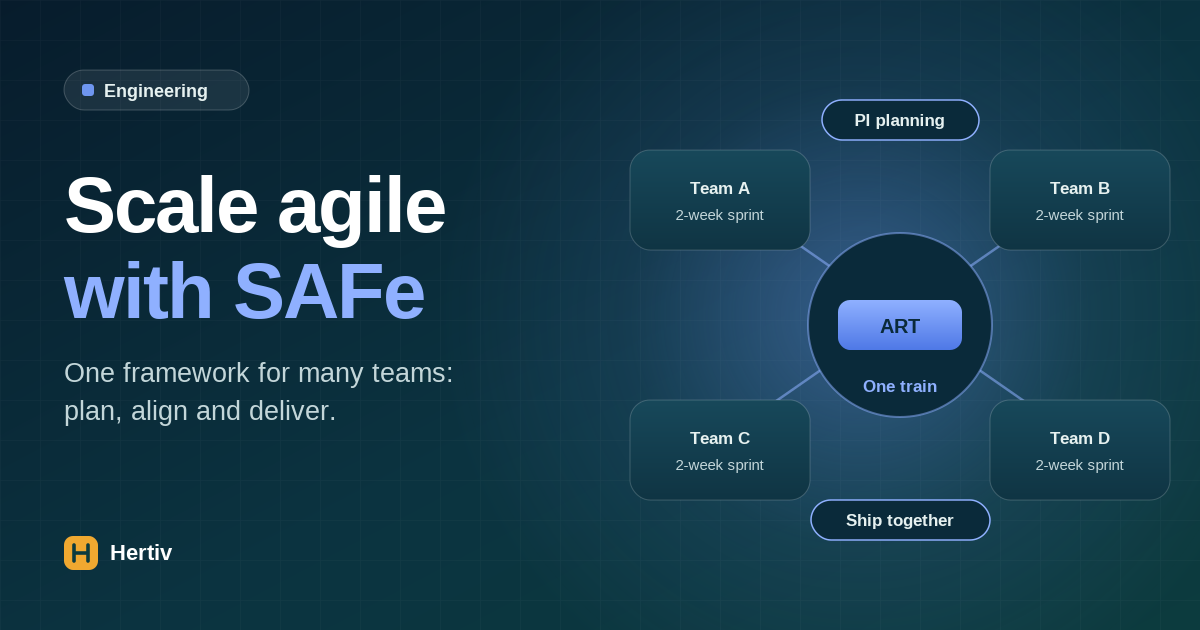
SAFe is organised in levels, and each level answers a different question. The team level builds features in short iterations. The programme level, called an agile release train, coordinates 5 to 12 teams that ship together. The portfolio level decides which big pieces of work, called epics, are worth funding.
The table below shows the three main levels and what each one owns.
| Level | Who works there | What it owns |
|---|---|---|
| Team | One Scrum or Kanban team | Stories and tasks in 2-week iterations |
| Programme (ART) | 5 to 12 teams, one release train | Features planned per interval |
| Portfolio | Executives and portfolio managers | Epics, budgets and strategy |
| Large solution (optional) | Several release trains | Very large systems |
The agile release train is the heart of SAFe. Teams on a train plan together, work in the same cadence and release together, so dependencies surface early instead of at the end. A train has a release train engineer who keeps the schedule and removes blockers, much like a Scrum Master does for one team.
The portfolio level uses lean budgeting: money is allocated to value streams, not to fixed projects, so funding can move as priorities change. This is the part leaders notice first, because it changes how budgets are set.
What roles does SAFe add?
SAFe adds roles that do not exist in single-team agile, because coordination needs owners. The most important are the release train engineer, the product manager and the system architect.
- Release train engineer. Runs the planning interval, tracks risks and keeps the train on schedule. This is a full-time coordination role, not a side job.
- Product manager. Owns the features for the whole train, sets priorities across teams and talks to customers.
- System architect. Owns the technical direction, sets architecture rules and helps teams resolve design conflicts.
- Business owner. A senior leader who sponsors the train, approves its objectives and accepts the results.
- Scrum Master. Still exists, but now also coordinates with other teams' Scrum Masters in a weekly meeting.
Teams keep their product owners and developers. SAFe does not replace the team; it adds a layer above it. If your teams already work well alone, the new roles should feel like help, not overhead. The comparison with single-team Scrum is covered in agile vs Scrum project management.
How does planning work in SAFe?
SAFe plans in planning intervals, usually 8 to 12 weeks long, made of four or five two-week iterations plus one innovation and planning iteration. Every team on a train plans the same interval at the same time, in a two-day event called PI planning.
PI planning follows a fixed rhythm:
- Business owners present the goals and the top features for the interval.
- Teams break features into stories, estimate them and flag dependencies on other teams.
- Teams present their draft plans, and dependencies are negotiated in the room.
- Teams commit to objectives, and each team states its confidence in delivering them.
- Risks are collected, owners are assigned, and the plan is published.
The confidence vote matters. If teams vote low confidence, the plan is too big or too risky, and scope is cut before work starts. This is the moment SAFe earns its keep: problems are found in planning, not in week nine of the interval.
Between intervals, teams run their normal iterations and a system demo every two weeks, so progress stays visible to everyone on the train.
How do you start with SAFe?
You start with SAFe by training leaders first, then launching one release train as a pilot, then adding more trains once the first one works.
- Train the leaders. Executives and managers learn the framework before teams do, because they set the budgets and the priorities.
- Pick one value stream. Choose a product area with 5 to 12 teams that already depend on each other.
- Run a PI planning event. Bring everyone together for two days and plan the first interval.
- Ship one interval. Deliver, demo and measure. Fix the coordination problems that appear.
- Review and expand. Only add a second train when the first one runs smoothly.
Most teams need two or three intervals before the rhythm feels natural. The first planning event is usually messy, and that is normal. What matters is that dependencies and risks become visible, because visibility is the main benefit SAFe offers. A step-by-step change plan is described in 8 steps of agile transformation.
Example: a bank scaling agile with one release train
Example (hypothetical): a retail bank has 8 teams building its mobile banking app. Each team plans its own sprints, but releases are late because the payments team needs the security team's API, and the security team is always busy with other work.
The bank launches one agile release train with all 8 teams. At the first PI planning event, the teams map their dependencies on a board: the payments team needs 3 APIs from the security team, and the security team needs a decision from the architecture team. The risks are written down with owners and dates.
Over the first 10-week interval, the train ships 4 features that were planned, and 2 that were not, because a dependency slipped. The confidence vote at the next planning event is higher, because the teams now know each other's capacity and the dependency board is part of every weekly meeting.
After three intervals, releases go out every 10 weeks on a fixed date, and the bank can tell customers when a feature will arrive. The teams did not get faster; they got predictable, which is what the business needed.
What are the common mistakes?
The most common SAFe mistakes are copying the structure without the mindset, launching too many trains at once, and treating PI planning as a status meeting.
- Copying roles without changing budgets. SAFe needs lean budgeting; fixed project budgets break the model.
- Launching five trains at once. One working train teaches more than five struggling ones.
- Skipping leader training. If managers keep asking for fixed dates and fixed scope, teams cannot plan honestly.
- PI planning without real decisions. If dependencies are noted but nobody negotiates them, the plan is fiction.
- No innovation iteration. Teams that never get time to fix technical debt slow down within a year.
- Measuring output, not outcomes. Counting stories shipped says nothing about whether customers benefit.
For the single-team basics, Scrum methodology explains the iteration rhythm SAFe builds on.
Key takeaways
- SAFe organises many agile teams into release trains that plan and ship together.
- Work is planned in 8 to 12 week planning intervals, starting with a two-day PI planning event.
- New roles such as release train engineer and product manager coordinate across teams.
- Start with one train as a pilot; expand only when it runs smoothly.
- SAFe suits large, dependent product areas, not small teams with few dependencies.
Frequently asked questions
Is SAFe the same as Scrum?
No. Scrum is a method for one team working in short sprints. SAFe is a framework that coordinates many Scrum or Kanban teams, adds planning intervals, new roles and a portfolio layer, and connects team work to business strategy.
How many teams can one agile release train hold?
Usually 5 to 12 teams, or about 50 to 125 people. A train larger than that becomes hard to plan in one room, and a train smaller than 5 teams may not need SAFe at all. Very large systems use several trains coordinated together.
How long is a planning interval?
Most planning intervals last 8 to 12 weeks, made of four or five two-week iterations plus one innovation and planning iteration for learning, fixes and planning the next interval. The fixed length is what makes releases predictable.
Does SAFe work for non-software teams?
SAFe was designed for software, but its planning and coordination ideas are used by hardware, marketing and operations teams too. The roles and terms change, but the core idea, shared planning cycles and visible dependencies, applies anywhere several teams must ship together.
What is the difference between SAFe and LeSS?
LeSS is a lighter way to scale Scrum, with fewer roles and less structure, and it suits organisations that want minimal added process. SAFe is more structured, with portfolio budgeting and more defined roles, and it suits large, regulated organisations that need that structure.
How much does SAFe adoption cost?
The main costs are training, coaching and the time teams spend in planning events. Most organisations budget for leader training first, then a pilot train with a dedicated coach for two or three intervals. The cost depends on size, so get a quote from a training provider rather than guessing.


