RWA-Backed Stablecoins: How Tokenized Assets Back a Dollar
RWA-backed stablecoins hold reserves in tokenized real-world assets, such as Treasury bills. Here is how the backing works and who can hold them.
On this page
Short answer
An RWA-backed stablecoin is a dollar-pegged token whose reserves are held in tokenized real-world assets, such as short-dated US Treasury bills, government money market funds, gold or private credit. The token is a claim on those assets, and the holder can usually see the reserve on chain.
What is an RWA-backed stablecoin?
An RWA-backed stablecoin is a dollar-pegged token whose reserves are held in tokenized real-world assets, such as short-dated US Treasury bills, government money market funds, gold or private credit, instead of bank deposits alone. The token is a claim on those assets, recorded on a blockchain.
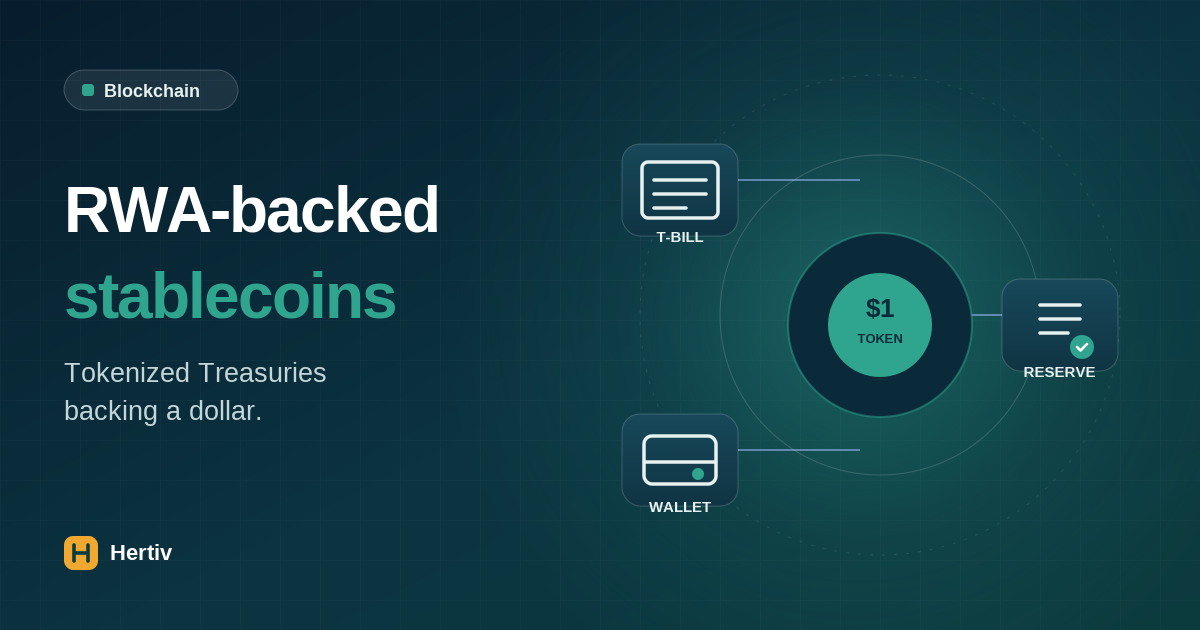
Most dollar stablecoins hold cash and Treasuries in a bank account. An RWA-backed stablecoin moves that reserve onto the chain: a regulated fund holds the underlying assets off chain, and a token represents a share of the fund. The holder can see the reserve composition on chain, and in many designs the token itself can be used as collateral in other protocols.
The best-known examples are tokenized Treasury funds: BlackRock's BUIDL, launched in March 2024 with Securitize, Circle's USYC and Ondo's USDY. Each holds short-dated government debt or repo and issues a token against it. As of 6 October 2026, tokenized Treasury funds held about $14.88 billion on chain, according to the rwa.xyz tracker. For the basic model, see what a stablecoin is.
What assets back these stablecoins?
The backing is what decides the risk, so the first question is always what sits in the reserve. Cash-like backing is short government paper, cash and repo, or a government money market fund. Credit backing is a book of private loans, invoices or other debt, which carries borrower risk the holder must understand.
| Backing type | Examples | What it means for the holder |
|---|---|---|
| Tokenized Treasuries | BUIDL, USYC, USDY, BENJI | Short-dated US government debt; yield tracks short rates |
| Tokenized gold | PAXG, XAUT | Allocated physical gold in a vault; price follows gold |
| Private credit | Tokenized loan funds | Higher yield, but borrower and manager risk |
| Real estate | Tokenized property funds | Illiquid underlying; value depends on appraisals |
Gold-backed tokens such as PAXG and XAUT are the oldest form: each token represents one ounce of allocated gold in a vault. Treasury-backed tokens are the fastest-growing slice, because short government debt is the closest thing to cash and the yield is easy to explain.
Credit and real estate backing can pay more, but the underlying assets are harder to value and slower to sell. For how the underlying assets get on chain, see how RWA tokenization works.
How does minting and redemption work?
Minting and redemption follow a simple loop: money or assets go in, tokens come out, and the reverse unwinds the position. The details depend on whether the token is open to the public or restricted to vetted investors.
- Onboard. The buyer passes identity checks and is added to an allow-list, because most tokenized funds are restricted to accredited or qualified investors.
- Subscribe. The buyer sends dollars to the fund, and the fund buys the underlying assets, such as Treasury bills.
- Mint. The issuer mints tokens equal to the subscription, minus fees, and sends them to the buyer's wallet.
- Hold or use. The holder can keep the token, transfer it to another allow-listed wallet, or post it as collateral where accepted.
- Redeem. The holder returns tokens and receives dollars, usually within one business day, after the fund sells or settles the underlying assets.
Two distribution models dominate. Rebasing tokens such as USDY and USYC increase the wallet balance daily as yield accrues. Net-asset-value tokens such as BUIDL and BENJI keep a fixed token count and accrue value through a daily price that stays near $1.00 plus accrued interest. The model matters for accounting and tax, so check which one a token uses before buying.
RWA-backed stablecoins vs fiat-backed stablecoins
An RWA-backed stablecoin and a fiat-backed stablecoin both aim at one dollar, but they differ in what the dollar is made of and who can hold it. The table below shows the practical differences.
| Feature | RWA-backed stablecoin | Fiat-backed stablecoin |
|---|---|---|
| Reserve | Tokenized Treasuries, gold, credit | Cash and bank deposits, plus Treasuries |
| Yield | Often passed to the holder | Usually kept by the issuer |
| Who can hold it | Often allow-listed investors only | Anyone, in most cases |
| Transparency | Reserve visible on chain | Attestations published by the issuer |
| Redemption | One business day is common | Usually same day |
The yield difference is the main attraction: a Treasury-backed token passes the short-term rate to the holder, while a fiat-backed stablecoin issuer usually keeps it. The trade is access and speed. Fiat-backed stablecoins such as USDC and USDT are open to anyone and redeem fast, while most RWA-backed tokens are restricted and redeem more slowly. For the yield angle in more detail, see what yield-bearing stablecoins are.
Who can hold an RWA-backed stablecoin?
Most RWA-backed stablecoins are not open to everyone. Tokenized Treasury funds are usually restricted to accredited, qualified or non-US investors, which separates them from ordinary stablecoins that anyone can buy on an exchange.
The restriction comes from the underlying asset: a tokenized fund is a regulated fund interest, so the issuer must check who buys it. A small subset, including Ondo's USDY under Regulation S and Franklin's BENJI on some retail rails, accepts non-US retail investors who pass identity checks. Even there, a US retail buyer is usually excluded.
That leaves two practical audiences. Institutions and funds use these tokens as on-chain cash that earns a yield and settles in seconds. Crypto-native treasuries and protocols use them as collateral and as a place to park idle dollars. A retail user who wants the same exposure usually buys a fiat-backed stablecoin and accepts that the issuer keeps the yield, or buys through a fund that is open to them.
Example (hypothetical): a treasury-backed dollar
Example (hypothetical): a small fund holds $10,000,000 in a tokenized Treasury fund. The fund's tokens track short-term government rates, and the current yield is 4% a year. Over one year the position earns $10,000,000 x 4% = $400,000, before the fund's management fee.
The fund charges a fee of 0.50% a year, which is $10,000,000 x 0.50% = $50,000. The net return is $400,000 - $50,000 = $350,000, or 3.50% on the $10,000,000. If the token is a rebasing token, the wallet balance grows by about $350,000 / 365 = $959 a day. If it is a net-asset-value token, the token count stays the same and the price rises by the same amount over the year.
The fund needs $2,000,000 of working cash one month, so it redeems 20% of its tokens. The issuer sells the underlying Treasuries and returns $2,000,000 plus the accrued yield on that share, usually within one business day. The remaining $8,000,000 keeps earning, and the fund's on-chain balance shows the new position at once.
What are the common mistakes?
The most common mistakes with RWA-backed stablecoins are treating every token as a dollar, ignoring who may hold it, and assuming the backing is cash when it is credit.
- Assuming a dollar is a dollar. A token backed by private loans is not the same as one backed by Treasury bills, even if both trade near $1.00.
- Skipping eligibility checks. Buying a token you are not allowed to hold can leave you unable to redeem it.
- Ignoring the fee. Management fees of 15 to 50 basis points come off the yield, so the headline rate is not what you keep.
- Trusting the label, not the reserve. Read the fund's own disclosure of what it holds, not the marketing name.
- Forgetting the issuer. The token is a claim on a fund, so the issuer's solvency and the custodian matter as much as the asset.
- Assuming instant redemption. Most funds redeem within a business day, not instantly, and large redemptions can take longer.
For the platform side of building with tokenized assets, see RWA tokenization platform development.
Key takeaways
- The reserve is tokenized real-world assets, not just bank deposits
- Treasury-backed tokens pass short-term rates to the holder
- Most tokenized funds are restricted to vetted investors
- Rebasing tokens grow the balance; NAV tokens grow the price
- Credit and real estate backing pay more and carry more risk
- Read the fund's own reserve disclosure before buying
Frequently asked questions
What is an RWA-backed stablecoin?
It is a dollar-pegged token whose reserves are held in tokenized real-world assets, such as Treasury bills, money market funds, gold or private credit. The token is a claim on those assets, recorded on a blockchain.
Which RWA-backed stablecoins are the best known?
The best-known are tokenized Treasury funds: BlackRock's BUIDL, Circle's USYC and Ondo's USDY, plus Franklin Templeton's BENJI. Gold-backed tokens such as PAXG and XAUT are the oldest form, and both track the price of one ounce of gold.
Do RWA-backed stablecoins pay yield?
Many do. Treasury-backed tokens pass the short-term government rate to the holder, minus a management fee of roughly 15 to 50 basis points. Fiat-backed stablecoins usually keep the yield for the issuer.
Can anyone buy an RWA-backed stablecoin?
Usually not. Most tokenized funds are restricted to accredited, qualified or non-US investors who pass identity checks. A small subset accepts non-US retail investors, but US retail buyers are usually excluded.
What is the difference between a rebasing token and an NAV token?
A rebasing token increases the wallet balance daily as yield accrues, while a net-asset-value token keeps a fixed token count and accrues value through a daily price. The total return is the same; the accounting differs.
What is the main risk of an RWA-backed stablecoin?
The backing itself. A token backed by private loans or real estate carries borrower and valuation risk that a Treasury-backed token does not. The issuer's solvency and the custodian also matter, since the token is a claim on a fund.


