Public vs Private Blockchain: Which Fits Your Project?
A public blockchain is open to anyone, while a private blockchain limits who can join and validate. The right choice depends on trust and privacy.
On this page
Short answer
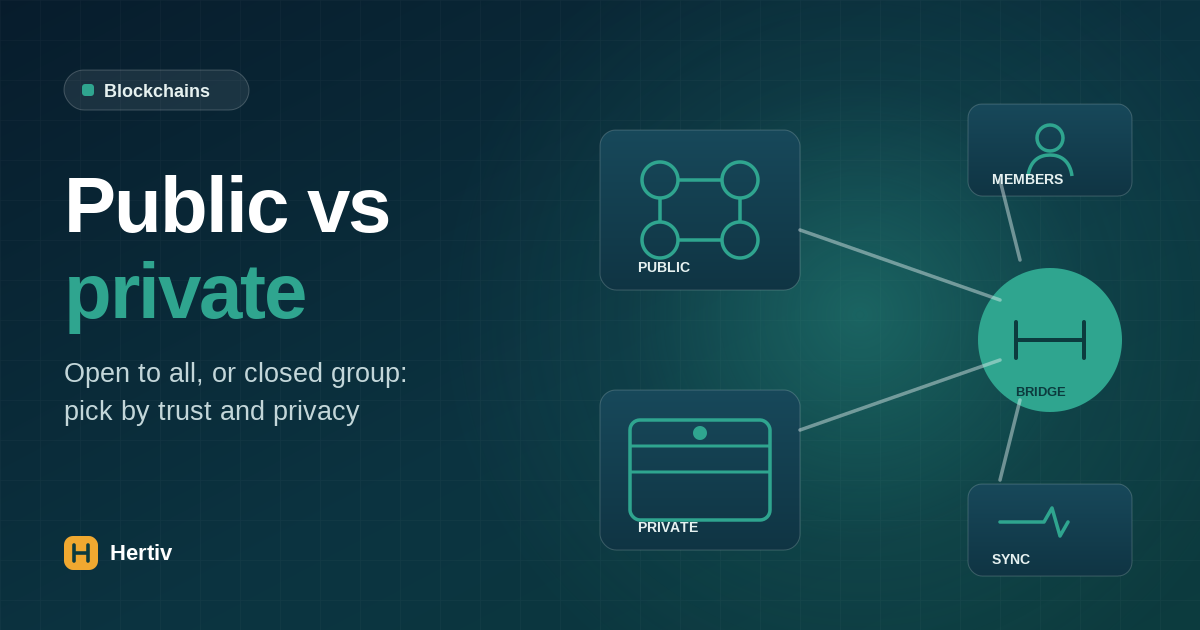
A public blockchain is open to anyone: anyone can join, read the ledger and, in most cases, help validate transactions. A private blockchain limits all of that to a known group, such as a set of companies or departments. Integration means connecting one of these ledgers to the software your team already uses, and the choice shapes cost, speed, privacy and who you must trust.
What is a public blockchain?
A public blockchain is a shared ledger that anyone can join and read. Transactions are checked by a wide network of validators, and the rules are set by the protocol, not by one company. Anyone can build on it, send a transaction, or read the full history without asking for permission.
The strength of a public chain is trust without a central owner. No single party can rewrite history or block a valid transaction, because the ledger is copied across many machines. That openness is also its limit: every transaction is visible, fees vary with demand, and changes to the rules need broad agreement.
Public chains fit cases where strangers must trust the same record, such as payments, tokenised assets and public registries. They fit less well when the data must stay private or when a company needs to control who joins the network.
What is a private blockchain?
A private blockchain is a shared ledger run by a known group, where only approved members can join, read or validate. A company or a consortium sets the rules, picks the validators, and decides who sees what. The ledger is still shared and tamper-evident, but the circle is closed.
Private chains are often run by a consortium, where each member runs a node and the group agrees the rules in writing before the first transaction. That written agreement matters: it sets who can join, who validates, and what happens when a member leaves.
The strength of a private chain is control. Transactions stay inside the group, so sensitive data is not published to the world. The network can also be faster, because fewer validators need to agree, and fees are set by the group rather than by an open market.
The trade-off is trust. Members must trust the group that runs the network, and the ledger is only as honest as its validators. Private chains fit cases where known parties share data, such as supply chains, interbank settlement and internal audit trails.
Public vs private blockchain: how do they compare?
The table below compares the two on the points that matter most when you integrate one into a product.
| Point | Public blockchain | Private blockchain |
|---|---|---|
| Who can join | Anyone, no permission needed | Approved members only |
| Who validates | Open network of validators | Chosen validators from the group |
| Data visibility | All transactions are public | Visible only to members |
| Speed | Slower, fees vary with demand | Faster, fees set by the group |
| Trust model | Trust the protocol, not a party | Trust the group that runs it |
| Best for | Payments, tokens, public records | Shared data between known parties |
Neither option is better in general. The right choice follows from one question: who must be able to trust the record, and who must not see it? If the answer is "everyone", a public chain fits. If the answer is "a known group, and no one else", a private chain fits. For a deeper look at closed networks, what a permissioned blockchain is explains the model in detail.
How do you integrate a blockchain into existing software?
Integrating a blockchain means connecting the ledger to the software your team already uses, so records move between the two without manual work. The integration usually follows six steps.
- Pick the data. Decide which records belong on the ledger, such as payments, shipments or certificates, and which stay in your database.
- Choose the chain. Pick a public or private chain that fits the trust and privacy needs from the comparison above.
- Design the smart contracts. Write the rules that move assets or record events, and keep them simple enough to audit.
- Build the connector. Add a service that reads events from the chain and writes results back to your systems.
- Test on a test network. Run the full flow with test data, including failures such as a rejected transaction.
- Launch in stages. Start with one record type and a small group of users, then add more.
The connector is the part teams underestimate. It must handle delays, failed transactions and chain reorganisations, and it must keep your database and the ledger in sync when something goes wrong. If you are building on a closed network, how to create a private blockchain covers the setup steps that come before integration.
Example (hypothetical): a food distributor picks a chain
Example (hypothetical): a food distributor wants a shared record of shipments between 12 suppliers, 3 warehouses and 40 shops. Each handoff should be recorded once, with a time and a temperature reading, so a bad batch can be traced in minutes.
A public chain would publish every shipment to the world, including prices the distributor wants to keep private. A private chain fits better: the 55 members join by approval, the ledger is visible only to them, and the group picks five validators from its largest members.
The team puts only the handoff record on the chain: shipment ID, time, temperature and the two parties. Prices and contracts stay in the distributor's database. A connector reads new chain events and updates the tracking dashboard, so staff see the same record whether they look at the dashboard or the ledger.
In the first three months, the group records about 400 handoffs a week. A trace that used to take two days of phone calls now takes a few minutes of searching the ledger, because every handoff is in one shared record.
What are the common mistakes?
The most common mistakes when integrating a blockchain are putting the wrong data on the chain, choosing the chain before the use case, and skipping the connector work.
- Putting everything on chain. Large files, prices and personal data belong in a database, with only a hash or a reference on the ledger.
- Choosing the chain first. The trust and privacy needs should pick the chain, not the other way round.
- Skipping the audit. A smart contract bug can lock funds or records. Audit before launch, even for a private chain.
- No plan for failed transactions. Transactions fail. The connector must retry or report, not silently drop them.
- Ignoring key management. Lost keys mean lost access. Plan how members store and recover keys from day one.
Smart contracts carry the rules of the integration, so they deserve a careful review. What smart contract development is explains what a good contract covers before you build one.
Key takeaways
- Public chains are open to anyone; private chains limit membership
- Pick the chain from trust and privacy needs, not from fashion
- Keep large files and private data off the ledger
- The connector that syncs chain and database is the hardest part
- Audit contracts and plan key recovery before launch
Frequently asked questions
Can a private blockchain become public later?
It can, but it is a big change, not a setting. Moving to a public chain means new validators, new fees and publishing data that was private. Most teams that need both run a private chain for internal records and publish proofs to a public chain when outside trust is needed.
Is a private blockchain still a blockchain?
Yes, if it keeps the core idea: a shared, tamper-evident ledger that members agree on. The difference is who can join and validate. A private chain trades open access for control, but the records are still shared and still hard to change after the fact.
Which is cheaper to run?
A private chain is usually cheaper to run, because fees are set by the group and the network is small. A public chain charges market fees that rise when the network is busy. The build cost depends more on the connector and the contracts than on the chain itself.
Do I need a token for a private blockchain?
No. A private chain does not need a tradable token, because the group sets the fees and the rules. Some private chains use an internal unit to track use, but it has no market price and cannot be bought or sold outside the group.
How long does integration take?
A first integration with one record type and a small group of users usually takes a few months, including contract audit and testing on a test network. The connector work and the audit take longer than teams expect, so plan for both from the start.
What happens if a validator goes offline?
The chain keeps running as long as enough validators stay online. On a private chain with few validators, one failure matters more, so the group should run validators in different places and have a plan to replace one that stops.


