Open Source CrewAI Alternatives: 7 to Compare
CrewAI builds teams of AI agents, but other open frameworks do the same job. These seven cover the same ground, from simple agent teams to full research crews.
On this page
Short answer
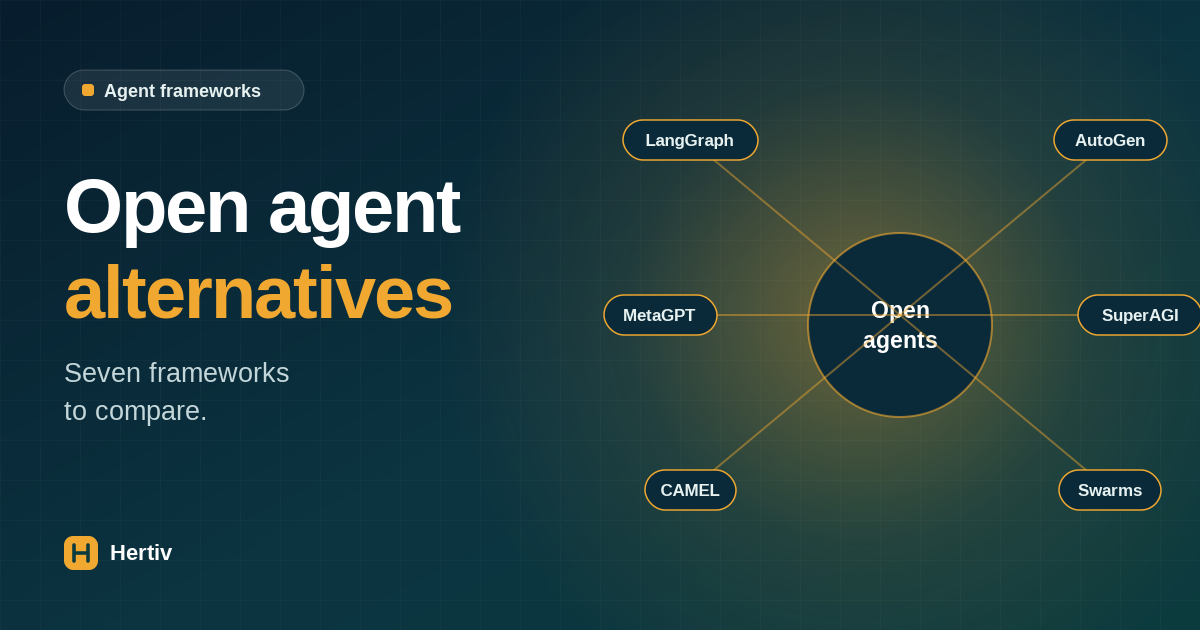
The best open source alternatives to CrewAI are LangGraph, AutoGen, MetaGPT, SuperAGI, CAMEL, AgentGPT and Swarms. Each one lets you build agents that plan, use tools and work together, and each one is free to run and change under an open licence. The right choice depends on whether you want a simple team of agents, a research crew, or a system you can run fully on your own servers.
Which open source CrewAI alternatives should you compare?
CrewAI is a framework for building teams of AI agents that work together on a task, with roles, goals and tools. It is popular because it is easy to start with. The alternatives below cover the same ground with different trade-offs: some give you more control, some run better on your own servers, and some are built for research rather than production.
The table compares seven open source frameworks. Use it to shortlist two or three, then build the same small agent team in each and compare how easy it is to write, test and run.
| Framework | Best for | Team shape | Main language |
|---|---|---|---|
| LangGraph | Agents with clear steps and checkpoints | Graphs and state machines | Python |
| AutoGen | Agents that talk to each other | Conversational teams | Python |
| MetaGPT | Software teams that write code | Role-based crews | Python |
| SuperAGI | Agents with a ready interface | Autonomous agents | Python |
| CAMEL | Research on agent behaviour | Role-playing agents | Python |
| AgentGPT | Trying agents in the browser | Single goal agents | TypeScript |
| Swarms | Large teams of agents | Swarm patterns | Python |
All seven are open source, so you can read the code, run them on your own servers and change them. That freedom comes with a duty: you must check the licence, keep the software updated, and test it yourself. If you want background on how these frameworks relate, read LangChain vs CrewAI vs AutoGen.
LangGraph and AutoGen: best for teams that code
1. LangGraph: best for agents with clear steps
LangGraph builds agents as a graph of steps, where each step is a node and the edges decide what happens next. That shape makes it easy to add checkpoints, loops and human approval points, which is useful when an agent must not act without a review. It works well for support, research and document workflows where the steps are known in advance.
The cost is more code. You define the graph, the state and the transitions yourself, so a simple team takes longer to write than in CrewAI. Teams that already use LangChain will find it familiar, and our guide to open source LangChain alternatives covers the wider ecosystem.
Pros: clear control flow, checkpoints and human approval built in, strong fit for production workflows.
Cons: more code to write, steeper learning curve for teams new to graphs.
2. AutoGen: best for agents that talk to each other
AutoGen, from Microsoft, builds agents that work by talking to each other in conversation. One agent proposes, another checks, a third acts, and the conversation itself is the workflow. That shape fits tasks where the answer emerges from discussion, such as code review, research and planning.
AutoGen is flexible, but that flexibility needs discipline. Conversations can loop or drift, so you need clear stop rules and a way to check the final result. If you are comparing it directly with LangChain, see AutoGen vs LangChain.
Pros: natural fit for multi-agent discussion, strong tooling, active development.
Cons: conversations can loop without clear stop rules, needs careful testing.
MetaGPT and SuperAGI: best for ready-made crews
3. MetaGPT: best for software teams that write code
MetaGPT assigns agents the roles of a software team: product manager, architect, engineer and tester. Give it a product idea and it produces requirements, design documents and code, with each agent checking the previous agent's work. It fits teams that want a ready-made crew for building software, rather than a toolkit for building their own.
The trade-off is that the roles are fixed. If your process does not look like a software team, you will fight the framework. It is strongest when the job is writing code from a clear specification.
Pros: ready-made software team roles, produces documents and code, good for standard builds.
Cons: fixed roles fit software work best, less useful outside coding.
4. SuperAGI: best for agents with a ready interface
SuperAGI is a framework for autonomous agents that comes with a graphical interface for running, watching and managing them. You define an agent's goal and tools, and the interface shows what it is doing, which makes it easier for a team to follow an agent's work without reading logs.
It is a good fit for teams that want to run agents as a service inside their own company. The interface is the selling point, but it also means more to install and maintain than a small library.
Pros: ready interface for running agents, easy to watch what agents do, good for internal tools.
Cons: heavier to install and maintain, more moving parts than a plain library.
CAMEL and AgentGPT: best for research-style work
5. CAMEL: best for research on agent behaviour
CAMEL is an open source framework from researchers that studies how agents behave when they play roles and talk to each other. It is built for experiments: you can set up two agents with different roles, give them a task, and watch how they negotiate, plan and solve it.
That research focus makes it less suited to production. It is a strong choice if you are studying agent behaviour, testing new ideas, or teaching a team how agents work, and a weaker choice if you need a stable system for customers.
Pros: built for experiments and research, simple role-playing model, easy to set up a study.
Cons: research focus, not built for production use, smaller community than the big frameworks.
6. AgentGPT: best for trying agents in the browser
AgentGPT lets you give an agent a goal in the browser and watch it work through the steps, with no installation. It is the fastest way to show a colleague what an autonomous agent does, and a useful way to test whether a goal is clear enough for an agent to follow.
It is a demo tool first and a production tool second. The browser version is limited, and running it seriously means deploying it yourself and adding the guardrails a real system needs.
Pros: no installation to try, clear step-by-step display, good for demos and learning.
Cons: limited as a demo, needs real deployment and guardrails for production.
Swarms: best for large agent teams
7. Swarms: best for large teams of agents
Swarms is a framework for running many agents at once, with patterns for how they share work: one agent leads, several work in parallel, or agents pass work along a chain. It fits jobs where the work splits naturally, such as processing many documents, checking many records, or running many small research tasks at the same time.
The framework is powerful but young, so expect less documentation and fewer examples than the bigger names. It rewards teams that are comfortable reading source code and testing their own patterns.
Pros: built for many agents at once, clear swarm patterns, good for parallel work.
Cons: younger project, less documentation, needs comfort with source code.
How to choose an open source CrewAI alternative
Choose by the shape of your work, not by the size of the feature list. The wrong framework will fight you on every task, while the right one will feel obvious after a week of use.
- Write down the job. One sentence: what should the agent team do, and what does done look like?
- Count the agents. One or two agents fit a simple library; five or more need a framework built for teams.
- Check the checkpoints. If a person must approve steps, pick a framework with human approval built in.
- Build the same small team twice. Take your real job, build it in two frameworks, and compare the code and the result.
- Check the licence and the maintenance. Make sure the licence fits your use and the project is still updated.
Run the test on your own data, not on a demo. A framework that shines on a tutorial can struggle on your real documents, your real tools and your real edge cases. Our guide to building an AI proof of concept shows how to run that test in four weeks.
What are the common mistakes?
The most common mistakes are picking a framework for its demo, skipping the licence check, and giving agents freedom they do not need.
- Choosing by the demo. A polished demo hides the hard parts: error handling, logging and testing.
- Skipping the licence. Open source does not mean free for every use, so read the licence before you build on it.
- Too many agents too soon. A team of eight agents is harder to debug than a team of two, so start small.
- No human checkpoint. Agents that can change data or contact customers need an approval step.
- Ignoring maintenance. Open source frameworks change fast, so plan for updates and breaking changes.
Key takeaways
- LangGraph fits agents with clear steps and checkpoints
- AutoGen fits agents that work by talking to each other
- MetaGPT and SuperAGI offer ready-made crews and interfaces
- CAMEL and AgentGPT fit research and demos best
- Swarms fits large teams of agents working in parallel
- Test two frameworks on your real job before you commit
Frequently asked questions
Is CrewAI itself open source?
Yes. CrewAI is open source, and the alternatives in this guide are open source too. The question is not whether CrewAI is open, but which framework fits your team shape, your language and your need for control.
Which CrewAI alternative is best for beginners?
AgentGPT is the easiest to try, because it runs in the browser with no installation. For a real project, LangGraph and AutoGen are the safest first choices, because they have the largest communities and the most examples.
Can I run these frameworks on my own servers?
Yes, all seven are open source and can run on your own servers. You still need a language model, which can be a hosted API or a model you run yourself, and you must keep both updated.
Do I need to pay for any of these frameworks?
The frameworks themselves are free under open licences. You pay for the language model calls, the servers you run them on, and the time your team spends building and maintaining the system.
Which alternative works best with Python?
LangGraph, AutoGen, MetaGPT, SuperAGI, CAMEL and Swarms are all Python-first. AgentGPT is TypeScript, so pick it only if your team is comfortable in that language. If your team works in Python, any of the six Python-first options will fit.
Can these frameworks replace CrewAI in an existing project?
Yes, but plan for a rewrite of the agent definitions, not a drop-in swap. Each framework has its own way of defining roles, tools and memory, so budget time to rebuild and retest the team.


