NFT-Backed P2P Lending Software: How It Works
NFT-backed P2P lending software lets a borrower lock an NFT in escrow and borrow against it, with terms enforced by smart contracts. Here is how it works.
On this page
Short answer
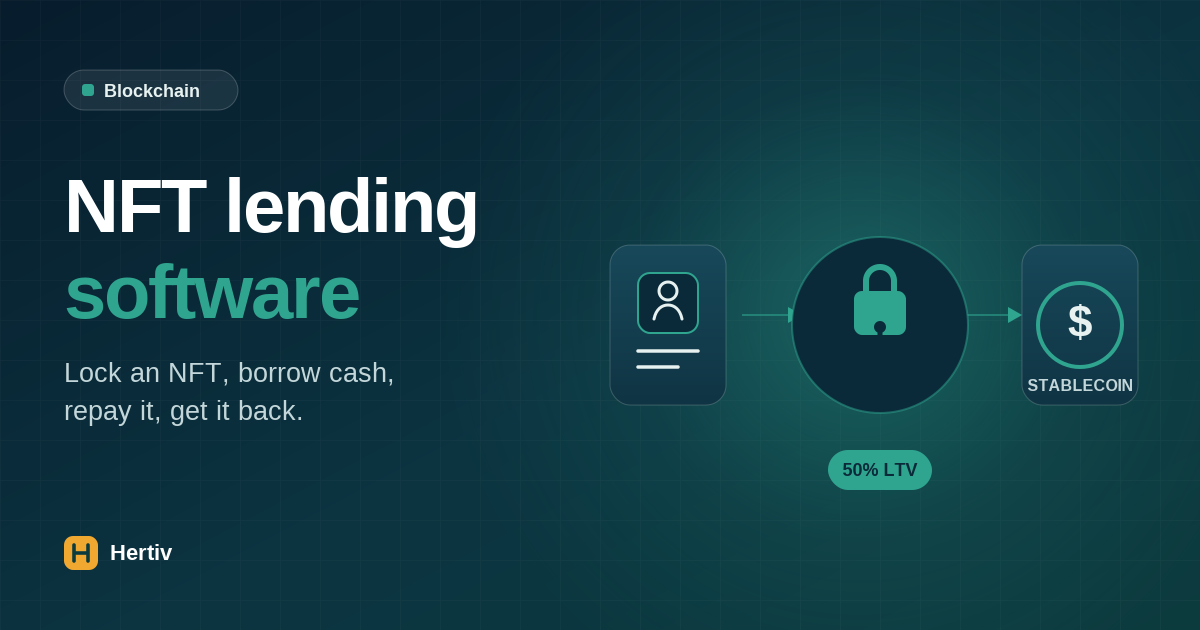
NFT-backed peer-to-peer lending software is a platform that lets one person borrow money using an NFT as collateral, with another person acting as the lender. The NFT is locked in a smart contract while the loan runs, and the loan terms, interest and repayment are enforced by code rather than by a bank.
What is NFT-backed P2P lending software?
NFT-backed peer-to-peer lending software is a platform that lets one person borrow money using an NFT as collateral, with another person acting as the lender. The NFT is locked in a smart contract while the loan runs, and the loan terms, interest and repayment are enforced by code rather than by a bank.
The borrower keeps ownership of the NFT in the sense that it returns to them when the loan is repaid. The lender holds a claim on it: if the borrower misses repayment, the lender can sell the NFT to recover the loan. The software sits between the two sides and runs the escrow, the valuation, the payments and the default handling.
Most loans are made in a stablecoin, so the amount borrowed holds its value during the loan. The NFT itself is usually a collectible, a game item or a piece of digital art with an active market, because the lender needs to be able to sell it if the borrower defaults.
The borrower side of the deal, including how a loan is priced and what it costs, is covered in how NFT lending works. This article covers the software that runs the deal.
How does a loan move through the software?
A loan moves through the software in six steps, from listing the NFT to returning it or selling it. Each step is recorded on chain, so both sides can see where the loan stands.
- List the NFT. The borrower connects a wallet, picks the NFT and asks for a loan amount and a term, such as 30 or 90 days.
- Value the collateral. The software checks recent sales of similar NFTs and sets a loan-to-value limit, often 30 to 50 percent of the estimated value.
- Match or accept an offer. A lender offers funds at a stated interest rate, or the borrower accepts an offer already listed on the platform.
- Lock the NFT in escrow. The NFT moves into a smart contract and the loan funds move to the borrower. Neither side can move the NFT while the loan runs.
- Repay or extend. The borrower repays the loan plus interest before the deadline, or asks for an extension if the software allows it.
- Return or sell. On repayment the NFT returns to the borrower. On default the lender can claim the NFT and sell it.
Interest usually accrues by the day, so a borrower who repays early pays less. The software shows the running total so neither side is surprised at the end of the term.
P2P matching or a lending pool: which model fits?
NFT-backed lending software runs on one of two models: peer-to-peer matching, where one lender funds one loan, or a lending pool, where many lenders fund many loans together. The choice changes who sets the rate and who takes the risk.
| Feature | P2P matching | Lending pool |
|---|---|---|
| Who sets the rate | Lender and borrower agree it | The pool sets it by supply and demand |
| Speed | Slower, waits for a match | Faster, funds are already there |
| Risk for the lender | One NFT, one borrower | Spread across many loans |
| Loan terms | Flexible, negotiated per loan | Fixed by the pool rules |
| Best for | Rare or high-value NFTs | Common NFTs with steady prices |
P2P matching suits NFTs that are hard to price, because a lender who knows the collection can judge the value. Pools suit NFTs with many recent sales, because the price is easier to estimate and the risk spreads across the pool.
What features does the software need?
NFT-backed P2P lending software needs five working parts: escrow, valuation, payments, default handling and a way for users to see what is happening. If any part is weak, the other four cannot make up for it.
- Escrow smart contracts. The NFT must be locked in a contract that only releases it on repayment or on default, with no way for either side to move it early.
- Valuation. Recent sales, floor prices and trait rarity feed the loan-to-value limit, so a loan is never made against a stale price.
- Payments. Stablecoin lending, interest accrual by the day, and a clear repayment path that works from a normal wallet.
- Default handling. A defined process for claiming and selling the NFT, including who pays the sale costs and what happens to any surplus.
- Transparency. Loan status, interest owed and deadlines visible to both sides, with alerts before the deadline passes.
Wallet support matters more than it looks: if a borrower cannot connect the wallet that holds the NFT, the loan cannot start. Check which wallets the software supports before building on it.
The smart contract side is the part that most often needs an audit. See NFT smart contract for what a contract does and what can go wrong with it.
What does NFT-backed P2P lending software cost?
Costs in NFT-backed P2P lending fall into three buckets: what the borrower pays, what the lender earns, and what the platform takes. The figures below are planning ranges, not fixed rates; actual rates move with the market.
| Cost or return | Planning range | Notes |
|---|---|---|
| Borrower interest | 5% to 20% a year | Higher for rare or volatile NFTs |
| Platform fee | 0.5% to 2% of the loan | Charged to borrower or lender |
| Network gas | A few dollars per action | Varies by chain and congestion |
| Lender return | Interest minus defaults | One bad loan can erase many good ones |
Loan-to-value is the number that matters most. A 50 percent limit on a $4,000 NFT means a $2,000 loan, so the NFT price can fall by half before the lender is out of pocket. A 80 percent limit leaves almost no room for a price drop.
Teams building this kind of platform usually start from the lending side rather than the NFT side. The build pattern is close to how to build P2P crypto lending software, with the NFT escrow and valuation added on top.
Example: a 90-day loan against a game NFT
Example (hypothetical): a borrower owns a game NFT that recently sold for around $4,000. The software sets a 50 percent loan-to-value limit, so the most the borrower can take is $4,000 x 50% = $2,000.
The lender offers the $2,000 at 12 percent a year for 90 days. Interest is $2,000 x 12% x 90 / 365 = $59.18, which rounds to $59. The borrower must repay $2,000 + $59 = $2,059 to get the NFT back.
The platform charges a 1 percent fee on the loan, which is $2,000 x 1% = $20. The borrower pays $2,059 + $20 = $2,079 in total, and the lender receives $2,059 minus any platform share of the fee.
If the borrower does not repay, the lender claims the NFT. If it then sells for $3,000, the lender recovers the $2,059 owed and the surplus stays with the platform rules, not with the borrower. That is why borrowers should only pledge NFTs they can afford to lose.
What are the common mistakes?
The most common mistakes in NFT-backed P2P lending are lending against a stale price, setting the loan-to-value too high, and skipping the audit on the escrow contract.
- Trusting a floor price. A collection floor can fall fast. Use recent sales of similar items, not a single listed price.
- High loan-to-value. A 80 percent limit leaves no room for a price drop. Start at 30 to 50 percent.
- Unaudited escrow. If the escrow contract has a flaw, the NFT can be stuck or taken. Get an audit before real money moves.
- No default plan. If nobody knows who sells the NFT and who pays the costs, the default turns into a dispute.
- Ignoring the chain. Gas fees and wallet support differ by chain, and a loan that works on one chain may be too costly on another.
Key takeaways
- NFT-backed P2P lending software locks an NFT in escrow while a lender funds the loan
- Loan-to-value of 30 to 50 percent leaves room for the NFT price to fall
- P2P matching suits rare NFTs; lending pools suit common ones with steady prices
- The escrow contract, the valuation method and the default plan need to be sound before launch
- Borrowers should only pledge NFTs they can afford to lose
Frequently asked questions
Can I borrow against any NFT?
No. Lenders want NFTs with recent sales and an active market, such as established collectibles or game items. An NFT that has not sold in months has no reliable price, so most platforms will not accept it as collateral.
What happens if the NFT price falls during the loan?
Nothing happens to the loan itself while it runs, since the terms are fixed. The risk lands at the end: if the borrower defaults and the NFT now sells for less than the loan, the lender loses the difference.
Do I keep ownership of my NFT while it is locked?
You keep the right to get it back on repayment, but the NFT sits in the escrow contract and you cannot sell, move or use it while the loan runs. Ownership in practice returns only when the loan is repaid.
Is NFT-backed lending legal?
It depends on the jurisdiction and on how the loan is structured. Some places treat it as a secured loan, others as a regulated credit activity. Get legal advice for your country before launching or borrowing.
How is this different from a DeFi lending pool?
In a pool, many lenders fund many loans and the rate is set by supply and demand. In P2P matching, one lender funds one loan and the two sides agree the rate and the term directly.
What does the platform charge?
Most platforms charge 0.5 to 2 percent of the loan, plus network gas for each on-chain action. Check the vendor site for the current fee, since fees change and some platforms split the fee between borrower and lender.


