How to Build a P2P Crypto Lending Platform
A P2P crypto lending platform matches lenders with borrowers, with smart contracts holding collateral and enforcing repayment. Here is how to build one.
On this page
Short answer
A P2P crypto lending platform is software that matches people who want to lend crypto with people who want to borrow it, using smart contracts to hold collateral, move repayments and sell collateral if a loan goes bad. Borrowers post more collateral than they borrow, so lenders are protected without credit checks.
What is a P2P crypto lending platform?
A P2P crypto lending platform is software that matches people who want to lend crypto with people who want to borrow it, and uses smart contracts to hold collateral, move repayments and sell collateral if a loan goes bad. The platform itself never takes the other side of a loan; it sets the rules and runs the matching.
The borrower posts crypto as collateral first, then borrows a smaller amount in another asset, usually a stablecoin. Because the collateral is worth more than the loan, the lender does not need a credit score or a court to get paid back. If the borrower stops paying or the collateral price falls too far, the contract sells the collateral and repays the lender.
Two designs dominate the market. Direct matching pairs one lender with one borrower, like the early ETHLend model. Pooled lending puts deposits into a shared pool that borrowers draw from, which is the model Aave and Compound made standard. For the wider picture, see what DeFi lending is.
How does a crypto loan work, step by step?
A crypto loan follows the same five steps on most platforms: deposit, request, match, contract and repayment. A lender deposits funds, usually a stablecoin such as USDC, into the platform, and the deposit sits in a smart contract until it is lent out.
A borrower then posts collateral, most often ETH or BTC, and asks for a loan below the value of that collateral. The platform matches the request with available funds, either by pairing the borrower with a specific lender or by drawing from the shared pool.
Once the terms are agreed, a smart contract records the principal, the interest rate and the repayment schedule, and releases the loan to the borrower. Repayments flow back through the contract to the lender, and the collateral is returned when the loan is fully repaid. The launch side of the same business is covered in how to launch a P2P lending platform.
P2P matching or a shared pool: which model fits?
The choice between direct matching and a shared pool decides how fast loans happen and how much work the platform does. Direct matching gives lenders control over who they fund and at what rate, but a borrower can wait days for a match. A shared pool lends instantly from pooled deposits, but the rate is set by an algorithm, not by negotiation.
| Feature | Direct P2P matching | Shared pool |
|---|---|---|
| Speed | Slow; waits for a match | Instant while funds last |
| Rate setting | Negotiated per loan | Algorithm, from pool use |
| Lender control | Pick each borrower | Pick a pool, not a person |
| Liquidity | Thin; money sits idle | Deep; deposits are reused |
| Complexity | Simpler contracts | Harder risk and rate logic |
| Best for | Custom or large loans | Everyday borrow and lend |
Most new platforms start with a shared pool, because instant loans attract borrowers and idle lender money earns nothing. Direct matching suits niche products, such as large loans with custom terms or loans against unusual collateral. Aave also showed a third trick worth knowing: flash loans let developers borrow within a single transaction, which only works on pooled designs.
How do collateral and liquidation protect lenders?
Collateral and liquidation are the whole safety system of a crypto lending platform, because there is no credit check and no court to chase a borrower. Every loan is over-collateralized: the borrower deposits more value than they borrow, so a price fall has room to happen before the lender loses money.
Two numbers control each asset. The loan-to-value ratio is the most a borrower can take out, for example 75% of the collateral value. The liquidation threshold is the level where the position can be sold off, for example 80%. The gap between the two is the room for the price to move before liquidation starts.
| Collateral | Max loan-to-value | Liquidation threshold |
|---|---|---|
| ETH | 75% | 80% |
| BTC | 70% | 75% |
| Stablecoin | 90% | 92% |
| Large-cap token | 50% | 60% |
The health factor rolls those numbers into one figure: collateral value times the liquidation threshold, divided by the debt. Below 1.0, anyone can repay part of the debt and take collateral at a discount. Prices come from an oracle, so a wrong price feed can trigger liquidations that should never happen, which is why oracle choice is a security decision, not a detail.
How to build a P2P crypto lending platform, step by step
Building a P2P crypto lending platform starts with the lending model and the legal position, not with code. The model decides the contracts, and the legal position decides whether the platform can serve real users at all.
- Pick the model. Choose direct matching or a shared pool, and decide whether loans are fixed-term or open-ended.
- Check the legal position. Take advice on lending rules, KYC and whether the platform needs a licence in each market it serves.
- Design the collateral rules. Set loan-to-value ratios, liquidation thresholds and which assets are accepted as collateral.
- Build the smart contracts. Write deposit, borrow, repay and liquidation contracts, and get them audited before launch.
- Add the price feeds. Connect a reliable oracle for every collateral asset, with a fallback feed for the largest ones.
- Build the app. Add wallets, loan listings, dashboards and alerts, so lenders and borrowers can act without reading contracts.
- Test with small limits. Launch with caps on deposits and loans, watch liquidations on real traffic, then raise the limits.
The audit in step four is not optional. Lending contracts hold other people's money, and a bug in the liquidation logic can drain a pool in minutes. For the contract side in more detail, see how smart contracts work.
Example (hypothetical): one loan from deposit to liquidation
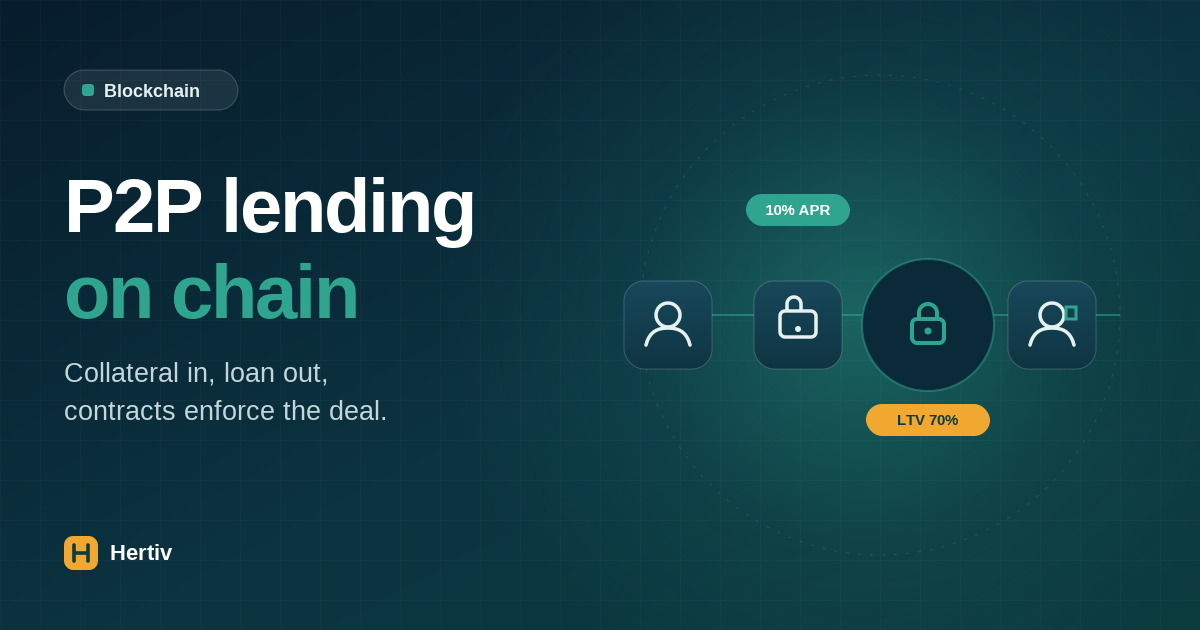
Example (hypothetical): a borrower posts ETH worth $10,000 as collateral and borrows $7,000 in USDC. The loan-to-value is 70%, inside the 75% limit, and the liquidation threshold is 80%.
The borrower pays 10% a year on the loan, which is $700 a year, or about $58 a month. The lender earns that interest, minus the platform fee, for as long as the loan runs.
Then the ETH price falls 20%, so the collateral is worth $8,000. The health factor is $8,000 x 0.80 / $7,000 = 0.91, below 1.0, so the position can be liquidated. A liquidator repays part of the $7,000 debt and takes ETH at a discount, the lender is made whole, and the borrower keeps the $7,000 but loses the collateral.
What are the common mistakes?
The most common mistakes with P2P crypto lending platforms are accepting weak collateral, trusting one price feed and skipping the audit.
- Weak collateral. A thinly traded token can fall 50% in a day, and no liquidation threshold saves a loan against it.
- One oracle only. If the single price feed fails or is manipulated, liquidations fire on wrong prices.
- Skipping the audit. Unaudited lending contracts are the fastest way to lose every deposit at once.
- Fixed rates at launch. A fixed rate that ignores pool use leaves the pool empty when demand spikes.
- No liquidation bots. Liquidation needs keepers watching prices around the clock, or bad loans sit and rot.
- Ignoring the law. Lending without checking the rules in each market can shut the platform down after launch.
Start with two or three strong collateral assets and small caps. A narrow platform that survives its first price crash earns the trust to add more assets later.
Key takeaways
- A lending platform matches lenders and borrowers; contracts enforce the deal
- Every loan is over-collateralized, so no credit score is needed
- Loan-to-value and liquidation threshold set the safety margin
- The health factor shows when a position can be liquidated
- Price oracles are a security decision, not a detail
- Audit the contracts and launch with small caps first
Frequently asked questions
What is a P2P crypto lending platform?
It is software that matches crypto lenders with borrowers and uses smart contracts to hold collateral, move repayments and sell collateral if a loan goes bad. The platform sets the rules and runs the matching; it does not take the other side of a loan.
How does a crypto loan work?
A lender deposits funds, a borrower posts collateral worth more than the loan, and a smart contract records the terms and releases the funds. Repayments flow back to the lender, and the collateral returns when the loan is fully repaid.
What is over-collateralization?
It means the borrower deposits more value than they borrow, so a price fall has room to happen before the lender loses money. For example, $10,000 of ETH collateral might support a $7,000 loan, a 70% loan-to-value ratio.
What is a health factor?
It is collateral value times the liquidation threshold, divided by the debt. A value below 1.0 means the position can be liquidated: someone repays part of the debt and takes collateral at a discount.
Do I need a licence to run a lending platform?
It depends on the markets served and how the platform is structured. Lending rules, KYC and licensing vary by country, so take legal advice before launch rather than after.
What is the difference between P2P matching and a shared pool?
Direct matching pairs one lender with one borrower at a negotiated rate, but can be slow. A shared pool lends instantly from pooled deposits at an algorithm-set rate, which is faster but gives lenders less control.


