What Is DeFi Lending, and How Does It Work?
DeFi lending lets you borrow crypto from a pool by locking up collateral, with a smart contract setting the rate. Learn how it works and the risks.
On this page
Short answer
DeFi lending is lending and borrowing that runs on smart contracts instead of a bank. A lender deposits crypto into a pool, a borrower takes a loan by locking up collateral, and the contract sets the interest rate and handles repayments.
What is DeFi lending?
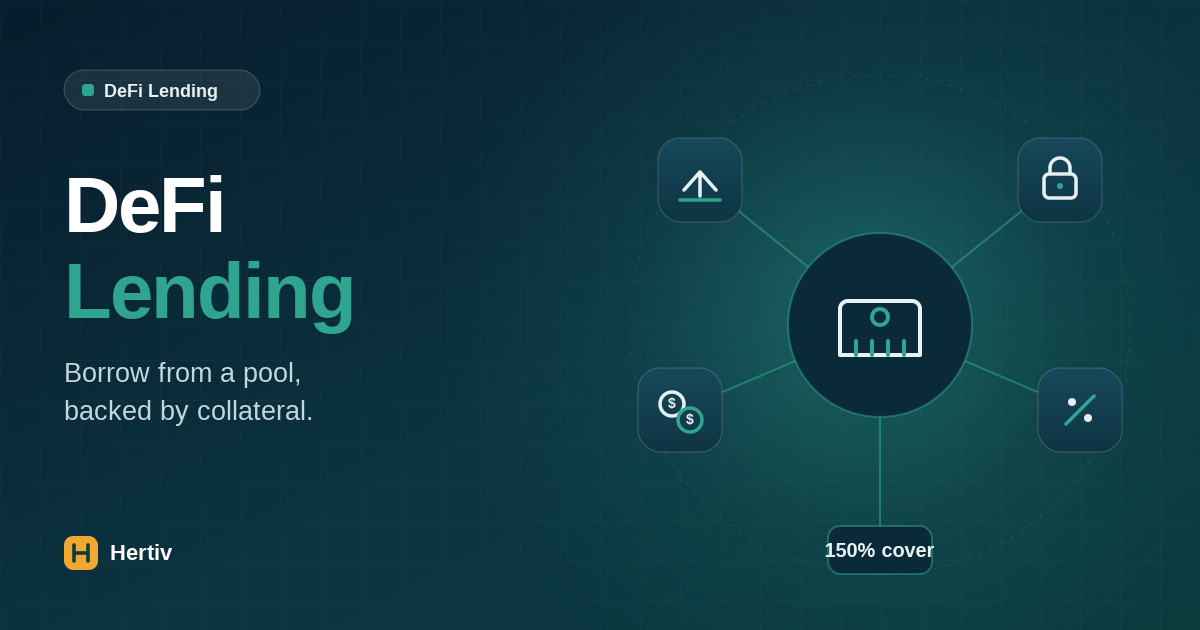
DeFi lending is lending and borrowing that runs on smart contracts instead of a bank. A lender deposits crypto into a lending pool, a borrower takes a loan from that pool by locking up collateral, and the smart contract sets the interest rate and handles repayments automatically.
There is no loan officer and no credit check in the usual sense. The contract checks the collateral, not the borrower. If the collateral falls below the required level, the contract sells part of it to repay the loan, which is how the pool protects lenders.
| Term | What it means | Example |
|---|---|---|
| Lending pool | Shared funds that borrowers draw from | A pool holding ETH and stablecoins |
| Collateral | Assets locked up to secure a loan | ETH worth 150 per 100 borrowed |
| Interest rate | Price of borrowing, set by supply and demand | Rises when the pool is nearly empty |
| Liquidation | Selling collateral when its value falls too far | Triggered below the set threshold |
| APY | Yearly return for lenders, including compounding | Shown per pool, changes daily |
DeFi lending is one of the oldest uses of decentralised finance, and it is where many people first meet the idea. For the wider field, see DeFi development use cases.
How does DeFi lending work?
DeFi lending works in five steps: deposit, borrow, interest, repayment and liquidation. Each step is written into the smart contract, so it runs the same way for every user.
- Deposit. A lender sends crypto into a lending pool and starts earning interest.
- Collateral. A borrower locks up assets worth more than the loan, usually 120 to 150 per cent of the amount.
- Borrow. The borrower takes the loan, often in a stablecoin, and can use it elsewhere.
- Interest. The rate moves with supply and demand: it rises when the pool is nearly empty and falls when it is full.
- Repay or liquidate. The borrower repays with interest, or the contract sells the collateral if its value falls too far.
The over-collateral rule is the key difference from bank lending. A bank lends on trust and a credit score; a DeFi pool lends on locked assets. That makes the loan possible without identity checks, but it also means the borrower must already own assets worth more than the loan.
Interest is not fixed. It changes as people deposit and borrow, so a borrower who takes a loan at 4 per cent may pay 8 per cent a month later if the pool drains. Lenders face the same movement in the other direction: their return rises when borrowing is heavy.
Why do people use DeFi lending?
People use DeFi lending for speed, access and yield. A loan that takes weeks at a bank can be ready in minutes on a lending protocol, and it is open to anyone with collateral, not only to people with a credit history.
Borrowers use it to release value without selling. A holder of ETH who needs cash for a few weeks can borrow stablecoins against the ETH instead of selling it, which avoids a taxable sale in some places and keeps the exposure to ETH. The risk is that the collateral can be sold if its price falls.
Lenders use it to earn a return on assets that would otherwise sit idle. The return is usually higher than a bank savings rate, but it is not guaranteed, and it moves with the market. A lender who deposits during a quiet period earns less than one who deposits during a busy one.
Traders use it to borrow and buy more of an asset, and repay later. That can raise gains, but it also raises losses, and a sharp price fall can trigger a liquidation before the trader can react. Borrowing to trade is the riskiest use of DeFi lending, and beginners should avoid it. how smart contracts work explains the code behind these pools.
What are the risks of DeFi lending?
The risks of DeFi lending are smart contract bugs, collateral price falls, liquidation and the failure of the stablecoin used for the loan. Each one can cost real money, and none of them has a customer service desk to call.
Smart contract bugs are the most serious risk. If the contract code has a flaw, an attacker may drain the pool, and there is no bank to reverse the transfer. Audits reduce the risk but do not remove it, which is why experienced users check whether a protocol has been audited and how long it has run.
Collateral price falls are the most common risk. If ETH falls 30 per cent in a day, a loan that was safe in the morning can be liquidated by the evening. Borrowers should keep a wide margin above the minimum, and check the position when the market moves.
Stablecoin risk is easy to miss. If the loan is in a stablecoin that loses its peg, the borrower may owe more than expected, and the lender may be repaid in a token worth less than a dollar. Check which stablecoin the pool uses before you deposit or borrow.
Example (hypothetical): borrowing against ETH without selling it
Example (hypothetical): a holder owns 10 ETH worth $30,000 and needs $10,000 for two months to pay a tax bill. Selling the ETH would end the exposure to its price, so the holder borrows instead.
The holder locks 5 ETH, worth $15,000, as collateral and borrows $10,000 in stablecoins. The collateral ratio is 150 per cent, which is $15,000 divided by $10,000. The interest rate is 5 per cent a year, so two months of interest is $10,000 times 5 per cent times 2 divided by 12, which is about $83.
Two months later the holder repays $10,083 and gets the 5 ETH back. If ETH had fallen 40 per cent in that time, the collateral would be worth $9,000, below the loan, and the contract would have sold part of it to repay the loan. The holder would keep the stablecoins but lose some ETH, which is the trade-off of borrowing against a falling asset.
What are the common mistakes?
The most common DeFi lending mistakes are borrowing too close to the limit, ignoring the interest rate, and using a protocol nobody has audited. Each one is avoidable with a small test first.
- Borrowing at the limit. A small price fall can liquidate a loan that sits near the minimum ratio.
- Ignoring the rate. Variable rates move, so check the rate weekly, not once at the start.
- Skipping the audit check. Never deposit in a protocol with no public audit.
- Borrowing to trade as a beginner. Borrowed money raises losses as fast as gains.
- Forgetting the stablecoin. Check which stablecoin the pool uses and whether it has held its peg.
Key takeaways
- DeFi lending runs on smart contracts, not banks, and checks collateral instead of credit
- Borrowers must lock up more than they borrow, usually 120 to 150 per cent
- Interest rates move with supply and demand, so they change over the life of a loan
- The main risks are contract bugs, collateral price falls and stablecoin depegs
- Start small, keep a wide margin above the minimum ratio, and check the audit
Frequently asked questions
Do I need a credit score for DeFi lending?
No. A DeFi lending pool does not check your credit history or your identity. It checks the collateral you lock up, which must be worth more than the loan. That is why anyone with crypto can borrow, but also why the borrower must already own assets.
How much collateral do I need to borrow?
Most pools ask for 120 to 150 per cent of the loan amount, so a $10,000 loan needs $12,000 to $15,000 of collateral. The exact ratio depends on the asset: volatile assets need a higher ratio than stable ones. Keep a wide margin above the minimum.
What happens if my collateral value falls?
If the collateral falls below the required level, the smart contract sells part of it to repay the loan. This is called liquidation, and it happens automatically. A borrower who watches the ratio and adds collateral in time can avoid it.
Is DeFi lending safe?
It carries real risks: smart contract bugs, price falls, liquidations and stablecoin problems. Audits and a long track record reduce the risk but do not remove it. Never deposit money you cannot afford to lose, and start with a small amount.
What is the difference between DeFi lending and a bank loan?
A bank lends on trust, identity and a credit score, and the process takes days or weeks. DeFi lending lends on locked collateral, needs no identity check, and is ready in minutes. The trade-off is that the borrower must already own the collateral.
Can I earn interest by lending crypto?
Yes. When you deposit crypto into a lending pool, borrowers pay interest and you receive a share of it. The rate moves with supply and demand, so it is not fixed. The return is usually higher than a bank savings rate, but it is not guaranteed.


