How NFT Lending Works: Loans Backed by Digital Assets
NFT lending lets owners borrow against an NFT instead of selling it. Here is how collateral, loan-to-value and liquidation work, and what to check first.
On this page
Short answer
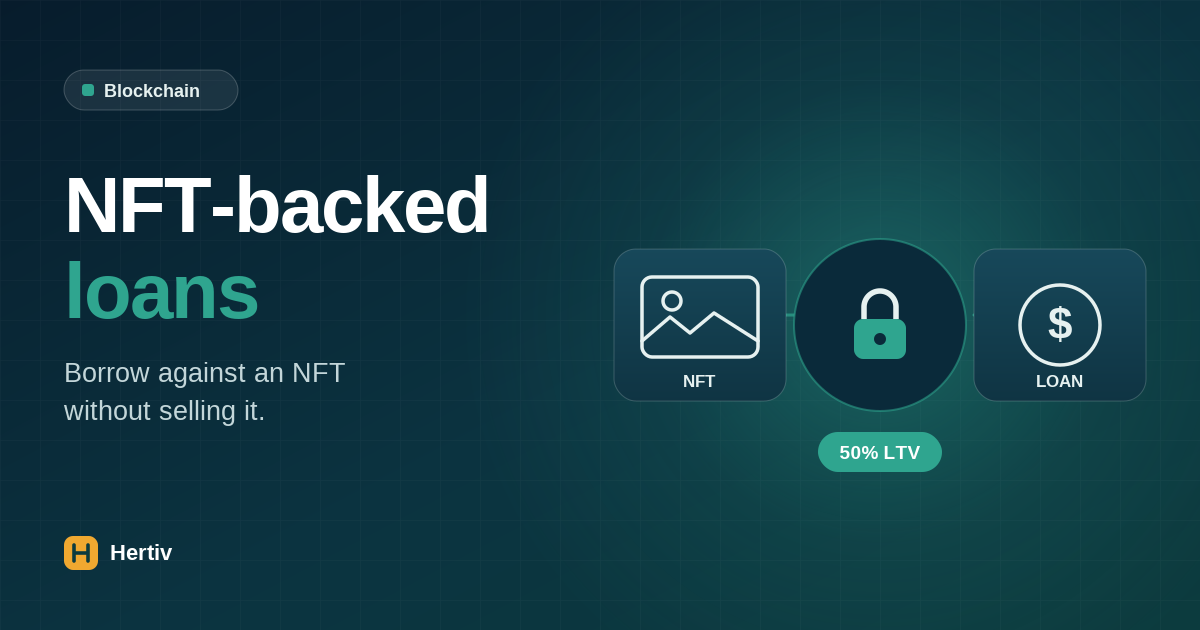
NFT lending is borrowing money with an NFT as collateral. The lender holds the NFT in escrow while the borrower receives a loan, usually in a stablecoin, worth a fraction of the NFT's value. If the borrower repays on time, the NFT returns; if not, the lender can sell it to recover the loan.
What is NFT lending?
NFT lending is borrowing money with an NFT as collateral, instead of selling the asset. The lender locks the NFT in a smart contract while the borrower receives a loan, usually in a stablecoin, and the NFT returns when the loan is repaid.
It differs from selling because the owner keeps the upside if the NFT rises in value, and it differs from unsecured DeFi lending because the loan is backed by a specific asset the lender can sell. That backing is what makes lenders willing to lend.
| Option | What happens to the NFT | When it fits |
|---|---|---|
| NFT lending | Locked in escrow, returned on repayment | You need cash but want to keep the NFT |
| Selling | NFT changes hands for good | You want out of the asset |
| Unsecured DeFi lending | No NFT involved, rates depend on the pool | You borrow stablecoins against crypto |
Most NFT loans run for 30 to 90 days, and the loan is usually a fraction of the NFT's value. The exact terms depend on the platform, the collection and how easy the NFT is to sell.
How does an NFT loan work?
An NFT loan follows the same five steps on most platforms, whether the lender is a person or a pool. The borrower lists the NFT, the lender offers terms, the contract locks the asset, the borrower receives the funds, and the loan closes on repayment or default.
- List the NFT as collateral and set the amount you want to borrow.
- Lenders offer a loan-to-value ratio, an interest rate and a term.
- Accept an offer and the smart contract locks the NFT in escrow.
- Receive the loan, usually in a stablecoin, in your wallet.
- Repay on time to get the NFT back, or the lender can sell it.
Loan-to-value is the key number: a 50% ratio on a $10,000 NFT means a $5,000 loan. Lower ratios mean cheaper rates, because the lender has more cushion if the price falls.
Some loans come from a single lender who sets the terms, while others come from a pool where many lenders fund loans together. Pool loans are faster to take out, but the terms are fixed; a single lender may offer a better rate for a strong collection, yet the deal takes longer to agree.
What can you borrow against an NFT?
The best collateral is an NFT from a well-known collection with regular sales, because lenders can price it and sell it if needed. Art, profile-picture collections, game items and virtual land are the most common types, while one-off pieces with no sales history are harder to borrow against.
| Asset type | Why lenders accept it | What to watch |
|---|---|---|
| Profile-picture collections | Regular sales give a clear price | Floor price can fall fast |
| Game items | In-game demand supports value | Value depends on the game staying live |
| Virtual land | Scarce plots in known worlds | Thin markets and slow sales |
| Art NFTs | Strong provenance and artist demand | One-off pieces are hard to price |
A lender checks recent sales, not the last asking price. If the collection has few sales, the lender will offer a lower ratio or decline, because selling the NFT to recover the loan could take weeks.
NFTs themselves are programmable assets, and the NFT smart contract guide explains how the token, the metadata and the lending escrow fit together.
What does NFT lending cost?
NFT lending costs come in three parts: interest on the loan, a platform fee and network fees for the transactions. Interest is usually quoted as an annual rate, and short loans cost less in total even when the rate looks high.
| Cost | Typical range | Notes |
|---|---|---|
| Interest | 5% to 30% a year | Depends on ratio, term and collection |
| Platform fee | 1% to 5% of the loan | Some platforms take it from the lender |
| Network fees | A few dollars per transaction | Higher on busy chains |
| Late fees | Set in the loan terms | Check before you accept |
Compare the total cost, not the headline rate. A 90-day loan at 12% a year costs far less than a 12-month loan at the same rate, and a lower loan-to-value ratio usually buys a lower rate.
If you want to compare venues, the top DeFi lending platforms roundup covers the main pool-based lenders and their terms.
Example: a 90-day loan against a game NFT
Example (hypothetical): a player owns a game NFT valued at $10,000 and needs $5,000 for 90 days. The lender offers a 50% loan-to-value ratio at 12% a year, so the loan is $5,000 and the interest is $5,000 times 12% times 90 days out of 365, which is about $148.
The player repays $5,148 on day 90 and the NFT returns to their wallet. If the NFT's floor price had fallen below $5,148 during the loan, the lender could have sold it, which is why the ratio matters more than the rate.
If the floor price had risen instead, the player would keep the gain: the NFT would still be worth more than the $5,148 owed, and the loan would have cost less than selling the asset and buying it back. That is the trade that makes NFT lending attractive, as long as the borrower can repay on time.
What are the risks of NFT lending?
The main risks are price falls, thin markets and contract flaws. An NFT can lose half its value in a week, a lender may not find a buyer at the floor price, and a bug in the lending contract can lock funds.
- Floor price falls below the loan, so the lender sells early
- Few buyers for the collection, so a sale takes weeks
- Smart contract bugs that freeze the NFT or the funds
- Borrowing more than you can repay in the term
- Hidden fees in the loan terms that raise the real cost
Check the contract, the platform's track record and the collection's sales history before you borrow. DeFi lending in general carries the same risks, and the main DeFi lending guide explains how pool-based loans differ from NFT-backed ones.
Also check how the platform values the NFT. Some use the floor price of the collection, some use an average of recent sales, and some use an oracle that updates the price. A valuation method that lags a falling market can leave a loan under-collateralised before anyone notices, so ask how often the price is updated.
Common mistakes with NFT lending
The most common mistakes are borrowing against an NFT you cannot afford to lose, ignoring the loan-to-value ratio and accepting terms without reading them. Each one is easy to avoid before the loan starts and costly after it.
- Borrowing the maximum amount instead of what you need
- Treating the floor price as a guarantee it will hold
- Skipping the liquidation terms in the contract
- Borrowing for a term longer than you need
- Using a platform with no audit or track record
If you are building a lending product rather than borrowing, DeFi development covers the contracts, audits and custody design that a lending platform needs.
Key takeaways
- NFT lending lets you borrow against an NFT without selling it.
- The loan-to-value ratio decides how much you can borrow and how safe the loan is.
- Interest, platform fees and network fees together make up the real cost.
- Floor prices can fall fast, so borrow less than the maximum.
- Read the liquidation terms before you accept any loan.
Frequently asked questions
Can I borrow against any NFT?
No. Lenders prefer NFTs from collections with regular sales, so they can price the asset and sell it if needed. One-off pieces with no sales history, or NFTs from games that shut down, are hard to borrow against, and most lenders will decline them.
What happens if I cannot repay an NFT loan?
The lender can sell the NFT to recover the loan. Most contracts sell when the value falls below a set level or when the term ends unpaid, so the borrower loses the asset and any gain it might have made later.
How much can I borrow against an NFT?
It depends on the loan-to-value ratio the lender offers, which is usually 30% to 60% of the NFT's floor price. A $10,000 NFT at 50% gives a $5,000 loan, and a lower ratio usually buys a lower interest rate.
Is NFT lending the same as DeFi lending?
No. DeFi lending usually means borrowing stablecoins against crypto such as ether, with the loan managed by a pool. NFT lending uses a specific NFT as collateral, and the terms are set per asset rather than by a pool rate.
Do I need to sell my NFT to get a loan?
No, that is the point of NFT lending. The NFT is locked in a smart contract while the loan runs, and it returns to your wallet when you repay. Selling is only needed if you default or the value falls below the liquidation level.
What fees should I expect on an NFT loan?
Expect interest, a platform fee and network fees. Interest is quoted as an annual rate, the platform fee is usually 1% to 5% of the loan, and network fees apply to each transaction. Add all three before you compare offers.


