MVP App Development in Australia: A Clear Guide
MVP app development in Australia means building the smallest working app that proves demand, with local privacy rules and local users in mind. Here is how it works.
On this page
Short answer
MVP app development in Australia is the process of building the smallest working version of an app that tests whether Australian users want it, before spending on the full product. It follows the same lean method used everywhere, with local rules on privacy and consumer law, local payment habits, and local users shaping what gets built first.
What is MVP app development in Australia?
MVP app development in Australia means building a minimum viable product: the smallest app that solves one real problem for one group of users, well enough to learn from. The goal is not a small version of the final app, but a working test that shows whether people will use it and pay for it.
The Australian part matters in three ways: the privacy rules, the consumer law, and the users. Australia's Privacy Act governs how personal information is collected and stored, the Australian Consumer Law sets rules on refunds and fair dealing, and Australian users expect local payment methods and local support hours. The guide to what an MVP is explains the basic idea.
Most Australian MVPs are built for one city or one industry first, such as a booking app for Sydney clinics or a quoting tool for Melbourne trades. A narrow start makes the test honest and the feedback useful.
What does an Australian MVP usually include?
An Australian MVP usually includes sign-up, the one core job, payments in Australian dollars, and a way to collect feedback. It leaves out the extras: multiple user roles, advanced settings, integrations and polished design beyond a clean, usable interface.
The table below shows what belongs in the first version and what can wait.
| Part | In the MVP | Waits for later |
|---|---|---|
| Sign-up and login | Email or phone, one role | Social login, teams |
| Core job | One flow, done well | Extra features |
| Payments | Cards and local methods | Subscriptions, invoicing |
| Feedback | In-app form, support email | Analytics dashboards |
| Design | Clean and usable | Custom illustration, animation |
If a feature does not help you learn whether users want the product, it does not belong in the MVP. Cut it, and spend the saved weeks talking to users instead.
How long does an MVP take to build in Australia?
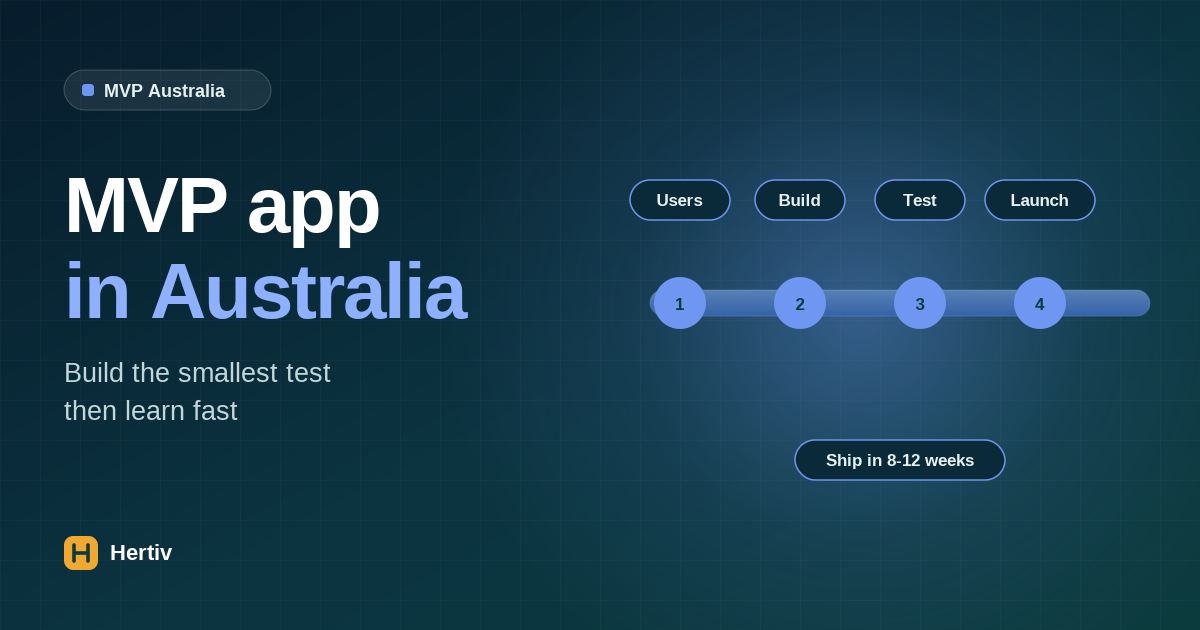
A simple MVP usually takes 8 to 12 weeks from a clear brief to a working app in the hands of real users. A more involved one, with payments, bookings or location features, can take 12 to 16 weeks. The range depends on the scope, not the country, but Australian teams often add time for local compliance checks and for testing with local users.
The fastest way to shorten the timeline is to cut scope, not to add people. One core flow, one user role and one payment method will always ship faster than three of each. The guide to MVP timelines shows what a 10-week plan looks like week by week.
Example (hypothetical): a Brisbane clinic booking MVP is planned at 10 weeks. Cutting the admin dashboard saves 2 weeks, and using a standard payment provider saves 1 week, so the team ships in 7 weeks. The 3 saved weeks go to testing with 20 real clinic staff, which finds 4 usability problems before launch.
What local rules should you know?
Three Australian rules shape most MVPs. The Privacy Act requires you to collect only the personal information you need, tell users why you collect it, and protect it. The Australian Consumer Law requires honest descriptions, working products and fair refund handling. And the Spam Act limits how you can email people who have not asked to hear from you.
If the app handles health, finance or children's data, extra rules apply, so get advice early. A short conversation with a lawyer who knows Australian technology law costs far less than fixing a product that breaks the rules after launch.
Keep data in Australia or in a country with equivalent protection when your users expect it, and say so plainly in your privacy policy. Users notice, and business buyers ask.
How to build an MVP app in Australia
Start with the users, not the technology. Talk to ten people in your target group, find the one job they struggle with, and build only that. Then test it with the same people, watch where they get stuck, and change the app before you add anything new.
- Interview ten target users and name the one job that matters most.
- Sketch the single flow that does that job, and nothing else.
- Build the MVP in 8 to 12 weeks with one developer team.
- Test it with 20 real users in Australia and watch them use it.
- Fix the problems they hit, then decide: grow, change or stop.
Choose a development team that has shipped Australian apps before, and ask to see one. Local experience shows in small things: the right payment methods, the right privacy wording, and support hours that match your users. The guide to building an MVP covers the steps in more detail.
Where should you test an MVP in Australia?
Sydney and Melbourne have the largest pools of early users, which makes them the usual first test cities. Sydney suits finance, health and enterprise tools, while Melbourne suits retail, education and creative products. A narrow start in one city gives you honest feedback faster than a thin launch across the whole country.
Brisbane, Perth and Adelaide can be better when the product serves a local industry, such as mining services in Perth or agriculture in regional Queensland. The test users should match the real buyers, not just the easiest people to reach, so pick the city where your buyers actually work.
Remote testing works too, and many Australian teams recruit users online across several cities. The advantage of one city is that you can meet users in person, watch them use the app, and hear the problems they do not write down. Five in-person sessions often teach more than fifty survey replies.
What does an MVP app cost in Australia?
An MVP app in Australia usually costs less than the full product, because it has fewer features and a shorter build. The final number depends on the scope, the team's rates and whether you use local or offshore developers. Local teams usually charge more per hour but need less hand-holding on local rules and user expectations.
Do not budget from a single quote. Ask three teams for a price on the same written brief, and compare what each one includes: testing, support after launch, and who owns the code. Prices vary widely, so check the vendor site or ask for a written quote before you compare costs. The MVP cost guide explains what drives the number.
Common mistakes
The most common mistake is building the full product and calling it an MVP. If the app has three user roles, five features and a settings page before anyone has used it, it is a product launch, not a test, and the learning comes too late to be cheap.
Another mistake is testing with friends instead of strangers. Friends are kind, strangers are honest, and only strangers will tell you the app is confusing. Find twenty people who match your target user and have never met you, and watch them use the app without help.
Key takeaways
- An MVP tests one job with real users, not a small full product
- Australian privacy and consumer law shape the build
- 8 to 12 weeks is typical for a simple MVP
- Cut scope to ship faster, not people
- Test with strangers, not friends
Frequently asked questions
How much does an MVP app cost in Australia?
It depends on scope and team rates, and prices vary widely. Ask three teams for a written quote on the same brief, compare what each includes, and check the vendor site for current rates before you budget.
Do I need an Australian developer to build an MVP in Australia?
No, but local experience helps with payment methods, privacy wording and support hours. If you use an offshore team, make sure someone on the team knows the Australian rules that apply to your app.
How long should I test an MVP before deciding?
Four to six weeks with real users is usually enough to see whether the core job works. If fewer than one in five testers comes back, the idea or the flow needs to change before you spend more.
What is the difference between an MVP and a prototype?
A prototype is a clickable mock-up that shows how the app would look. An MVP is a working app that real users can use to do the job. The prototype tests the idea; the MVP tests the reality.
Can I launch an MVP on the app stores in Australia?
Yes. Both major app stores accept MVPs, and many Australian teams launch there to reach real users. Make sure the app works well and the privacy policy is complete before you submit it.
What happens after the MVP works?
You keep the users, fix the problems they found, and add the next most-wanted feature. The MVP becomes the first version of the real product, and the learning from the test shapes what gets built next.


