How Long Does It Take to Build an MVP?
A simple MVP usually takes 6 to 12 weeks, while a larger one can take 4 to 6 months. Learn what sets the timeline and how to plan the first version.
On this page
Short answer
A simple MVP usually takes 6 to 12 weeks to build, while an MVP with payments, accounts and an admin area often takes 3 to 6 months. The timeline depends on how many features the first version has, how much design and testing it needs, and whether one small team or several teams build it.
How long does it take to build an MVP?
An MVP, or minimum viable product, is the smallest version of a product that real users can try. Building one usually takes 6 to 12 weeks for a simple app, and 3 to 6 months for a larger one with payments, accounts and an admin area. The range is wide because the word MVP covers everything from a booking form to a full marketplace.
The timeline is set by scope, not by speed. A team that builds five features in ten weeks is fast; a team that builds twenty features in ten weeks is building a finished product and calling it an MVP. The first question is always how small the first version can be while still being useful to real users.
Most of the time goes to building, but design, testing and launch each take their share. A realistic plan gives each phase its own weeks, and the table below shows what each size of MVP usually looks like.
| MVP size | Typical time | What it usually includes |
|---|---|---|
| Simple | 6 to 12 weeks | One core job, sign-up, basic pages |
| Medium | 3 to 4 months | Accounts, payments, admin area |
| Larger | 4 to 6 months | Several user types, integrations, reports |
What sets the timeline?
Scope sets the timeline more than anything else. Each feature adds design, building, testing and fixing, so cutting five features from the first version can cut a month from the plan. Teams that protect the scope protect the date.
Team size matters, but only up to a point. One small team of three to five people can build a simple MVP in ten weeks. Adding more people helps a little, but each new person needs time to learn the product, and a team that doubles in size rarely doubles in speed.
Design and testing add weeks that teams often forget to plan. A custom design takes longer than a ready-made one, and testing with real users always finds fixes that need time. Integrations with payment providers, maps or other services also add time, since each one has its own setup and its own quirks. What an MVP is explains how to judge whether a feature belongs in the first version.
A realistic MVP timeline, week by week
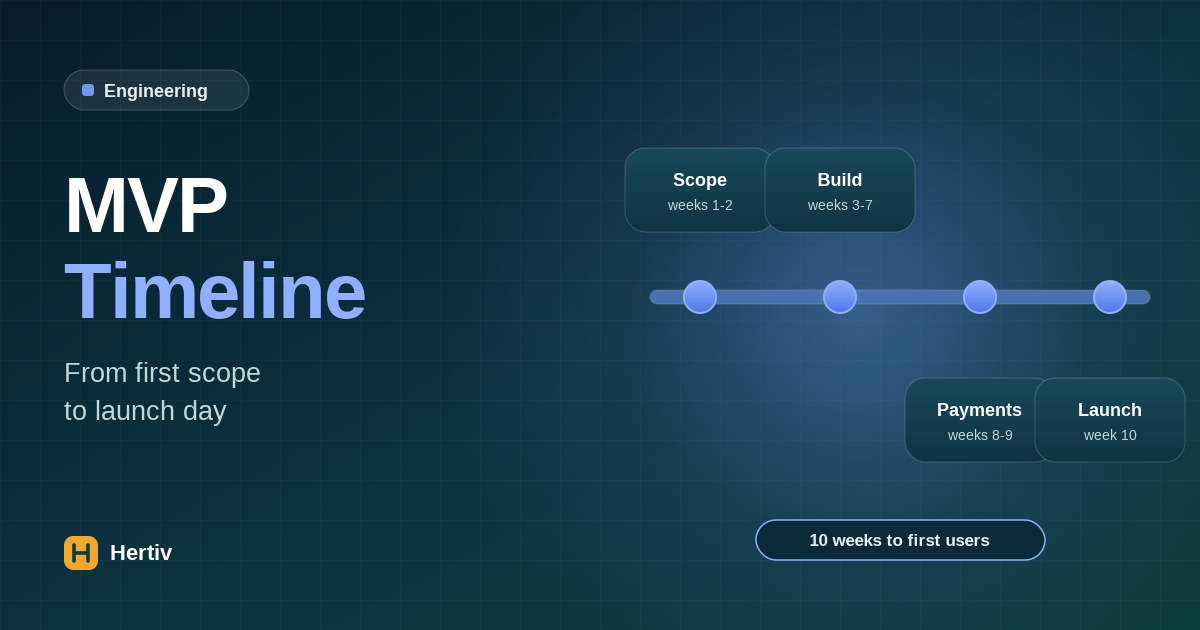
A ten-week plan for a simple MVP usually breaks into four phases, and each phase has a clear job. The phases overlap a little, but the order stays the same: scope first, then design, then building, then testing and launch.
- Weeks 1 to 2: scope and design. Agree the five or six features the first version will have, sketch the main screens, and write down what is out of scope. This is the cheapest time to change your mind.
- Weeks 3 to 7: build the core. Build the main job first, such as booking or ordering, then add sign-up and the basic pages. Show working software every week, even if it is rough.
- Weeks 8 to 9: payments and admin. Add payments and the admin area the team needs to run the product, and connect any outside services the core job needs.
- Week 10: test and launch. Test with a small group of real users, fix the faults they find, and launch to a small audience before opening the doors wide.
A medium MVP follows the same shape with longer phases: three weeks of scope and design, eight weeks of building, three weeks of payments and admin, and two weeks of testing. The shape stays the same; only the length changes.
Example (hypothetical): a clinic booking MVP
Example (hypothetical): a small clinic wants an MVP that lets patients book appointments online. The scope is six features: a booking form, patient sign-up, a doctor calendar, reminders, a simple admin page and a payment page for deposits.
The team plans 400 hours of building at $70 an hour, which is 400 × $70 = $28,000. Design costs $3,000 and testing with real patients costs $2,000, so the total is $28,000 + $3,000 + $2,000 = $33,000. A 10% reserve for fixes adds $3,300, bringing the budget to $36,300.
The timeline is 10 weeks: 2 weeks of scope and design, 5 weeks of building the booking flow, 2 weeks for payments and admin, and 1 week of testing and launch. The clinic launches to its own patients first, watches the first hundred bookings, and only then opens booking to new patients.
How to shorten the timeline without cutting quality
Shorten the timeline by cutting scope, not by cutting testing. A feature removed from the first version saves its design, building and testing time, while a skipped test only moves the fault to launch day, where it costs more to fix.
Use ready-made parts for the jobs that are not your product. Payments, sign-in, maps and email are solved problems, and a ready-made service for each one saves weeks of building. Your team's time should go to the one job that makes your product different.
Decide fast and in one place. An MVP stalls when each decision waits for a meeting, so give one person the job of deciding scope questions on the day they arise. A decision made today is worth more than a perfect decision made in three weeks. How to build an MVP covers the steps from idea to first users.
What slows an MVP down?
Scope creep slows an MVP more than any technical problem. Each new feature sounds small on its own, but five small additions can add a month, and each one pushes the launch further away. Write the out-of-scope list down and check new ideas against it.
Waiting slows it down too. Waiting for logo files, for content, for a payment account or for a decision can stall a team for days. Prepare the content, the accounts and the decisions before the building starts, so the team never waits on something outside its control.
Untested assumptions slow it down last. A team that builds for three months without showing real users anything often finds at launch that the core job is wrong. Show working software to real users every week, and the fixes stay small. MVP app development cost shows how the same scope choices set the budget.
What are the common mistakes?
The most common mistake is calling a finished product an MVP. An MVP with twenty features is not a first version; it is a launch, and it takes launch time. If the list does not fit on one page, it is too long.
The second mistake is skipping the test week. A week of testing with real users finds the faults that the team cannot see, and fixing them before launch is cheap. Skipping it does not save a week; it moves the faults to the first real users.
The third mistake is planning the date before planning the scope. A date set first forces the team to squeeze features into too little time, and the result is a rushed product that is late anyway. Plan the scope first, then read the date off the plan.
Key takeaways
- A simple MVP takes 6 to 12 weeks; a larger one takes 3 to 6 months
- Scope sets the timeline more than team speed does
- Cut features to shorten the plan, never cut testing
- Use ready-made parts for payments, sign-in and maps
- Plan the scope first, then read the date off the plan
Frequently asked questions
How long does it take to build an MVP app?
A simple MVP app usually takes 6 to 12 weeks, while a medium one with accounts and payments takes 3 to 4 months. The exact time depends on how many features the first version has and how much design and testing it needs.
Can an MVP be built in a month?
A very small MVP can be built in 4 to 6 weeks if it has one core job, a ready-made design and no payments. Most MVPs need longer, because sign-up, design, testing and launch each take real time.
What takes the most time in an MVP?
Building the core job takes the most time, usually about half the plan. Design, payments, the admin area and testing take the rest, so a plan that only counts building time will always run late.
Does a bigger team build an MVP faster?
A bigger team helps a little, but not in proportion. Each new person needs time to learn the product, and a team of three to five people is often the fastest size for a first version.
How do I know if my MVP scope is too big?
If the feature list does not fit on one page, or if the plan runs past six months, the scope is too big. Cut the features that can wait until after the first real users have tried the product.
Should I launch an MVP that is not perfect?
Yes, if the core job works and the rough edges are honest ones. An MVP is meant to be tried by real users, and their feedback is worth more than extra weeks of polishing before anyone has used it.


