What Is an MVP, and How Do You Scope One That Ships?
An MVP is the smallest version of a product that tests one core assumption with real users. Here is how to define what it must do, what to cut, and when to ship.
On this page
Short answer
An MVP (minimum viable product) is the smallest version of a product that lets real users complete one core job, so you can test a key business assumption before building more. It is a learning instrument, not a stripped-down final product.
What is a minimum viable product?
A minimum viable product is the smallest build that lets a real user complete the core job your product promises, so you can measure whether anyone wants it. The word viable carries the weight: the user has to reach a genuine outcome, not a demo.
That separates an MVP from two things it is often confused with. A prototype or proof of concept shows that something can work technically; it usually has no real users, no data persistence and no path to production. A first release is a smaller version of a finished product, with usability, support and reliability already treated as requirements.
An MVP sits in between. It runs in a real environment with real users, but deliberately leaves out anything that does not help test the assumption. If you are testing whether finance teams will reconcile invoices inside your tool, an MVP needs real invoices and a real reconciliation result. It does not need role-based permissions, a billing portal or a settings page.
The useful mental model: the MVP is a question with a running cost. Every feature you add should either sharpen the question or make the answer easier to measure. Anything else is deferred work that arrived early.
How is an MVP different from a prototype or a full product?
A prototype answers "can this work?", an MVP answers "will people use this?", and a full product answers "can this run reliably and profitably at scale?". Each question needs a different level of engineering.
| Stage | Main question | Real users | Typical build scope | What you learn |
|---|---|---|---|---|
| Concept or prototype | Is this technically feasible? | No | Mock data, one path, no accounts | Whether the hard part is actually hard |
| Proof of concept | Does the approach hold with real inputs? | Internal only | Scripts, notebooks, rough UI | Whether the logic survives real data |
| MVP | Will a target user adopt this for one job? | Yes, a small group | One workflow end to end, minimal admin | Demand, activation, retention signals |
| First release | Can we support this properly? | Growing group | Reliability, onboarding, roles, billing | Unit economics, support load |
| Scaled product | Can this grow without breaking? | Many | Performance, compliance, integrations | Where the system bends |
Moving one row down too early is the most common way budgets disappear. Moving too late is rarer and usually cheaper.
The practical test: if no user outside your team has ever completed the core job in the product, you have a prototype, whatever it says in the deck. The table is a planning tool, not a certificate. Revisit it whenever someone asks to add a feature that only matters at a later stage.
What should an MVP actually include?
An MVP should include the shortest end-to-end path that produces a real outcome for one type of user, plus enough instrumentation to tell whether it happened. Everything else is out of scope until that path works.
A workable checklist:
- One clearly named user group, narrow enough that you can recruit a handful of them by hand
- One core job, written as a sentence: the user does X to get Y
- One path to completion, with the fewest screens or steps that still make sense
- Real data, or a realistic substitute, because fake inputs hide the hard problems
- A way to see what users did, even if that is a shared log or a manual note per session
- A defined decision: what result means continue, what result means change the idea
Everything else is negotiation. Accounts and permissions, integrations with many systems, mobile and web parity, polished design, admin tooling and self-serve billing all matter eventually. None of them help you learn whether the core job is worth doing.
For AI features specifically, "viable" also means the model's output is good enough that a user would act on it. A demo that is right most of the time is not an MVP until you know what happens with the wrong answers from the user's side. If your product uses agents or generative features, the MVP development service covers how that path is usually scoped.
How do you scope an MVP in practice?
Scope an MVP by writing the single user journey first, then cutting every step that is not needed to reach the outcome. Scope creep rarely comes from big additions; it comes from a dozen small "while we're in there" requests.
A sequence that holds up:
- Write the assumption as a falsifiable sentence. "At least some target users will move their weekly reporting into this tool rather than a spreadsheet" is testable. "Teams want better reporting" is not.
- Write the journey in five to seven steps from the user's point of view, ending in the outcome.
- For each step, decide build, buy or fake. Faking means a human does it behind the scenes, or a spreadsheet, form or script stands in for software.
- Pick the one technical risk that could sink the product and resolve it first, before building around it.
- Set the measurement and the decision rule before development starts.
Example (hypothetical): a team wants an internal tool that drafts responses to supplier emails. The assumption is that operations staff will send drafts after light editing. The MVP keeps the retrieval, drafting and review screen, and fakes the email integration: a staff member copies the email in and pastes the draft out. If staff will not use drafts in that simple form, no amount of integration work will change the answer. A more detailed version of this planning process is in how to scope an MVP you can ship in 10 weeks.
How long should an MVP take to build?
Most business-facing MVPs are best treated as a matter of weeks, not quarters, with the timeline dominated by scope decisions rather than coding. The honest answer is that duration follows from how much you are willing to fake.
A short cycle works when the core workflow is narrow, integrations are stubbed or manual, and the user group is small enough to onboard by hand. It stretches when the product depends on access to third-party systems, regulated data, hardware or a model quality bar that needs its own evaluation work.
What usually pushes an MVP past its estimate:
- Waiting on API access, security review or data-sharing agreements from a customer or vendor
- Treating design as a phase after engineering rather than part of the same short loop
- Adding a second user role because the first one "needed" an approver
- Rebuilding infrastructure for scale that no user has justified yet
Plan the calendar around the slowest external dependency, not the fastest developer. If access to a partner system takes a month, that month is part of the MVP timeline whether or not anyone writes code in it. Start those conversations before the build starts, and keep the engineering work on parts you control.
What are common MVP mistakes?
The most common MVP mistakes are building too much, measuring too little, and treating the first version as a commitment to every future feature. Each one is avoidable with a decision written down in advance.
- No stated assumption. If the team cannot say in one sentence what the MVP tests, the release will be judged on opinions instead of evidence.
- Viability confused with polish. Users must finish the job, but the interface does not need to be finished. Spending weeks on visual detail delays the only thing that matters.
- No instrumentation. Without usage data, a quiet launch looks like failure and a noisy one looks like success, with nothing to distinguish the two.
- Faking the wrong part. Manual workarounds belong outside the hypothesis. If a human is doing the core value step, you are testing your team's capacity, not the product.
- Skipping the decision rule. Teams that do not define what result means stop, change or continue tend to continue by default.
- Shipping to the wrong users. Friends and internal staff are forgiving in ways real users are not.
How do you choose what to build first?
Choose what to build first by ranking candidate features against two questions: does this test the main assumption, and does it block a user from finishing the core job? Anything that scores low on both waits.
A short prioritisation pass:
- List every feature anyone has asked for, in plain language.
- Mark each as core path, measurement, or later. Only the first two categories are candidates.
- For each core path item, ask whether it can be manual, bought or stubbed for the first cohort.
- Build in the order of technical risk, not user-visible excitement. The part most likely to fail should fail early and cheaply.
- Re-read the list after every release and move items between categories, because what counts as core shifts as you learn.
This keeps the build honest. It also gives you something useful to show stakeholders who ask for a date: a ranked list with reasons, rather than a promise that everything arrives at once.
When you are ready to build, the choice between hiring, contracting and partnering matters less than having this list. If the plan is solid but the team is thin, custom software development can carry the build without changing the scope. For cost expectations, see how much does an MVP cost; it explains what drives the range without quoting fixed figures.
Key takeaways
- An MVP exists to test one assumption, not to deliver every feature at low quality
- Viability means a real user can finish the core job without a human stepping in
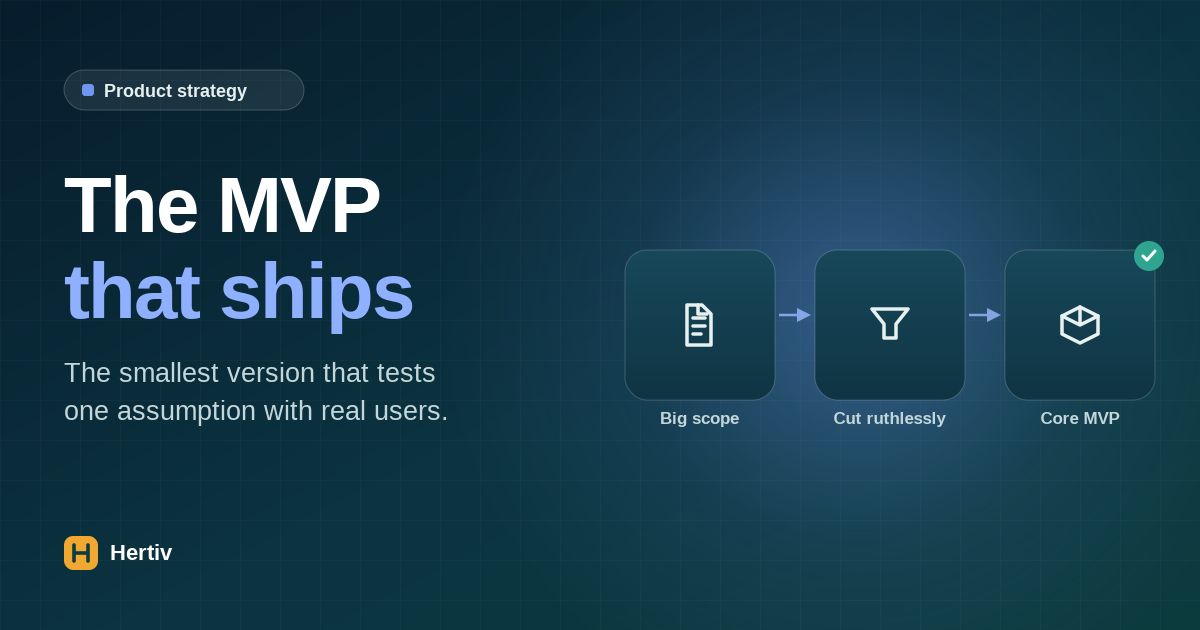
- Scope the smallest workflow that produces a genuine outcome, then cut everything else
- Manual and no-code workarounds are valid for any part that is not the hypothesis
- Instrument usage from day one, or the release teaches you nothing
- Decide the kill, pivot or continue criteria before you start building
Frequently asked questions
Is an MVP the same as a prototype?
No. A prototype checks whether something can work and rarely has real users. An MVP runs in a real environment with a small group of target users and measures whether they adopt it for one core job. Confusing the two leads teams to test demand with something that only proves feasibility.
Does an MVP have to be low quality?
It should be narrow, not careless. The core path needs to work reliably enough that a user reaches a real outcome and would consider coming back. What you skip is breadth: extra roles, integrations, admin tools and polish, not the correctness of the one workflow you are testing.
How many features should an MVP have?
Enough to complete one end-to-end job for one user group, plus measurement. There is no target number, and counting features is the wrong instinct. Ask instead whether each item can change your decision after launch. If it cannot, it belongs in a later release.
How do I know when the MVP is done?
It is done when a real user from the target group can finish the core job unaided, and you can see from data or records what happened. That is a scope definition you set before building, not a feeling at the end. Define it early so the team knows what to stop at.
What happens after an MVP launches?
You compare results with the decision rule you set in advance and choose to stop, change the assumption or continue. If you continue, the next work is usually reliability, onboarding and the features you deliberately deferred. The MVP's job ends when it has answered its question.
Can an MVP be built with AI agents or generative AI?
Yes, and the rules are the same. Pick the one workflow where model output changes a user's action, measure whether users accept the output, and keep integrations and admin tools out of the first build. Model quality becomes part of what "viable" means, so evaluate it early.


