How to scope an MVP you can ship in 10 weeks
A simple method to cut a product idea down to the one flow that proves it, plus what to leave out and how to plan the ten weeks.
On this page
Short answer
Pick the single riskiest assumption in your idea and design the shortest flow that tests it with real users. Build only what that flow needs: sign-up, the core action, the result, and basic admin. Leave out settings, roles, integrations and polish that do not change what you learn. Most products scoped this way fit in eight to twelve weeks.
Start with the riskiest assumption
Every product rests on a few beliefs: people have this problem, they will try your solution, they will pay. Write them down and pick the one that, if wrong, makes everything else pointless. Your MVP exists to test that belief.
Map one flow end to end
Describe the shortest path from “a new user arrives” to “they got the value”. For example: sign up, upload a file, get a report, share it. Everything on that path is in scope. Everything else needs a strong reason.
What to leave out
| Usually not needed yet | Do this instead |
|---|---|
| Multiple user roles | One role, with admin done by your team |
| Settings pages | Sensible defaults |
| Many integrations | One integration, or a CSV import |
| Self-serve billing | Invoices or a simple payment link |
| Native apps on two platforms | A responsive web app |
| Custom design system | A clean, consistent UI kit |
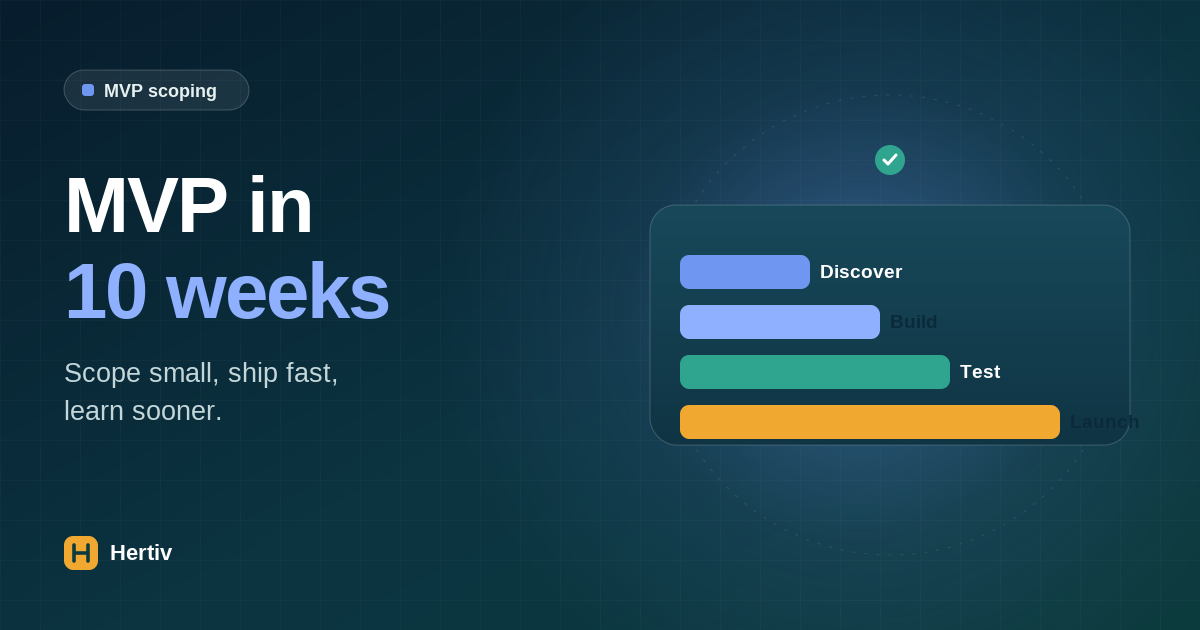
A ten-week plan
| Week | Focus |
|---|---|
| 1 | Scope sprint: flow, screens, data model, risks |
| 2–3 | Design of the key flow; backend foundations; auth |
| 4–7 | Build the core flow; weekly demos to real users |
| 8 | Analytics, admin tools, error tracking |
| 9 | Testing, fixes, security basics |
| 10 | Launch to the first users; measure |
A weekly demo with real users from week four catches wrong assumptions while they are still cheap to fix.
Decide what “worked” means before launch
Choose two or three numbers, such as the share of sign-ups who complete the key flow, how many come back in the second week, or how many agree to pay. Set a threshold for each. After launch you will know whether to double down, change direction or stop.
Cost
A ten-week MVP built this way typically costs $40k–$90k, depending on the flow, integrations and any AI features. A short scope sprint first costs $5k–$10k and usually pays for itself by removing features. See the MVP cost guide and MVP development.
Key takeaways
- Test the riskiest assumption first.
- Build one end-to-end flow and leave out everything else.
- Set success numbers before launch.
Frequently asked questions
Can an MVP include AI features?
Yes, if the AI is part of the core value. Keep it narrow and measure its quality from day one.
Should the MVP code be thrown away later?
Not if it is built properly. A focused MVP should become the base of the product.
What if ten weeks is not enough?
Cut scope further, or split into two releases with a real user test in between.


