Money Market Fund Tokenization: How It Works
Money market fund tokenization turns shares of a low-risk cash fund into tokens that settle in minutes and pay yield daily. Here is how it works and what to watch.
On this page
Short answer
Money market fund tokenization records shares of a money market fund as digital tokens on a blockchain, so investors can buy, hold and transfer fund shares with near-instant settlement instead of waiting a day or more. The fund still holds the same short-term government debt and cash, pays yield in the same way, and stays a regulated investment product; only the record of ownership and the settlement process change.
What is money market fund tokenization?
Money market fund tokenization is the process of recording shares of a money market fund as digital tokens on a blockchain. A money market fund is a low-risk investment product that holds cash and short-term government debt, and it is where companies and investors park money they may need soon.
Each token stands for a share in the fund. The fund itself does not change: it still holds the same underlying assets, it still pays yield, and it still follows the same rules and reporting duties. What changes is the record of who owns what and how ownership moves from one party to another.
Instead of waiting for a transfer agent to update a register overnight, the blockchain updates ownership when the token moves. That is the whole idea. For the general background, read what fund tokenization is and how it works across fund types.
How does a tokenized money market fund work?
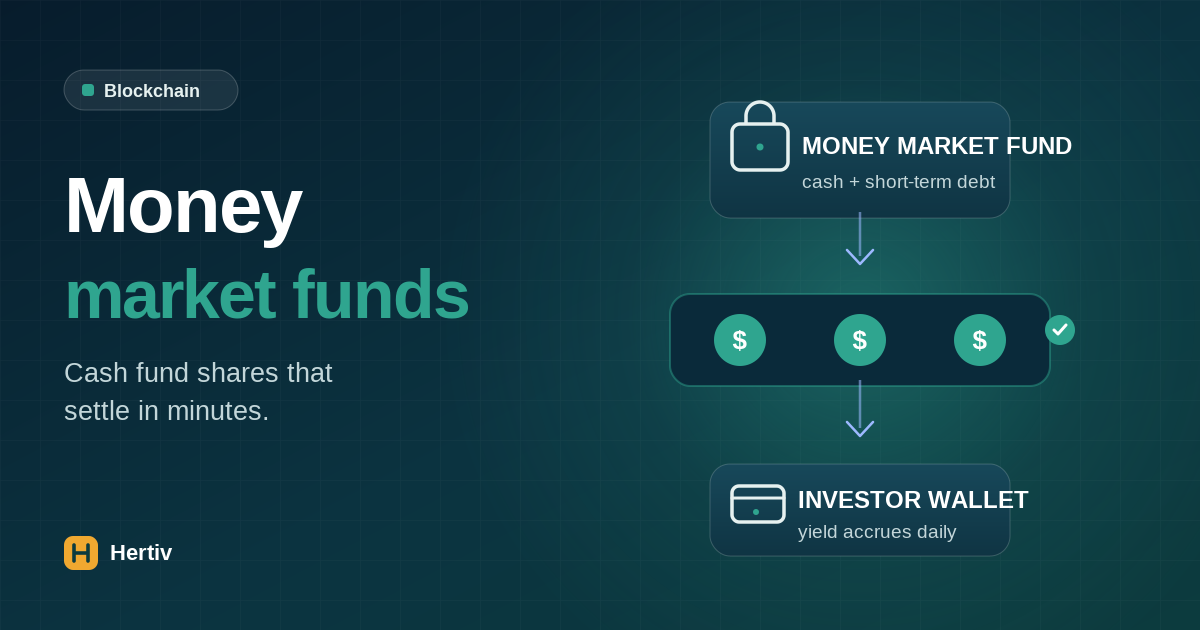
A tokenized money market fund works like a normal fund with a faster back office. An investor subscribes, the fund issues tokens to their wallet, and yield accrues on the shares they hold. When they redeem or transfer, the tokens move and the fund's records update at the same time.
| Feature | Traditional fund shares | Tokenized fund shares |
|---|---|---|
| Settlement | One business day or more | Minutes, around the clock |
| Ownership record | Transfer agent register | Shared blockchain ledger |
| Transfer | Through intermediaries | Wallet to wallet |
| Yield | Paid on a set schedule | Accrues daily, visible in the wallet |
| Use as collateral | Slow, paper-heavy process | Pledged on-chain in minutes |
| Minimum investment | Often high for institutions | Can be split into smaller pieces |
Building the platform that runs all of this is a separate job. How to build a tokenized money market fund platform covers the fund structure, the token design and the build steps for teams doing that work.
What can investors do with tokenized fund shares?
Tokenized fund shares give investors the same yield as the underlying fund, with more ways to use the holding. The shares are still a claim on a regulated fund; the token is just a more flexible wrapper around that claim.
- Hold cash that earns yield. Investors keep money in a low-risk fund and earn the fund's yield while it sits there, instead of leaving it idle in a bank account.
- Transfer around the clock. Shares can move between wallets at any hour, including weekends, when banks and fund administrators are closed.
- Use shares as collateral. A fund share can be pledged to back a loan or a trading position, and released when the obligation is met, without selling the underlying holding.
- Settle trades faster. A buyer can pay with fund shares instead of cash, and the seller receives a yield-bearing asset rather than money that sits idle.
- Split holdings. Tokens can be divided into smaller pieces than traditional fund shares, so smaller investors and smaller treasuries can take part.
The most common users so far are crypto firms, trading desks and corporate treasuries that already hold digital assets. Tokenized US Treasury investment is a close cousin: the same idea applied to government bonds rather than fund shares.
What are the benefits for treasurers and funds?
The benefits of money market fund tokenization are speed, transparency and lower admin work, and they matter most to people who move cash often. A treasurer who settles trades every day gains more than an investor who buys once and holds for a year.
Settlement speed is the clearest gain. Cash that arrives on a Friday can be put to work the same day instead of waiting until Monday, and money needed for a payment can be redeemed without a day of delay. Over a year of daily operations, those saved days add up to real yield.
Transparency is the second gain. Every holder, transfer and yield payment sits on a shared ledger that the fund, the investor and the auditor can all read, which cuts the reconciliation work that follows each transaction.
Funds also gain a wider set of buyers, since tokens can reach investors in places where traditional fund distribution is slow or costly. The cost side matters too: fund tokenization cost depends on the platform, the legal work and the ongoing compliance, so it should be priced before any launch decision.
Example (hypothetical): a treasurer parks $2 million
Example (hypothetical): a company treasurer holds $2,000,000 in cash that will be needed for payroll and supplier payments over the next quarter. Instead of leaving it in a bank account, she puts it into a tokenized money market fund paying 4% a year.
At 4% a year, $2,000,000 earns $80,000 a year, which is $80,000 divided by 365, or about $219 a day. In a traditional fund, redeeming $500,000 on a Friday would mean waiting until Monday for the cash. In the tokenized fund, the same redemption settles in minutes, so the treasurer can pay suppliers on Friday and still earn yield on the balance until the moment it moves.
The arithmetic is simple, and that is the point: the fund does not pay more than a normal money market fund. It pays the same yield, but the money is available when it is needed, and the treasurer can see the balance and the yield in the wallet at any time.
What are the risks and limits of money market fund tokenization?
Money market fund tokenization carries the same risks as the underlying fund, plus new ones from the token and the platform. A token does not make a low-risk fund risk-free, and it adds points of failure that a traditional fund does not have.
- Regulation. Tokenized funds are regulated investment products, and the rules differ by country. A fund that is legal in one place may not be offered in another, and marketing rules still apply.
- Platform risk. The token runs on a blockchain and a set of smart contracts. A bug, an outage or a lost key can block redemptions even when the fund itself is sound.
- Liquidity limits. A token is only easy to sell if someone wants to buy it. Early tokenized funds can be thin markets, so large redemptions may still go through the fund's normal process.
- Counterparty risk. The fund, the custodian, the token issuer and the platform operator are all parties an investor depends on, and each one needs checking.
- Accounting and tax. Holding fund shares as tokens raises questions about how to book them, how to report yield, and how to handle transfers, which finance teams must settle before investing.
None of these risks is a reason to dismiss the idea, but they are reasons to treat a tokenized fund like any other investment: check the fund, check the platform, and keep the position sized to what you can afford to have locked up if something goes wrong.
What are the common mistakes?
The most common mistakes with money market fund tokenization are treating the token as the investment, assuming instant liquidity, and skipping the legal review.
- Confusing the token with the fund. The value comes from the fund's assets, not the token. A slick platform cannot fix a weak fund.
- Assuming instant redemption. Small transfers settle fast, but large redemptions still depend on the fund's liquidity and its normal process.
- Skipping the legal review. The fund, the token and the offering all need legal sign-off in each country where investors are based.
- Ignoring custody. Whoever holds the wallet keys controls the shares, so custody and recovery plans need the same care as the fund choice.
- Chasing yield. A tokenized fund that pays far more than other money market funds is taking far more risk somewhere, and the token does not hide that.
Key takeaways
- Tokenization changes the record and the settlement, not the fund itself
- Tokenized shares settle in minutes and can be transferred around the clock
- Shares can be pledged as collateral and split into smaller pieces
- The yield is the same as the underlying fund; the gain is availability and transparency
- Regulation, platform risk and liquidity limits still apply and need checking first
Frequently asked questions
Is a tokenized money market fund still a regulated fund?
Yes. Tokenization changes how shares are recorded and transferred, not what the fund is. The fund still holds cash and short-term government debt, follows the same investment rules, and must meet the same reporting and investor-protection duties in each country where it is offered.
How fast can I redeem tokenized fund shares?
Small transfers usually settle in minutes, including outside banking hours. Large redemptions may still follow the fund's normal process, since the fund needs enough liquid assets to pay out. Check the fund's redemption terms before investing, not after.
Do tokenized money market funds pay more yield?
No. They pay the yield of the underlying fund, which comes from short-term government debt and cash. Any fund advertising far more yield than others is taking more risk, and the token wrapper does not change that.
Who uses tokenized money market funds today?
The earliest users are crypto firms, trading desks and corporate treasuries that already hold digital assets and need cash that earns yield while staying available. Traditional investors are joining as regulated offerings appear in more countries.
Can I use tokenized fund shares as collateral?
In many cases, yes. Shares can be pledged on-chain to back a loan or a trading position and released when the obligation is met. Whether a specific lender accepts them depends on the fund, the platform and the lender's own rules.
What happens if the platform goes down?
The fund still exists and still holds its assets, but redemptions through the token may be blocked until the platform recovers. That is why custody, recovery plans and the fund's own redemption process matter as much as the technology.


