Metaverse vs Multiverse: What Is the Difference?
The metaverse is one shared virtual world, while a multiverse is many linked virtual worlds. Here is how they differ and what comes after the metaverse.
On this page
Short answer
The metaverse is a single shared virtual space where people work, play and trade through avatars, while a multiverse is a set of many connected virtual worlds that share identity, assets and rules. The metaverse is one place; the multiverse is many places that talk to each other. The future beyond the metaverse is likely a multiverse, where you move between worlds without losing your identity or items.
What is the difference between the metaverse and the multiverse?
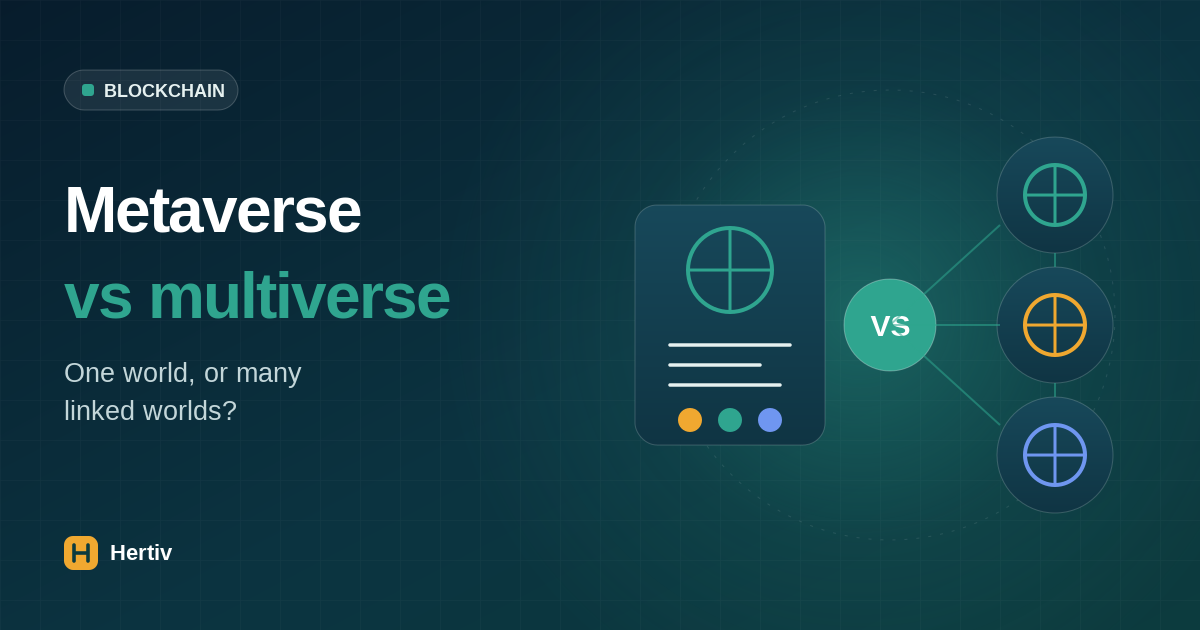
The metaverse is one shared virtual world that many people enter at the same time, usually through avatars, while the multiverse is many virtual worlds that are linked together so people, identities and digital items can move between them.
Think of the metaverse as a single city with districts for work, games, shopping and events. The multiverse is a network of cities with roads between them: each world has its own rules and look, but your identity and your belongings travel with you.
The key difference is scope. A metaverse is one environment, often run by one company or platform. A multiverse is an open system of many environments, and no single owner controls all of it. How the metaverse differs from Web3 is covered in Web3 vs metaverse.
What is the metaverse?
The metaverse is a persistent, shared virtual space where people meet, work, play and trade as avatars, using virtual reality headsets, phones or computers to enter it.
It is persistent, which means it keeps running and changing even when you log out. It is shared, so other people are there at the same time, and it is spatial, so you move through places rather than scrolling through pages.
Most metaverse platforms today are single worlds with their own accounts, currencies and items. A game world, a virtual office and a concert venue can each call itself a metaverse, but your avatar and items usually stay inside the one you are in. For a fuller picture, see what the metaverse is.
What is the multiverse?
The multiverse is a network of virtual worlds that share open standards for identity, assets and payments, so a person can move from one world to another without starting over.
In a multiverse, your avatar, your digital items and your reputation are portable. A jacket bought in one world could be worn in another, and a payment made in one world could settle in a shared currency or token.
This needs standards that no single company controls: shared identity formats, asset formats that many worlds can read, and rules for how worlds hand a user over to each other. Blockchains are often proposed for this job, since they can record ownership in a way that no one world can rewrite.
The multiverse also changes who earns from a virtual world. In a single metaverse, the platform owner takes a cut of every sale. In a multiverse, creators can sell an item once and have it work in many worlds, which gives them more reach and less dependence on one platform's rules.
Metaverse vs multiverse: a side-by-side comparison
The two ideas share the same building blocks, but they answer different questions. The metaverse asks what one virtual world can be; the multiverse asks how many worlds can work together.
| Feature | Metaverse | Multiverse |
|---|---|---|
| Number of worlds | One shared world | Many linked worlds |
| Identity | One account per world | One identity across worlds |
| Digital items | Usable in one world | Portable between worlds |
| Ownership | Usually one company | Shared standards, many owners |
| Movement | Stay inside the world | Move between worlds |
| Main challenge | Building a good world | Agreeing on shared rules |
The multiverse is harder to build because it needs agreement between worlds that compete with each other. That is why most working products today are metaverses, while the multiverse is still mostly a design goal.
Where do the metaverse and the multiverse overlap?
The metaverse and the multiverse overlap in the technology they share: avatars, 3D spaces, real-time graphics, digital payments and the networks that connect them.
A metaverse can grow into part of a multiverse when it opens up. If a game world lets you bring in an avatar from another world, or lets you spend a token earned elsewhere, it has taken a step toward the multiverse model.
Virtual reality and the metaverse are often confused, but they are not the same thing; the comparison in metaverse vs virtual reality explains the difference. A multiverse can include worlds that run in VR, on a phone, or in a plain browser, and the device matters less than whether the worlds connect.
The overlap is also practical. A company that runs a virtual store today can join a multiverse later without rebuilding everything, as long as it uses open formats for its products and its customer accounts. The store stays the same; only the doors to other worlds are added.
What comes after the metaverse?
The future beyond the metaverse is likely a set of connected worlds rather than one bigger world. People will move between a work world, a game world and a shopping world the way they move between websites today.
Example (hypothetical): a designer starts the day in a virtual studio with her team, then joins a client in a product showroom, then attends a concert in a game world. Her avatar, her notes and her payment method follow her, and each world reads the same identity. She never creates a new account or re-buys the same items.
Three things have to work for this to happen. First, identity must be portable, so one login works everywhere. Second, assets must use formats that many worlds can read. Third, payments must settle across worlds without a long delay or a high fee.
None of this needs a single company to build it all. Open standards and shared ledgers can do the job, but they need enough worlds to adopt them before the network effect kicks in.
The shift will be gradual rather than sudden. First, a few large worlds will agree on one shared format, probably for avatars or payments. Then smaller worlds will adopt the same format to reach those users, and the network will grow one connection at a time.
What are the common mistakes?
The most common mistakes are treating the metaverse and the multiverse as the same idea, assuming one company will own the whole multiverse, and building for a single world when users will want to move.
- Using the words interchangeably. A metaverse is one world; a multiverse is many linked worlds, and the difference changes the design.
- Assuming a single owner. A multiverse needs shared standards, so no one company can set all the rules.
- Locking items to one world. Items that cannot leave a world lose value the moment a user wants to move.
- Ignoring identity. Without portable identity, every world needs its own account, and the multiverse never forms.
- Betting on one device. Worlds that only work in VR exclude the many people who use phones and browsers.
Key takeaways
- The metaverse is one shared virtual world; the multiverse is many linked worlds
- Portable identity and portable items are what turn separate metaverses into a multiverse
- Most working products today are single metaverses, not a multiverse
- The future beyond the metaverse is connected worlds, not one bigger world
- Shared standards matter more than any single platform
Frequently asked questions
Is the multiverse the same as the metaverse?
No. The metaverse is one shared virtual world, while the multiverse is many virtual worlds linked together. The multiverse adds portable identity, portable items and shared rules so people can move between worlds.
Does the multiverse exist yet?
Not as a finished system. Individual worlds exist, and some let you move items or identity between them, but there is no widely used set of standards that links many worlds together. It is a design goal that teams are working toward.
Is Web3 the same as the multiverse?
No. Web3 is a set of ideas about open, user-owned internet services, often using blockchains. A multiverse could use Web3 tools for identity and ownership, but it could also be built on other shared standards.
Can I use the same avatar in every metaverse?
Not yet. Most worlds use their own avatar formats and accounts, so your avatar usually stays in the world where you created it. Portable avatars need shared formats that many worlds agree to support.
What is the multiverse in simple terms?
It is a network of virtual worlds that share identity, items and payments, so you can move between worlds without starting over. Think of it as many cities with roads between them, rather than one big city.
Should a business build for the metaverse or the multiverse?
Build for one metaverse first, but use open formats for identity and items where you can. That keeps your work useful today and ready to connect to other worlds if shared standards take hold.


