Top 5 Metaverse Trends in Education to Watch
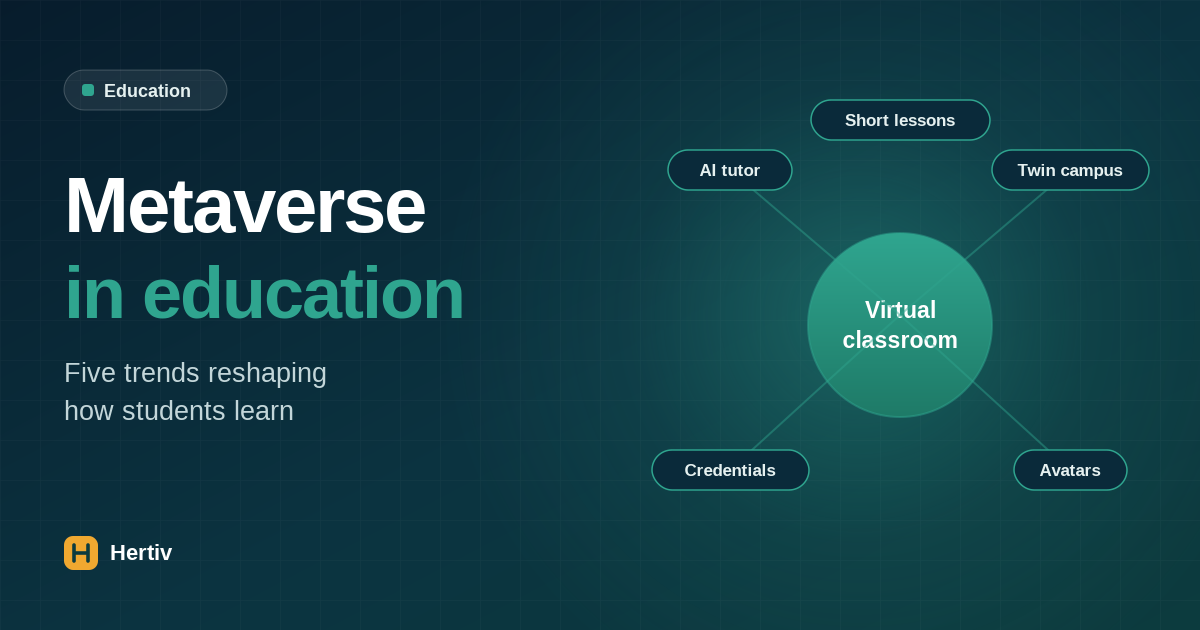
Five metaverse trends are changing how schools teach: AI tutors, digital twin campuses, verified credentials, short lessons and portable avatars.
On this page
Short answer
Metaverse trends in education are the changes that decide what a virtual classroom can do next. The five that matter most are AI tutors inside 3D lessons, digital twins of real campuses, credentials recorded on chain, short immersive lessons, and avatars that work across platforms. Each one is already being tried in real schools and training teams.
Which metaverse trends matter in education?
Five trends stand out because they change what a lesson can do, not just where it happens. AI tutors give every student a patient helper inside the virtual room. Digital twins let a class visit a campus or a factory that no longer exists, or one that is too far away.
The other three trends fix the boring parts: proving what a student learned, keeping lessons short enough to hold attention, and letting one avatar move between apps. Together they decide whether a school should invest now or wait. For the background, read what the metaverse is before you plan a pilot.
| Trend | What changes | Who it helps most |
|---|---|---|
| AI tutors in 3D lessons | Every student gets live help | Large classes |
| Digital twin campuses | Real places rebuilt as 3D spaces | Remote learners |
| Credentials on chain | Certificates anyone can check | Employers and students |
| Short immersive lessons | Practice in 10-minute sessions | Busy adult learners |
| Portable avatars | One identity across apps | Schools with many tools |
<h3>1. AI tutors inside virtual lessons: best for large classes</h3>
An AI tutor in a virtual classroom answers questions while the teacher works with a small group. A student who is stuck on a step can ask the tutor, try again, and keep going without waiting for the teacher to come back. The tutor follows the lesson plan, so its answers stay on topic.
This matters most in large classes, where one teacher cannot reach every student in one session. The tutor handles the repeat questions, and the teacher handles the hard ones. The lesson still needs a human in charge, because the tutor cannot tell when a student is upset or guessing.
- Pros: every student gets help at once; repeat questions cost the teacher no time.
- Cons: the tutor can give a confident wrong answer; it needs a teacher to check its work.
<h3>2. Digital twin campuses: best for remote learners</h3>
A digital twin campus is a 3D copy of a real place: a school building, a hospital ward, a factory floor. Students walk through it as avatars, find the right room, and practise a task where the real place is too far, too busy or too risky to visit.
The strongest use is practice that needs a place. A nursing student can rehearse a ward round in a twin of a hospital. An engineering student can walk a power station that is closed to visitors. The twin does not replace the real visit, but it makes the first real visit far less confusing.
- Pros: students can practise in places they cannot reach; mistakes cost nothing.
- Cons: building a good twin takes time and money; a rough twin teaches the wrong layout.
<h3>3. Credentials on chain: best for proving skills</h3>
Credentials on chain are certificates and badges recorded so anyone can check them. When a student finishes a course, the school issues a record that an employer can verify without phoning the school. The record shows what was learned, when, and by whom.
This helps students who learn in many places. A short course, a workplace badge and a degree can sit in one record, and an employer can check all three in minutes. Schools still decide what counts as a pass; the chain only makes the record easy to check and hard to fake.
- Pros: employers can verify a certificate fast; students keep one record across schools.
- Cons: the record is only as good as the course behind it; privacy rules must be checked first.
<h3>4. Short immersive lessons: best for adult learners</h3>
Short immersive lessons break practice into sessions of about ten minutes. A learner puts on a headset, practises one skill, such as giving a presentation or fixing a valve, and stops before tiredness sets in. The short length fits around work and family.
Short lessons work because they repeat. A learner can redo the same ten minutes three times in a week, which builds memory better than one long session. The lesson must end with a clear result, such as a score or a note on what to fix next time.
- Pros: easy to fit into a workday; repeat practice builds skill fast.
- Cons: a ten-minute lesson cannot cover a big topic; too many short lessons feel scattered.
<h3>5. Portable avatars: best for schools with many tools</h3>
A portable avatar is one identity that a student uses across different virtual apps. Instead of making a new avatar for every tool, the student keeps one look, one name and one set of settings. Teachers can recognise their students at a glance, in any app the class uses.
This trend matters because schools rarely use one platform. A class might meet in one app, practise in another and present in a third. If the avatar follows the student, the class keeps its sense of who is who. The hard part is agreement between platforms, which is still being worked out.
- Pros: students stay recognisable across tools; less time lost setting up each app.
- Cons: not all platforms accept the same avatar; identity rules differ between apps.
How to choose a trend to follow
Start from a teaching problem, not from the trend. If students wait too long for help, an AI tutor is worth a pilot. If the problem is reaching a place, a digital twin is the better test. A trend that solves no problem will fade after one term.
Then run one small pilot with one class and one clear measure, such as time saved, questions answered, or a test score. Compare the pilot class with a class taught the usual way, and keep the trend only if the pilot class does better. Read how the metaverse is used in business for the same test-first approach in training teams.
- Pick one teaching problem the trend could fix.
- Choose the trend that fits that problem, not the newest one.
- Run a pilot with one class and one measure.
- Compare the pilot class with a normal class.
- Keep the trend only if the pilot clearly helps.
Common mistakes
The most common mistake is buying headsets before choosing a lesson. Hardware without a lesson plan becomes a cupboard of expensive boxes. Pick the lesson first, then buy only what that lesson needs.
Another mistake is copying a trend from a different subject. A trend that works for medical training may not work for language teaching, because the practice is different. Test the trend in your own subject, with your own students.
A third mistake is ignoring the students who cannot use the metaverse. Some students get motion sickness, some have no headset at home, and some need screen readers. Every lesson needs a plain alternative, or those students fall behind.
Finally, do not expect the metaverse to replace teaching. The trends above make good teaching reach further, but a weak lesson in 3D is still a weak lesson. The teacher, the plan and the practice matter more than the platform.
Key takeaways
- AI tutors help large classes; digital twins open places students cannot visit.
- Credentials on chain make certificates easy to check and hard to fake.
- Short immersive lessons fit practice around work and repeat well.
- Portable avatars keep students recognisable across different apps.
- Pick one trend, pilot it with one class, and keep it only if it helps.
Frequently asked questions
What is the biggest metaverse trend in education?
AI tutors inside virtual lessons are the biggest trend, because they help every student at once. A tutor answers repeat questions while the teacher works with small groups. The tutor must be checked by a teacher, because it can give a confident wrong answer.
Do schools need headsets for every student?
No. Many metaverse lessons run on a laptop or tablet, with headsets only for short practice sessions. Start with screens, and add headsets only for lessons where being inside the scene changes the result.
Are metaverse credentials accepted by employers?
That depends on the course, not the technology. A credential on chain is easy to check, but an employer still judges the school and the course behind it. Check with employers in your field before you promise acceptance.
How long should a metaverse lesson be?
About ten to twenty minutes of immersive practice is enough for most learners. Longer sessions cause tiredness and motion sickness for some students. Split a big topic into short sessions spread across a week.
What does a metaverse pilot cost?
Costs vary with the lesson and the hardware, so check with vendors for current prices. A screen-based pilot with one class costs far less than headsets for a whole school. See vendor sites for prices before you budget.
Can the metaverse replace classroom teaching?
No. The metaverse is a place to practise and meet, not a replacement for a teacher. A weak lesson in 3D is still a weak lesson. Use the metaverse to extend good teaching, not to replace it.


