What Is Metaverse as a Service for Enterprises?
Metaverse as a service gives enterprises a ready-made virtual world platform: avatars, spaces, identity and payments, without building the 3D engine themselves.
On this page
Short answer
Metaverse as a service, or MaaS, is a hosted platform that lets an enterprise run virtual worlds without building the underlying technology. The provider supplies the 3D engine, avatars, identity, payments and analytics, and the enterprise supplies the content, the brand and the audience. It suits training, virtual events, showrooms and remote collaboration where a shared 3D space adds value over a video call.
What is metaverse as a service?
Metaverse as a service is a hosted platform that provides the building blocks of a virtual world as a subscription. Instead of hiring a 3D engine team, an enterprise rents a platform that already handles rendering, avatars, voice, identity, payments and analytics, then builds its own spaces on top of it.
The model is similar to software as a service. The provider runs the infrastructure and ships updates; the customer configures spaces, uploads content and invites users. The enterprise does not own the engine, but it owns the experience its users see.
A MaaS platform typically includes a library of ready-made spaces, tools to build custom ones, avatar creation, spatial voice chat, screen sharing, and a dashboard that shows who attended and what they did. Some platforms add blockchain features, such as token-gated access or digital collectibles, but those are optional. The core value is a shared 3D space that works in a browser, without asking users to install anything.
The model suits enterprises that want to test virtual worlds without a large engineering investment. If the pilot works, the enterprise can keep renting the platform or build a custom one later. To see how virtual worlds are used more broadly, what the metaverse is covers the basic concepts.
What does a metaverse as a service platform provide?
A metaverse as a service platform provides the parts an enterprise would otherwise have to build: the 3D engine, the avatar system, identity and access, payments and the analytics that show whether anyone used it.
| Component | What it does | Why it matters |
|---|---|---|
| 3D engine | Renders spaces in the browser | No install for users |
| Avatars | Represents each user in the space | Presence and identity |
| Voice and chat | Spatial audio and text | Natural conversation |
| Identity and access | Login, roles, guest links | Control who enters |
| Content tools | Build and brand spaces | Match the enterprise |
| Payments | Tickets, shops, tokens | Revenue in the world |
| Analytics | Attendance and behaviour | Prove the value |
The provider also handles the parts users never see: scaling when hundreds of people join at once, moderation tools, data hosting and security updates. An enterprise that builds its own platform must staff all of that. A MaaS platform turns those costs into a subscription.
Not every platform provides every component. Some focus on events, others on training or on virtual showrooms. Check the feature list against the use case before signing, and ask which parts are included in the base price. Prices change often, so check the vendor site for current plans.
How do enterprises use metaverse as a service?
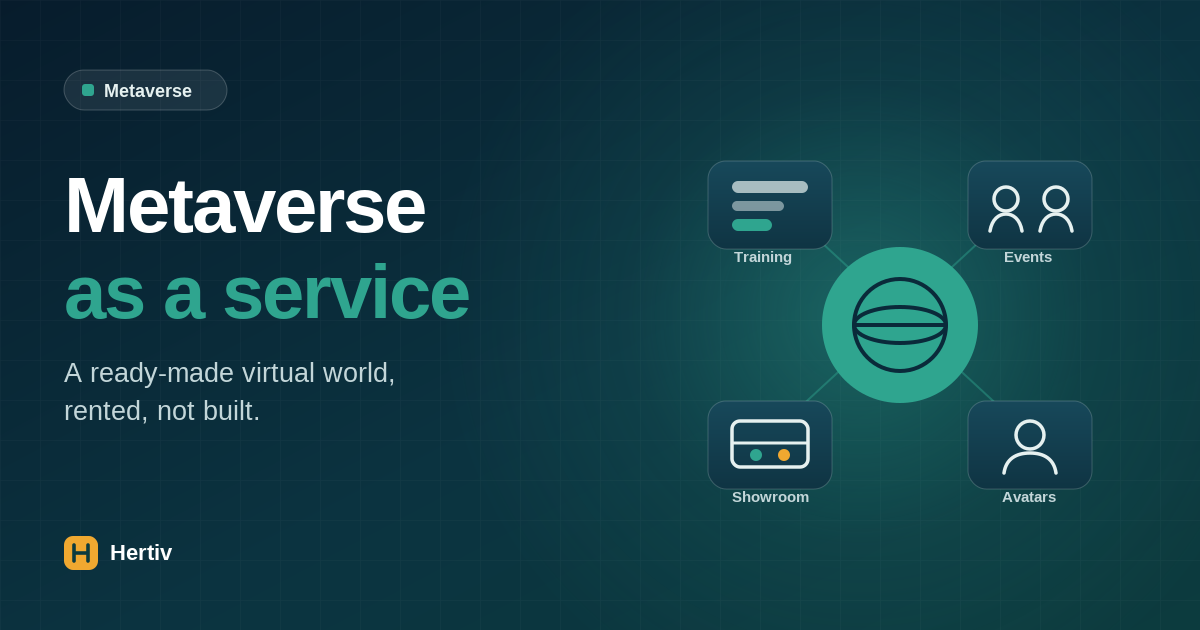
Enterprises use metaverse as a service for training, virtual events, product showrooms and remote collaboration. The common thread is a task where being in a shared space helps, but where building a custom world would cost too much for a first attempt.
Training is the most common use. A factory can train staff on a virtual production line, a retailer can rehearse store layouts, and a hospital can practise emergency drills. Staff learn by doing in a space that would be expensive or dangerous to reproduce in real life.
Virtual events are the second common use. A product launch, a conference or a job fair in a virtual venue can reach people in many countries without travel. Attendees walk between booths, talk to staff and watch demos, which is closer to a real event than a video stream.
Showrooms and collaboration fill out the list. A car maker can show a new model in a virtual showroom. A design team can review a 3D prototype together from different offices. In each case the value is the shared space, not the novelty of the graphics. For education-focused use, metaverse platforms for education shows how the same pattern works in schools.
How to choose a metaverse as a service platform
Choose a metaverse as a service platform by matching it to one use case, then checking access, branding, data and cost in that order.
- Define the use case. Training, events, showrooms and collaboration need different features. Pick one use case and judge every platform against it.
- Check how users enter. A browser-based platform reaches more people than one that needs a headset or an app install. Ask what hardware your users already have.
- Test the branding tools. The space should look like your enterprise, not like the vendor's demo. Ask for a trial space with your own logo and colours.
- Ask about data and privacy. Find out where user data is stored, who can see attendance records, and whether the platform meets your compliance rules.
- Compare the real cost. Count seats, events and support, not just the headline price. A platform that charges per event may cost more than a flat subscription for frequent use.
- Run a small pilot. Invite twenty real users to one session and watch what they do. If they struggle to join, the platform is not ready for your audience.
The pilot is the most important step. A platform that looks good in a sales demo can still fail when real users with real devices try to join. If the pilot works, expand to one department before rolling out company-wide. Building a custom world is a separate decision; metaverse development cost covers what that involves.
Example (hypothetical): a retailer trains store staff in a virtual store
Example (hypothetical): a retailer with 120 store staff wants to train them on a new store layout before the refit. It rents a MaaS platform for three months and builds a virtual copy of one store.
The training runs in four sessions of 30 staff each. Thirty times four is 120, so every member of staff attends once. Each session lasts 45 minutes: 15 minutes of guided walkthrough, 20 minutes of practice tasks in the virtual store, and 10 minutes of questions.
The platform records that 112 of the 120 staff completed all four practice tasks, which is 93% of the group. The 8 who did not finish get a second session the following week. The trainer compares this with the previous year's classroom training, which took two full days and a hired venue.
The retailer keeps the virtual store for new joiners and pays for one more quarter. The pilot worked because the use case was narrow, the staff already had laptops, and the trainer could see who had finished. A broader launch without that evidence would have been a guess.
What are the limits and risks?
The limits of metaverse as a service are dependence on the vendor, variable user experience and unclear returns. An enterprise that builds its whole training programme on one platform cannot easily move it elsewhere, because the spaces, avatars and data live in the vendor's system.
User experience varies with devices and networks. A virtual world that runs smoothly on a new laptop can stutter on an old one or on a slow connection. If a third of your audience cannot join comfortably, the format is wrong for that audience, however good the content is.
There are also privacy and moderation risks. A shared virtual space needs rules for behaviour, and the enterprise needs to know who can see attendance and conversation records. Ask the vendor how moderation works and where the data is stored before the first session.
Finally, the return is hard to measure. Attendance is easy to count, but learning and sales are harder. Set one outcome to measure before the pilot, such as training completion time or event attendance, and judge the platform on that. Without a measure, the pilot will drift into a demo.
What are the common mistakes?
The most common mistakes are choosing the platform before the use case, skipping the pilot and underestimating the content work.
- Buying the platform first. A subscription without a defined use case becomes a demo that nobody uses.
- Skipping the pilot. A sales demo does not show how real users with real devices will cope. Test with twenty real users first.
- Underestimating content. A virtual world needs spaces, scripts and training material. The platform is the venue, not the event.
- Ignoring access. If users need a headset they do not have, attendance will be low. Browser access reaches more people.
- No success measure. Without one outcome to track, nobody can say whether the pilot worked.
- Locking in too early. A long contract before the pilot results are in removes the option to switch.
Key takeaways
- Metaverse as a service rents a ready-made virtual world platform instead of building one
- The provider supplies the engine, avatars, identity, payments and analytics; the enterprise supplies content and audience
- Training, virtual events, showrooms and remote collaboration are the most common enterprise uses
- Choose by use case, browser access, branding, data rules and real cost, then run a small pilot
- Measure one outcome before the pilot, or nobody can say whether it worked
Frequently asked questions
What is the difference between metaverse as a service and a metaverse platform?
A metaverse platform is the software itself. Metaverse as a service is the hosted, subscription version of it: the vendor runs the platform and the enterprise rents access. The enterprise configures spaces and content but does not build or maintain the engine.
Do users need a VR headset for metaverse as a service?
Usually not. Most MaaS platforms run in a web browser on a laptop or phone, with an optional headset mode. Browser access reaches far more users, so check what your audience already has before choosing a platform that needs special hardware.
How much does metaverse as a service cost?
Pricing varies by seats, events and features, and there is no standard market price. Some platforms charge per user per month, others per event. Ask vendors for a written quote for your use case, and check the vendor site for current plans before budgeting.
Can we move our content to another platform later?
It depends on the vendor. Spaces, avatars and data are often stored in the vendor's own format, which makes moving difficult. Ask about export options and data ownership before signing, and keep your source content, such as 3D models and scripts, in your own files.
Is metaverse as a service only for large enterprises?
No. Small teams use it for training, virtual events and showrooms too, because the subscription replaces a large engineering investment. The key is a narrow use case with a clear audience, not the size of the company.
What should we measure in a MaaS pilot?
Pick one outcome tied to the use case, such as training completion time, event attendance or time to first sale in a virtual showroom. Track it on the pilot group and compare it with the previous method. Attendance alone is not enough to prove value.


