What Is a Layer 3 Blockchain, and What Is It For?
A layer 3 blockchain is an application-specific chain that settles on a layer 2. Here is how the layers stack, what layer 3s are used for, and where they fall short.
On this page
Short answer
A layer 3 blockchain is a chain built on top of a layer 2 and tuned for one application, or a small group of applications, such as a game or a trading app. It settles its transactions on the layer 2 below it, which in turn settles on the layer 1, so it inherits security from the layers below while keeping its own rules, fees and speed.
What is a layer 3 blockchain?
A layer 3 blockchain is a chain that sits on top of a layer 2 and is built for one application, or a small group of related applications, rather than for general use.
A game, a trading app or a social app can run on its own layer 3, with its own fee rules, its own block time and its own features, while the layer 2 below it handles settlement and the layer 1 below that provides the base security.
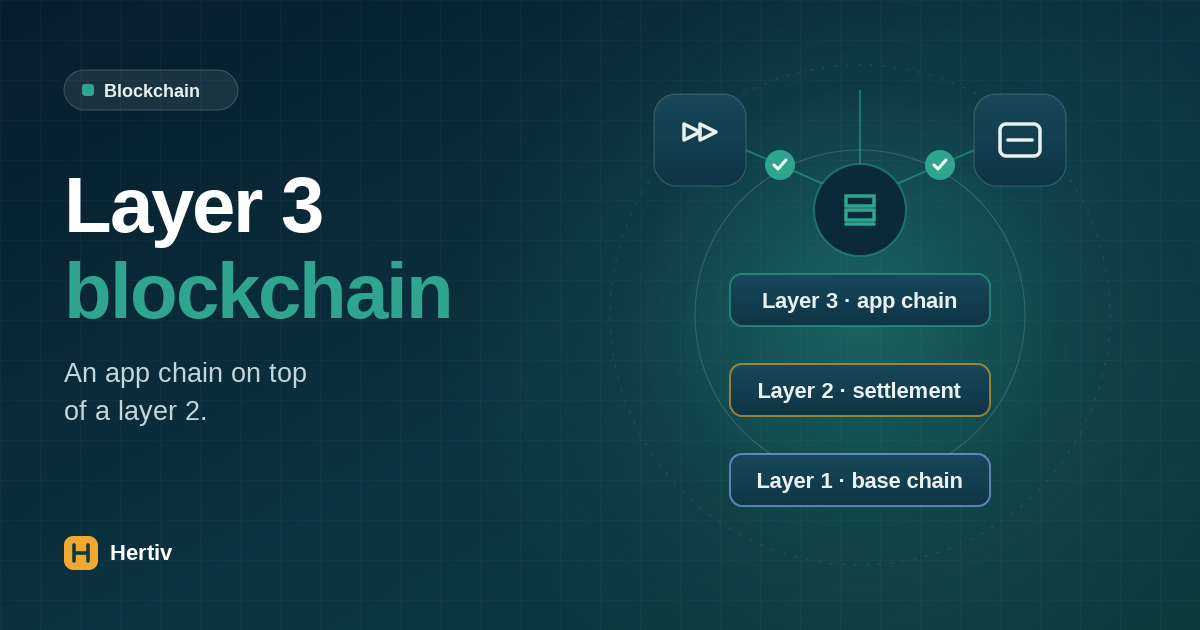
The idea is a stack. The layer 1 is the base chain where final settlement happens. The layer 2 scales the layer 1 by handling most transactions off the base chain and posting proofs back to it. The layer 3 then scales the layer 2 the same way, handling the application's own transactions and posting proofs to the layer 2.
Each layer in the stack gives up some generality to gain speed or control. A layer 1 must serve everyone, a layer 2 serves many apps, and a layer 3 serves one app well. That trade is the point: an app that needs thousands of cheap transactions a day does not need the full generality of a base chain.
How does a layer 3 work?
A layer 3 works by running its own chain for the application and periodically proving what happened to the layer below. Users transact on the layer 3, where fees are low and blocks are fast, and the layer 3 batches those transactions into a proof that is posted to the layer 2.
The proof is what connects the layers. Depending on the design, it can be a fraud proof, where anyone can challenge a wrong batch, or a validity proof, where cryptography shows the batch is correct. Either way, the layer 2 holds the record, and the layer 1 holds the record of the layer 2, so the chain of trust runs all the way down.
Moving assets between layers uses a bridge. A user locks tokens on the layer 2 and receives the same amount on the layer 3, and the reverse releases them.
The bridge is the part that needs the most care, because a bridge bug can strand assets even when the chains themselves work fine. Teams building on this stack usually start with Ethereum development patterns for bridging and settlement, since most layer 2s and 3s today settle on Ethereum.
What are layer 3 blockchains used for?
Layer 3s are used where one application generates far more transactions than a shared chain can handle cheaply, or where the application needs rules a shared chain cannot offer. Games are the clearest case: a game can produce thousands of small actions a day per player, and those actions are worthless if each one costs a noticeable fee.
Other common uses are trading apps that need fast matching, social apps that need cheap posts and tips, and app chains for a single company that wants its own fee token or its own privacy rules. In each case the application gets a chain tuned to its own traffic instead of competing with every other app for space.
The table below summarises how the layers differ in practice.
| Layer | What it is for | Who shares it | Typical fee |
|---|---|---|---|
| Layer 1 | Base settlement and security | Every app on the chain | Highest |
| Layer 2 | Scaling many apps at once | Many apps | Low |
| Layer 3 | One application, tuned to it | One app or a small group | Lowest |
The fee column is a general pattern, not a promise. Fees depend on traffic, design and how the chain is run, and a badly run layer 3 can cost more than a well run layer 2.
Layer 3 vs layer 2: what actually changes?
The main change from layer 2 to layer 3 is who the chain serves. A layer 2 is shared infrastructure: many applications use it, and its rules have to suit all of them. A layer 3 is dedicated infrastructure: it serves one application, so its rules can be written for that application's exact needs.
That dedication brings three practical differences. First, fees can be set per application, including near-zero fees for actions the app wants to encourage. Second, the chain can add features a shared chain would not, such as a custom fee token, a built-in privacy mode, or a block time tuned to the app's pace. Third, upgrades can happen on the application's schedule rather than waiting for a shared network to agree.
The cost of that dedication is isolation. Assets and users on one layer 3 do not automatically reach another, so every connection needs a bridge, and bridges add risk and delay.
A team choosing between the two should ask whether its application really needs its own chain, or whether a layer 2 already gives it the speed and cost it needs. The layer 2 question is worth answering first, because most apps never outgrow a layer 2.
Example (hypothetical): a game moves to its own layer 3
Example (hypothetical): a Web3 game has 10,000 daily players, and each player makes about 20 small in-game actions a day, which is 200,000 transactions a day. On a layer 2 charging a planning figure of $0.05 per transaction, that is 200,000 × $0.05 = $10,000 a day in fees, which the game cannot pass on to players for actions worth a fraction of a cent.
On its own layer 3, the game sets a fee of $0.001 per action. The same 200,000 actions then cost 200,000 × $0.001 = $200 a day, which the game covers from its own revenue. The layer 3 batches the day's actions and posts proofs to the layer 2, so the game keeps a verifiable record without paying layer 2 fees for every action.
The trade is that players must bridge assets onto the layer 3 before they can play, and the game must run or pay for the chain's infrastructure. The team budgets for that running cost and for a bridge audit before launch, because a bridge failure would lock players out of their items.
What are the limits and risks?
The biggest limit of layer 3s is fragmentation. Every new layer 3 is a separate island, and moving assets between islands needs bridges that are slow, costly and historically the weakest part of the stack. A game that launches its own layer 3 gains cheap transactions and loses easy access to the users and liquidity on other chains.
Security is the second risk. A layer 3 inherits security from the layers below only as far as its proofs and bridges are sound. A small layer 3 with few validators or a single operator is easier to stop or censor than a large shared chain, and its users may not notice the difference until something goes wrong.
Tooling is the third limit. Wallets, explorers, indexers and developer tools are built first for large chains, and a new layer 3 often ships without them. Teams should check what tooling exists before committing, and compare the layer 3 solutions already running to see which designs have survived real traffic.
What are the common mistakes?
The most common layer 3 mistakes are launching a chain before the application needs one, underestimating bridge risk, and ignoring the running cost.
- Building a layer 3 for a small user base that a layer 2 could already serve cheaply.
- Treating the bridge as an afterthought instead of the highest-risk component.
- Setting fees to zero with no plan for who pays for the chain's infrastructure.
- Assuming security is inherited automatically without checking the proof and validator setup.
- Launching without wallets and explorers, so users cannot see or move their assets easily.
- Ignoring liquidity, so the app's token trades nowhere useful.
Key takeaways
- A layer 3 is an application-specific chain that settles on a layer 2, which settles on a layer 1
- Games and single-app chains gain cheap, fast transactions and custom rules from a layer 3
- The trade is isolation: assets and users need bridges to reach other chains
- Security depends on the proofs and the bridge, not just on the layers below
- Most apps should prove themselves on a layer 2 before building a layer 3
Frequently asked questions
What is a layer 3 blockchain in simple terms?
It is a chain built on top of a layer 2 for one application, such as a game or a trading app. It runs that application's transactions cheaply and quickly, then posts proofs of what happened to the layer 2 below it, which in turn settles on the layer 1.
Is a layer 3 more secure than a layer 2?
Not automatically. A layer 3 inherits security from the layers below only as far as its proofs, bridges and validators are sound. A small layer 3 with one operator can be easier to stop or censor than a large shared layer 2.
Why would a game need its own layer 3?
Games produce huge numbers of tiny transactions, such as item moves and actions, that are worth almost nothing each. A dedicated layer 3 can price those actions near zero and tune block times to the game, which a shared chain cannot do for one app.
Do I need a bridge to use a layer 3?
Yes, to move assets in and out. You lock tokens on the layer below and receive the same amount on the layer 3, and the reverse releases them. The bridge is the part that needs the most care, since a bridge bug can strand assets.
What is the difference between a layer 3 and an app chain?
They overlap. An app chain is a chain dedicated to one application, and a layer 3 is one way to build an app chain, by settling on a layer 2. Some app chains settle directly on a layer 1 instead, which is a different design with different trade-offs.
Will every app end up on its own layer 3?
Probably not. Most applications never generate enough transactions to justify the cost and isolation of their own chain. Layer 3s make sense for high-volume, single-purpose apps; most apps are better served by a shared layer 2.


