Are Layer 2 Solutions the Key to Scaling Blockchains?
Layer 2 solutions cut the cost and raise the speed of transactions, but they are only part of the answer to scaling. Here is what they fix and what they cannot.
On this page
Short answer
Layer 2 solutions are the key to cheaper, faster blockchain transactions, but not the key to every scaling problem. They move the bulk of the work off the main chain, so fees fall and throughput rises. They cannot fix data availability, fragmented liquidity or the risk in bridges. Judge them on the whole flow, including how users move funds in and out.
What do people mean by layer 2 solutions?
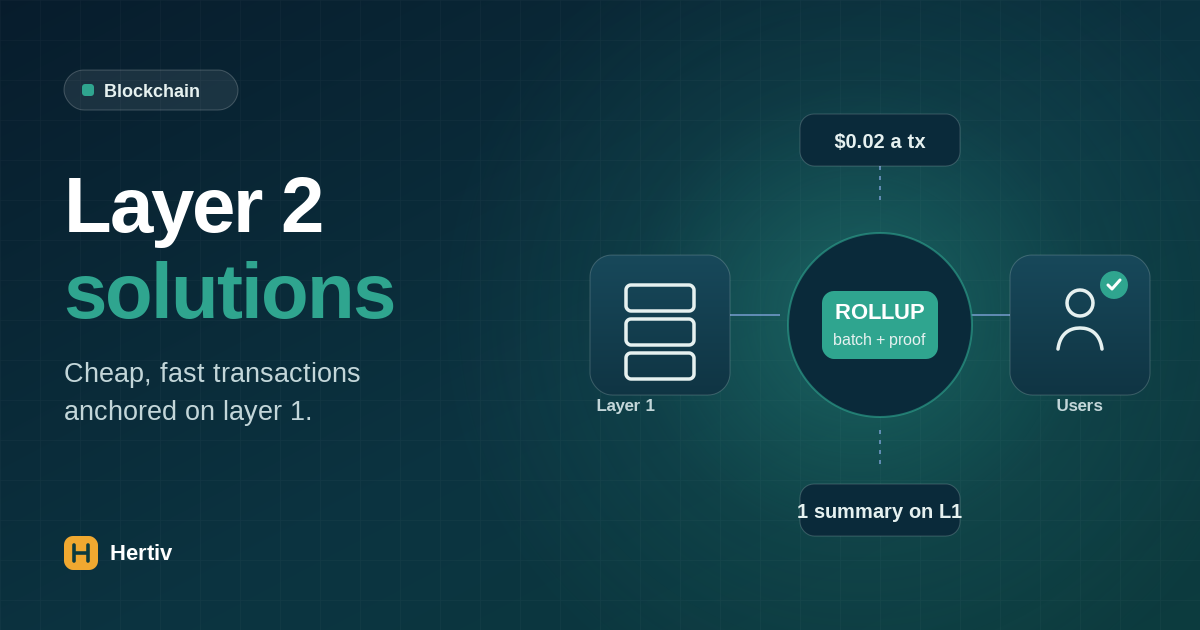
A layer 2 solution is a system that runs transactions off a main blockchain and then posts a summary back to it, so the main chain carries less work. The main chain, called layer 1, stays in charge of security and final settlement, while the layer 2 handles the bulk of the activity. The idea is simple: do the heavy work somewhere cheap, and anchor the result somewhere secure.
The best-known layer 2 systems are rollups, which bundle many transactions into one batch and post a proof to the main chain. Others include payment channels, which let two parties trade back and forth off-chain and settle once, and validiums, which keep transaction data off the main chain to cut costs further.
The word 'key' in the question matters. People usually ask whether layer 2 systems are the answer to slow, costly blockchains. They help a great deal with speed and fees, but they are one part of scaling, not the whole of it.
What problem are layer 2 solutions trying to solve?
A main chain can only process so many transactions per block. When demand passes that limit, fees rise and waits grow, and small transactions stop making sense. A layer 2 moves the bulk of the work off the chain so the main chain only has to check a summary.
| Type | How it works | Best for |
|---|---|---|
| Optimistic rollup | Bundles transactions and assumes they are valid unless challenged | General apps and lower cost |
| ZK rollup | Bundles transactions with a proof that they are valid | Apps that need fast finality |
| Payment channel | Two parties trade off-chain and settle once | Repeated payments between the same parties |
| Validium | Keeps data off-chain and posts proofs on-chain | High-volume apps that accept the trade-off |
The gain is real: a rollup can cut the cost of a transaction from dollars to cents and raise throughput far above what the main chain manages alone. That is why most new apps that need many small transactions start on a layer 2 rather than on the main chain. Our guide to what a layer 2 is sets out the basics before the trade-offs.
Do layer 2 solutions actually fix scaling?
For raw throughput, yes. A rollup that batches thousands of transactions into one main-chain record removes the main chain as the bottleneck for everyday activity. Fees fall because the cost of one main-chain record is shared across the whole batch.
But scaling is more than throughput. A chain also needs data to stay available, users to move between layers without friction, and apps to talk to each other. Layer 2 systems improve the first part and add work to the other two, since every new layer is another place a user must bridge to and from.
The honest answer is that layer 2 systems are the key to cheaper, faster transactions, but not the key to every scaling problem. They solve the cost of doing many transactions. They do not solve data availability, fragmented liquidity, or the risk in bridges.
What can layer 2 solutions not fix?
A layer 2 cannot make the main chain hold more data. Every rollup still posts its batches to layer 1, and if that data grows faster than the main chain can carry it, costs rise again. That is why data availability layers have become part of the scaling conversation.
Bridges are the other weak point. Moving assets between layers needs a bridge, and bridges have been the target of some of the largest thefts in crypto. A project that relies on a layer 2 inherits the risk of the bridge its users must cross.
- Fragmented liquidity: money spread across many layers is harder to use than money on one chain.
- Finality waits: some rollups take days before a withdrawal is final.
- Centralised sequencers: many rollups still rely on one operator to order transactions.
None of this makes layer 2 systems a bad choice. It means the choice should weigh these limits alongside the fee saving, and a project should plan for them from the start. The comparison in our layer 1 versus layer 2 article shows where the main chain still matters.
When is a layer 2 the right answer for your project?
A layer 2 is the right answer when the project does many small transactions and the main chain's fees would eat the margins. Games, social apps, micropayments and high-volume trading all fit that shape.
- Count the transactions: how many a day, and what each one is worth.
- Price the same load on the main chain and on two layer 2 options.
- Check how users will move funds in and out, and what the wait is.
- Check who orders transactions and what happens if that operator stops.
- Run a pilot with real users before moving the whole app.
Our comparison of top layer 2 blockchains shows how the main options differ on fees, finality and tooling, and it is a good place to start the shortlist.
Example (hypothetical): a payments app weighs layer 2
Example (hypothetical): a payments app expects 10,000 small payments a day at $1.50 each on the main chain. That is $15,000 a day in fees, which is more than the payments are worth. On a layer 2 charging $0.02 per payment, the same load costs $200 a day, saving $14,800 a day.
The catch is the withdrawal wait. On an optimistic rollup, moving funds back to the main chain can take seven days, so the app keeps a float on the main chain to pay out users who leave early. With 500 users leaving a day at $20 each, the float must cover $10,000 a day. The layer 2 still wins on cost, but only because the app planned for the float.
The lesson is to price the whole flow, including the way out. Fees on the way in are only half the cost of a layer 2.
What are the common mistakes?
The mistakes below come from treating layer 2 as a simple switch rather than a new system with its own limits.
- Treating every layer 2 as the same: rollups, channels and validiums solve different problems.
- Ignoring the bridge risk when users move funds between layers.
- Forgetting the withdrawal wait when planning cash flow.
- Assuming fees stay low when the layer gets busy.
- Building on a layer 2 with one sequencer and no plan if it stops.
Key takeaways
- A layer 2 runs transactions off the main chain and posts a summary back to it.
- Rollups cut fees and raise throughput, but they do not fix data availability or bridge risk.
- The right layer 2 depends on the project's transaction count, value and exit needs.
- Price the whole flow, including withdrawals and the float they need.
- Run a pilot with real users before moving the whole app.
Frequently asked questions
What is a layer 2 solution?
A layer 2 solution is a system that runs transactions off a main blockchain and posts a summary back to it. The main chain keeps security and final settlement, while the layer 2 handles the bulk of the activity.
Are layer 2 solutions the key to blockchain scaling?
They are the key to cheaper, faster transactions, but only part of the answer to scaling. They do not fix data availability, fragmented liquidity or bridge risk, which are separate problems that need their own answers.
What is the difference between an optimistic rollup and a ZK rollup?
An optimistic rollup assumes transactions are valid unless someone challenges them, which can mean a long wait before a withdrawal is final. A ZK rollup posts a proof that the transactions are valid, so finality comes faster.
Do layer 2 solutions make the main chain unnecessary?
No. The main chain still provides security and final settlement, and every layer 2 depends on it. A layer 2 without a secure main chain behind it has nothing to anchor its results to.
What is the biggest risk of using a layer 2?
The bridge that moves assets between layers carries the most risk, and it has been the target of some of the largest thefts in crypto. Withdrawal waits and centralised sequencers are the other risks to plan for.
How do I choose a layer 2 for my project?
Count the daily transactions and their value, price the same load on the main chain and on two layer 2 options, check the withdrawal wait and who orders transactions, then run a pilot with real users.


