Layer 1 vs Layer 2: How They Differ and When to Use Each
Layer 1 is the base chain; layer 2 does the work off-chain and posts a proof back. Learn how each works, when to build on which, and the mistakes to avoid.
On this page
Short answer
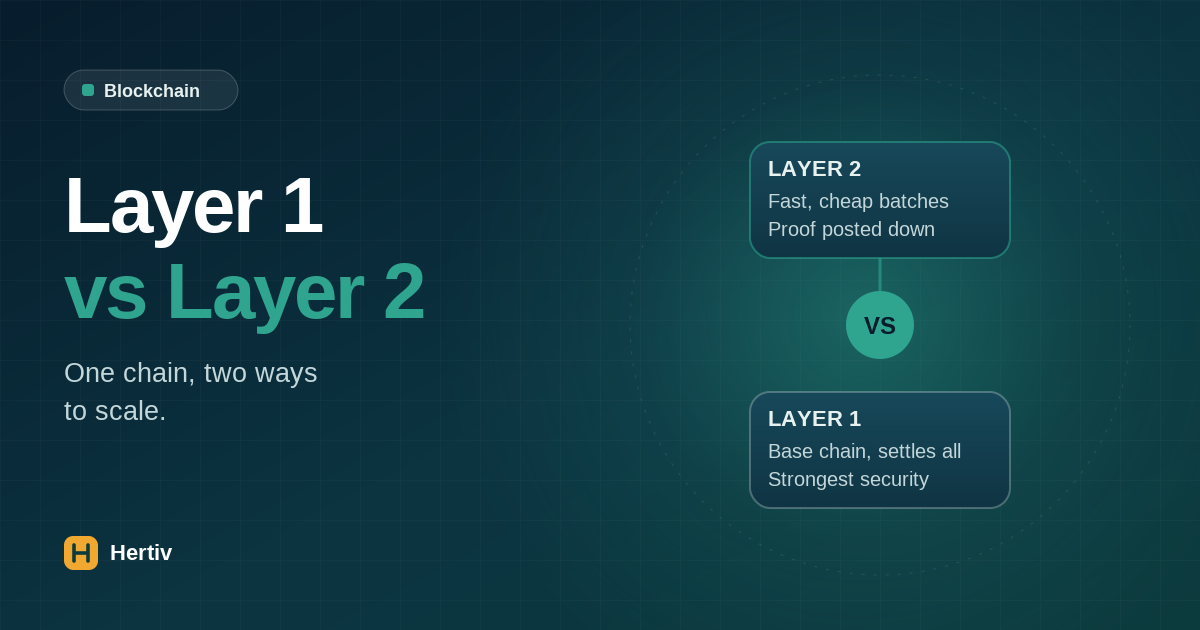
Layer 1 is the base blockchain that runs consensus and settles transactions, while layer 2 is a system built on top of it that processes transactions off the main chain and posts a compact proof back. Layer 1 gives the strongest security, layer 2 gives speed and lower fees, and most products end up using both.
What is layer 1, and what is layer 2?
Layer 1 is the base blockchain itself, such as Ethereum or Bitcoin: it runs the consensus, stores the ledger and settles transactions. Layer 2 is a system built on top of a layer 1 that does most of the work off the main chain and then posts a compact proof back to it, so the base chain stays secure while the second layer handles the volume.
The difference is where the work happens. On layer 1, every node checks every transaction, which keeps the network decentralised but slow and costly when demand is high. On layer 2, transactions are processed elsewhere and only the result is checked by the base chain, which is faster and cheaper for the user.
| Layer 1 | Layer 2 | |
|---|---|---|
| What it is | The base chain | A system on top of the base chain |
| Examples | Ethereum, Bitcoin, Solana | Arbitrum, Optimism, Polygon, Base |
| Speed | Slower, every node checks | Faster, work done off-chain |
| Fees | Higher when busy | Lower, costs shared across many users |
| Security | Comes from the chain itself | Borrowed from the layer 1 below it |
Neither layer replaces the other. Layer 2 needs layer 1 for security and final settlement, and layer 1 needs layer 2 to serve more users than it can handle alone. For a plain explainer of the second layer, see what layer 2 is.
How does a layer 1 chain work?
A layer 1 chain works by getting many independent computers, called nodes, to agree on one shared record of who owns what. When a user sends a transaction, the nodes check the signature and the balance, agree on the order of transactions, and add a new block to the chain.
Agreement is the hard part. Proof-of-stake chains pick a validator to propose each block, and other validators check it; if a validator cheats, it loses some of its staked funds. That shared punishment is what keeps the record honest without a central operator.
The trade-off is throughput. Because every node checks every transaction, the chain can only process a limited number per second. When demand rises above that limit, users bid higher fees to get in, which is why a simple transfer can cost a few cents one day and several dollars the next.
Layer 1 chains also handle their own upgrades. Changing the rules needs the agreement of the people who run the nodes, which is slow but deliberate. That slowness is a feature: the base layer is the one place where a mistake cannot be rolled back easily.
How does a layer 2 chain work?
A layer 2 chain works by moving transactions off the base chain, processing them in batches, and posting a short proof back to layer 1. Users get fast, cheap transactions, and the base chain only has to check the proof, not every single transaction.
Rollups are the most common kind. An optimistic rollup assumes transactions are valid and lets anyone challenge them for a week; a zero-knowledge rollup posts a cryptographic proof that the batch is correct, so there is no waiting period. Both kinds settle on the same layer 1, so they inherit its security.
The user experience is close to a normal app. A user bridges funds from layer 1 to layer 2 once, then makes many cheap transactions there, and can bridge back when they want. The bridge step is the part that needs care, because moving funds between chains is where most layer 2 losses have happened.
Other layer 2 designs exist, such as state channels for repeated payments between two parties and sidechains that run their own consensus. They are faster in some cases, but they do not borrow layer 1 security in the same way a rollup does, so the choice depends on what you are willing to trade. Bitcoin's own second layer is covered in what Bitcoin layer 2 is.
When should you build on layer 1?
Build on layer 1 when security and simplicity matter more than cost or speed. A high-value contract, a token that many other contracts depend on, or a system that must work for decades belongs on the base chain, where the rules change slowly and the security is the strongest available.
Layer 1 is also the right choice when your users are few and your transactions are rare. If an app handles a handful of large transactions a day, the base chain fee is a small cost, and the extra step of bridging to layer 2 adds risk for no real gain.
There is a third case: when you need other contracts to find you easily. The base chain is where the most liquidity, the most wallets and the most developers already are, so a new contract there is easier to discover and to connect with. A layer 2 with few users can leave a good product invisible.
The cost to watch is not only the fee. Building on layer 1 means your users pay the base fee on every action, so a product with many small actions, such as a game or a social app, can become too costly to use. That is the point where layer 2 starts to make sense.
When should you build on layer 2?
Build on layer 2 when your users make many small transactions and fees would otherwise eat the product. Games, social apps, micropayments and high-frequency trading all fit this pattern, because the per-transaction cost on layer 1 would be larger than the value of the action itself.
Layer 2 also fits when your users are already there. If the wallets, exchanges and other apps your product needs are already on a particular layer 2, building on the same one removes bridging steps and keeps the experience smooth. A fragmented choice, where your users are spread across five chains, is harder to serve than one chain with a real community.
The decision is not permanent. Many teams start on layer 1, prove the product, and move the high-volume parts to layer 2 once the fees become a problem. Others start on layer 2 and settle their most valuable contracts on layer 1. The two layers are a toolkit, not a single choice.
Before choosing, check the rollup design. Optimistic rollups have a withdrawal delay of about a week, while zero-knowledge rollups settle faster but support fewer kinds of contracts. The right answer depends on whether your users need fast withdrawals or complex logic. For the rollup types in detail, see what a ZK rollup is.
Example (hypothetical): a payments team picks a layer
Example (hypothetical): a payments team handles 5,000 transfers a day and has to choose a layer. On layer 1, each transfer costs $1.50 in fees, so the daily cost is 5,000 times $1.50, which is $7,500 a day.
On a layer 2 rollup, each transfer costs $0.02, so the daily cost is 5,000 times $0.02, which is $100 a day. The saving is $7,500 minus $100, which is $7,400 a day, or about $222,000 a month.
The team does not move everything. It keeps the settlement contract, which holds the team's reserves, on layer 1, and moves the daily transfers to layer 2. Bridging the funds once a week costs about $50, so the weekly bridging cost is small next to the daily saving.
The team also checks withdrawals. With an optimistic rollup, moving funds back to layer 1 takes about a week, so the team keeps a cash buffer on layer 1 to cover refunds during that wait. The buffer costs nothing to hold, and it removes the one delay that could have caused a support problem.
What are the common mistakes?
The most common layer 1 vs layer 2 mistakes are picking a layer for its marketing, ignoring bridge risk, and assuming layer 2 is always cheaper. Each one is easy to avoid with a small test.
- Choosing by hype. A chain with a loud launch can have few users and little liquidity. Check real activity, not announcements.
- Ignoring the bridge. Moving funds between layers is the riskiest step. Use a well-tested bridge and move a small amount first.
- Assuming layer 2 is always cheaper. Bridging fees, withdrawal delays and fragmented liquidity can eat the saving on small volumes.
- Putting everything on one layer. Keep high-value contracts on layer 1 and high-volume activity on layer 2.
- Forgetting the user. If users have to bridge, switch networks and wait a week to withdraw, many will simply not use the product.
- Skipping the exit plan. Know how funds get back to layer 1 before you move them to layer 2, not after.
Key takeaways
- Layer 1 is the base chain: consensus, ledger and settlement in one place
- Layer 2 batches work off-chain and posts a proof back to layer 1
- Rollups are the most common layer 2, in optimistic and zero-knowledge forms
- Build on layer 1 for high value and simplicity, on layer 2 for high volume
- Bridges are the riskiest step, so test with a small amount first
Frequently asked questions
Is layer 2 a separate blockchain?
Not quite. A layer 2 is a system that depends on a layer 1 for security and final settlement. It processes transactions off the main chain and posts proofs back to it, so it cannot exist on its own the way a separate chain can.
Which is more secure, layer 1 or layer 2?
Layer 1 is more secure, because its rules are checked by every node on the base chain. A rollup borrows that security through its proofs, but the bridge that moves funds between layers adds risk, so the overall safety depends on the bridge as well as the chain.
Can I move my app from layer 1 to layer 2 later?
Yes, and many teams do. The usual path is to start on layer 1, prove the product, then move the high-volume parts to layer 2 while keeping the most valuable contracts on the base chain. The move needs a migration plan for users and funds.
Why are layer 2 fees so much lower?
Because many transactions share one batch. The cost of posting the batch to layer 1 is split across all the transactions in it, so each user pays a small share instead of a full base-chain fee. The saving grows as more people use the same rollup.
What is the withdrawal delay on layer 2?
It depends on the design. Optimistic rollups let anyone challenge a batch for about a week, so withdrawals can take that long. Zero-knowledge rollups post a proof that is checked at once, so withdrawals are faster, though they support fewer kinds of contracts.
Do I need layer 2 if my app has few users?
Probably not. If your app handles a handful of large transactions a day, the layer 1 fee is small and the extra step of bridging adds risk for no real gain. Layer 2 pays off when transaction volume is high and fees start to hurt.


