What Is Bitcoin Layer 2, and Why Does Bitcoin Need It?
A Bitcoin layer 2 is a network on top of Bitcoin that moves transactions off the main chain so they are faster and cheaper. Learn how it works and when to use it.
On this page
Short answer
A Bitcoin layer 2 is a network built on top of Bitcoin that handles transactions off the main chain and settles the result back on it. It exists because the base layer is slow and costly for small payments: a new block appears about every ten minutes. A layer 2 moves payments off the chain, so they are fast and cheap, while Bitcoin keeps the final record.
What is a Bitcoin layer 2?
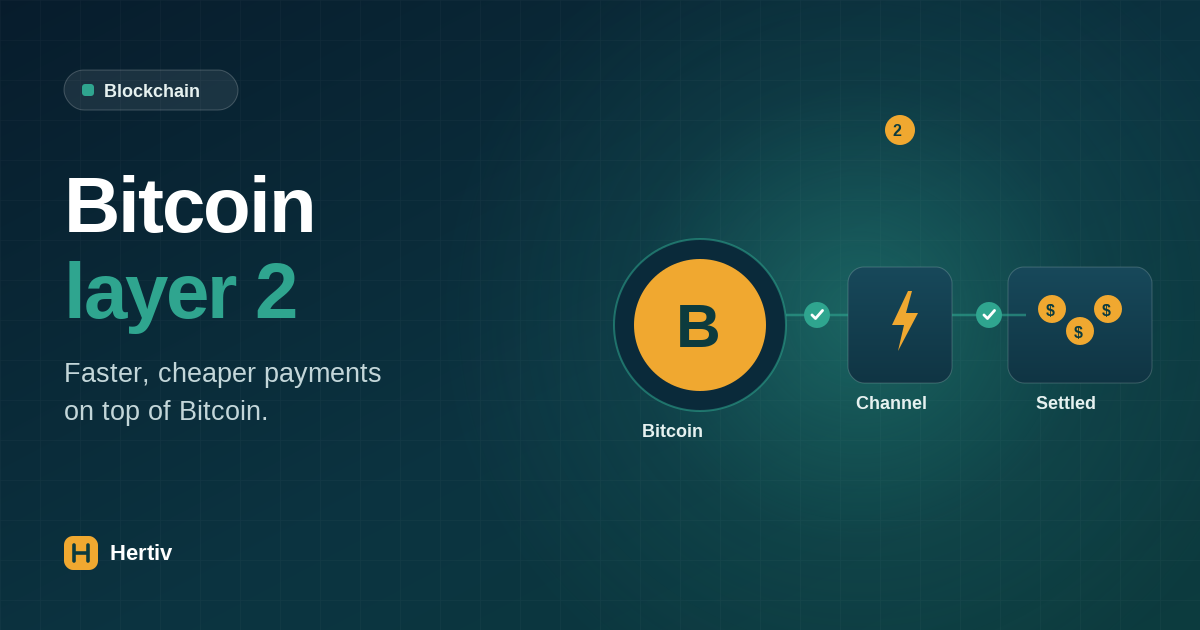
A Bitcoin layer 2 is a network built on top of Bitcoin that moves transactions off the main chain and settles the result back on it. The base layer stays the final record of who owns what, while the layer 2 handles the everyday payments that would be slow and costly on the chain itself.
Think of it like a tab at a bar. Instead of paying for every drink separately, you open a tab, order as much as you like, and settle once at the end. A layer 2 works the same way: many small payments happen off the chain, and only the opening and the final settlement are written to Bitcoin.
| Layer | Speed | Cost | Security |
|---|---|---|---|
| Bitcoin base layer | Minutes per confirmation | Higher, varies with demand | Full Bitcoin security |
| Lightning Network | Seconds | Very small | Secured by channels |
| Sidechains | Seconds to minutes | Low | Depends on the design |
The point is not to replace Bitcoin. The base layer does what it is good at, keeping a secure record that nobody can rewrite, and the layer 2 does what the base layer cannot, moving small payments quickly and cheaply.
Why does Bitcoin need a second layer?
Bitcoin needs a second layer because the base layer was designed for security, not speed. A new block appears about every ten minutes, and each block holds a limited number of transactions. When many people want to transact at once, the queue grows and fees rise, because users bid for the limited space.
That design is fine for large transfers and for settling value, but it is a poor fit for buying coffee. Nobody wants to wait ten minutes and pay a fee that costs more than the coffee. A second layer solves this by moving small, frequent payments off the chain, so the base layer is used only for opening, closing and settling.
The same pattern appears in other payment systems. Card networks do not settle every coffee purchase on the spot; they batch and settle later. A Bitcoin layer 2 applies the same idea to Bitcoin, with the difference that the settlement is written to a public chain anyone can check.
How do layer 2 networks work?
Layer 2 networks work by locking bitcoin on the base layer, moving value around off the chain, and settling the final balances back on the chain. The lock is what makes the off-chain payments trustworthy: the bitcoin cannot be spent twice, because it is held until the channel or sidechain closes.
The best-known design is the Lightning Network. Two people open a payment channel by locking some bitcoin in a shared address on the base layer. They can then send payments back and forth inside the channel as often as they like, instantly and for almost nothing. When they are done, they close the channel, and the final balance is written to Bitcoin.
Sidechains work differently. A sidechain is a separate chain that runs alongside Bitcoin and moves bitcoin onto it through a two-way peg. Stacks and Rootstock are examples: they support smart contracts and faster blocks, and they settle back to Bitcoin. The trade-off is that a sidechain has its own security model, so it is not as trustless as a Lightning channel.
Both designs share one rule: the base layer is the court of last resort. If anything goes wrong off the chain, the parties can close the channel or exit the sidechain and let Bitcoin decide the final balances.
How do you use a Bitcoin layer 2?
You use a Bitcoin layer 2 by getting a wallet that supports it, moving a small amount of bitcoin onto it, and using it for the payments that need speed. Start small, because the tools are still improving and mistakes are easier to fix with small amounts.
- Pick the layer for the job. Use Lightning for fast, small payments and a sidechain for apps and contracts.
- Choose a wallet. Pick a wallet that supports the layer you chose and that you can back up, and write down the recovery phrase.
- Move a small amount first. Send a small test amount onto the layer and confirm it arrives before moving more.
- Open a channel or bridge funds. For Lightning, open a channel with enough capacity for your payments; for a sidechain, use its bridge.
- Pay and watch the fees. Send payments and check what each one costs, so you can see whether the layer is actually cheaper for your use.
- Close and settle when done. Close channels you no longer use so the final balance is written back to Bitcoin.
A crypto wallet that supports Lightning makes this much easier, because channel management and fee choices are handled inside the wallet instead of by hand.
Example (hypothetical): paying for coffee on Lightning
Example (hypothetical): a cafe regular buys a coffee every workday for $4. Paying on the Bitcoin base layer costs about $2 in fees each time, so 20 coffees in a month cost $80 for coffee and $40 in fees, which is half as much again.
On Lightning, the regular opens one channel with a single on-chain fee of $2. Inside the channel, each coffee payment costs about $0.01. Twenty coffees then cost $80 for coffee, $2 to open the channel and $0.20 in payment fees, which is $82.20 in total instead of $120.
The saving is $120 minus $82.20, which is $37.80 a month, or about $450 a year. The numbers are invented to show the arithmetic, not a real price. The point is that a layer 2 makes small, repeated payments affordable, which is the job the base layer was never designed to do.
What are the common mistakes?
The most common mistakes with Bitcoin layer 2 are treating it like the base layer, moving too much money at once and ignoring channel capacity. Each one comes from assuming the layer works the same way as Bitcoin itself, when it does not.
- Moving too much at once. A first transfer should be small, so a mistake costs little while you learn the wallet.
- Ignoring channel capacity. A Lightning channel can only send up to the amount locked in it, and a payment larger than that will fail.
- Losing the backup. Some Lightning wallets need a backup of channel data, not just a recovery phrase, or funds can be lost.
- Expecting base-layer security. A sidechain has its own security model, so it is not the same as holding bitcoin on the base layer.
- Skipping the exit plan. Know how to close a channel or exit a sidechain before you need to, not after a problem appears.
The safest habit is to treat a layer 2 like a wallet you carry, not a vault. Keep spending money on it and savings on the base layer, and the worst case stays small.
What are the trade-offs and risks?
The trade-offs and risks of a Bitcoin layer 2 are that you give up some of the base layer's simplicity and security in exchange for speed and low cost. That trade is worth it for everyday payments, and a poor choice for savings you plan to hold for years.
Lightning channels need to be online to receive payments, and a channel with too little capacity cannot take a large payment. Sidechains add their own risks: a bridge can fail, and a sidechain's security depends on its own validators or miners, not on Bitcoin's full network.
There is also complexity. A base-layer transaction is simple to understand: it is confirmed or it is not. A layer 2 adds channels, liquidity, routing and exits, and each one is something a user must understand or trust a wallet to handle. For most users, that means choosing a well-tested wallet matters more than choosing the cleverest layer.
Teams building on these networks usually start with blockchain development help to choose the right layer.
The guide to creating a cryptocurrency explains the base-layer choices that a layer 2 builds on.
Key takeaways
- A Bitcoin layer 2 moves everyday payments off the chain and settles the result back on it
- The base layer is secure but slow, with a new block about every ten minutes
- Lightning uses payment channels for fast, cheap payments; sidechains add apps and contracts
- Start small, back up channel data, and keep savings on the base layer
- A layer 2 trades some simplicity for speed, so pick the layer that fits the job
Frequently asked questions
Is a Bitcoin layer 2 the same as another blockchain?
No. A layer 2 is built on top of Bitcoin and settles back to it, so its value comes from Bitcoin itself. Another blockchain is a separate network with its own coin and its own record. A sidechain sits between the two: it is a separate chain, but it is pegged to Bitcoin and designed to work with it.
Is the Lightning Network safe?
Lightning is safe for the small amounts it is designed for, because payments are secured by locked bitcoin and either side can close the channel and settle on Bitcoin. It is not a place for life savings: channel backups matter, and a payment can fail if a channel has too little capacity.
Do I need a layer 2 to use Bitcoin?
No. You can use Bitcoin on the base layer for large transfers and long-term holding, where the fee and the wait are acceptable. A layer 2 is useful when you make many small payments and the base-layer fee or wait would make them impractical.
What is the difference between Lightning and a sidechain?
Lightning is a network of payment channels designed for fast, small payments, with settlement back to Bitcoin. A sidechain is a separate chain pegged to Bitcoin that can run smart contracts and faster blocks. Lightning is better for payments; sidechains are better for apps that need more than payments.
Can I lose bitcoin on a layer 2?
Yes, if you lose channel backup data, send to a bad address, or use a sidechain bridge that fails. The amounts are usually small when users follow the basic rules: start with a test amount, back up the wallet properly, and keep savings on the base layer rather than on a layer 2.
Will Bitcoin ever be fast without a layer 2?
Probably not by design. Bitcoin's slow blocks and limited space are part of what makes it secure and hard to change. The community has chosen to keep the base layer simple and secure, and to build speed on top of it with layer 2 networks instead of changing the base layer itself.


