Large Multimodal Models: What They Are and How They Work
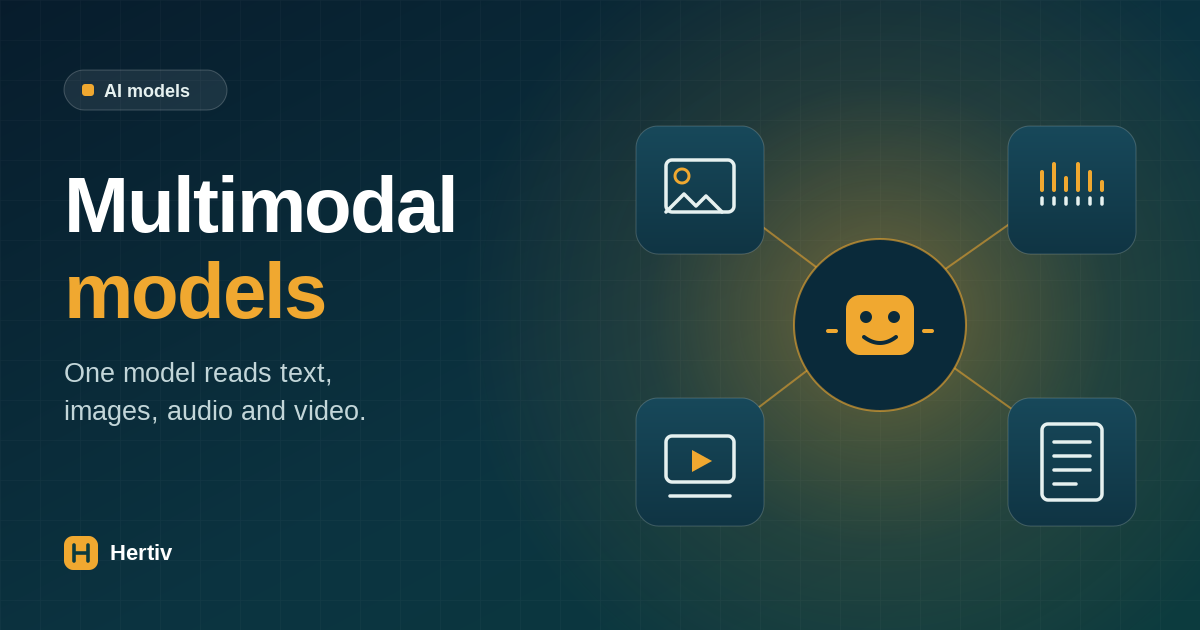
A large multimodal model is trained on text, images, audio and video together, so one model can read a photo, hear speech and answer in text.
On this page
Short answer
A large multimodal model is a foundation model trained on text, images, audio and video at the same time, so it can take a photo, a recording or a document as input and answer in text, speech or images. It pairs a large language model with encoders that turn each input type into tokens the model can reason over. The leading examples are GPT-4o, Gemini and Claude with vision.
What is a large multimodal model?
A large multimodal model is a foundation model trained on more than one kind of input at the same time, usually text, images, audio and video, so a single model can read a photo, listen to a recording and answer in text. The word large refers to scale: these models train on vast amounts of data and learn patterns across modalities, rather than serving one narrow task.
Earlier systems stitched separate models together: a vision model described an image in words, and a language model answered from that. A large multimodal model keeps the modalities together inside one model, so image, audio and text inform each other directly instead of passing through a text summary that loses detail.
| Model type | Inputs | Outputs | How it works |
|---|---|---|---|
| Text-only language model | Text | Text | Trained on text alone |
| Vision-language model | Text and images | Text | Vision encoder feeds a language model |
| Native multimodal model | Text, image, audio, video | Text, image, audio | One model trained on all modalities together |
| Any-to-any model | Any modality | Any modality | Single model that can take and produce any input type |
The best-known examples show the two main designs. GPT-4o, released by OpenAI in May 2024, was the company's first natively multimodal model, handling text, audio, images and video in one model. Google's Gemini family was natively multimodal from the start, first released in December 2023. Anthropic's Claude reads images alongside text and is widely used for documents. See our guide to what multimodal AI is for the general background.
How are large multimodal models built?
A large multimodal model is built by teaching a large language model to understand inputs that are not text. The usual design has three parts: an encoder for each input type, a connector that translates the encoder's output into the language model's token space, and the language model itself, which reasons over the combined tokens.
For images, the encoder is often a vision model trained to match pictures with captions, which turns a photo into a set of visual tokens. For audio, a speech encoder turns sound into tokens that capture words, tone and timing.
The connector is a small network that lines these tokens up with the language model's vocabulary, so the model can treat a picture of a chart and a paragraph about it as parts of the same conversation.
Training usually happens in stages. First the model learns each modality on its own, often from image-caption pairs and transcribed speech. Then it is trained on mixed data, such as documents with text, tables and images, so it learns how the modalities relate. Finally it is tuned with instructions and human feedback, so it follows requests and refuses where it should.
Native models are trained on interleaved modalities from the start, rather than having a vision encoder bolted onto a finished language model. The native design tends to reason better across modalities, while the adapter design is cheaper to build and easier to run on your own hardware.
What can large multimodal models do?
Large multimodal models can answer questions about images, read documents, summarise recordings and compare what they see with what they are told. The common thread is that they take more than one kind of evidence and reason across it, rather than handling each input in isolation.
Reading documents is the most reliable capability today. A model can take a photo of an invoice, a contract page or a whiteboard, extract the text and figures, and answer questions about them, including questions that need a calculation from a table. This works best when the document is clear and the question is specific; handwriting and dense layouts still cause errors.
Images and video are the next tier. A model can describe what is in a photo, spot a defect in a product image, compare two versions of a design, or summarise a short video from its frames and audio. Audio adds another channel: the model can transcribe a call, note the tone of a speaker, and pick out the parts that matter for a decision.
Generation is the newest capability. Some large multimodal models can produce images or speech as well as text, which lets one model draft a diagram from a description or read an answer aloud. These outputs still need a human check, because a generated image or spoken answer can look confident while being wrong.
Where do teams use them today?
Teams use large multimodal models where the work already arrives in more than one form. Support is the clearest case: customers send a photo of a broken product with a short message, and the model reads both together to work out what is wrong and what to ask next. Without the photo, the agent would need several rounds of questions to get the same information.
Document work is the second big area. Finance, legal and operations teams feed the model invoices, contracts, forms and scanned letters, and ask it to pull out fields, flag missing clauses or compare a document against a template. The model does the reading; a person checks the result before it is filed or sent.
Field and frontline work is a third area. Technicians photograph equipment and ask the model what the fault might be; retail staff check shelf photos against a planogram; warehouse teams file damage claims with a photo and a short note. In each case the photo carries information that would be slow to type out.
Accessibility is a quieter use that matters a lot to the people who rely on it. A model can describe a scene, read a sign or summarise a video for someone who cannot see or hear it, and the quality of that description is now good enough to be genuinely useful, though it should never be the only source for safety-critical information.
The range of uses is mapped in our guide to multimodal AI applications.
How do you evaluate a large multimodal model?
You evaluate a large multimodal model the same way you evaluate any model: on your own data, with a fixed test set, and against the tasks your product actually has to do. Public benchmarks are a starting point, not a verdict, because a model that scores well on general image questions can still fail on your invoices or your product photos.
Public benchmarks exist for this class of model. MMMU tests college-level questions that mix text and images, while others cover chart reading, document understanding and maths from photos. These are useful for shortlisting, but the scores come from test sets that may overlap with training data, so they say little about your documents.
A better test is a set of your own cases. Gather fifty to a hundred real examples from your work: photos, documents, recordings and the questions your team asks, each with a known good answer. Run each candidate model over the same set and score the answers the same way, so the comparison is fair.
Score more than accuracy. Check whether the model invents details that are not in the image, whether it says it does not know when the input is unclear, and how often it needs a second try.
Also measure cost and speed: a model that reads a hundred photos a minute is a different product from one that reads ten. Our guide to LLM model evaluation covers how to build and run this kind of test set.
Example (hypothetical): a support team triages photos and text
Example (hypothetical): a support team for a home-appliance company receives 200 tickets a day, and 120 include a photo of the faulty product. Before the model, an agent read each ticket and photo, taking about 6 minutes per ticket: 200 tickets times 6 minutes is 1,200 minutes, about 20 hours of agent time a day.
The team adds a large multimodal model as a first step. The model reads the photo and the message, and drafts a first answer or a routing suggestion. For 140 of the 200 tickets, the draft is good enough that an agent needs only 2 minutes to check and send it: 140 times 2 minutes is 280 minutes. The other 60 tickets still need a full 6 minutes each, which is 360 minutes.
Total agent time falls to 640 minutes, about 10 hours and 40 minutes a day, roughly half the previous 20. The saving comes from the 140 tickets the model handles well, not from removing the agent: every draft is still checked before it goes out, and the 60 hard tickets still get full human attention.
The team also tracks mistakes. In the first month the model misreads 8 of the 120 photos, usually because the photo is dark or blurred, and in those cases the agent corrects the draft and the ticket takes the full 6 minutes. The team adds a rule: if a photo is too dark to read, the model asks for a better one instead of guessing.
What are the common mistakes?
The most common mistakes with large multimodal models come from trusting what the model sees more than what it actually knows.
- Trusting vision output without a check. A model can describe a photo confidently and still get a number, a label or a detail wrong. Every output that affects a customer or a payment needs a human or a rule-based check.
- No grounding in your own data. A model that answers from its training data will invent product names, prices and procedures. Give it your catalogue, your manuals and your policies to read from.
- Testing on public benchmarks only. A high benchmark score does not predict performance on your documents. Build a test set from your own cases before choosing a model.
- Ignoring cost and speed. Multimodal calls cost more and take longer than text calls, especially for video. A design that sends every photo at full resolution will be slow and expensive.
- Forgetting the failure path. Blurry photos, missing audio and unclear documents are normal. The product should ask for better input or hand off to a person, not guess.
- Treating the model as a replacement for records. A model's answer is not a record. Keep the original photo, document or recording, and log what the model said about it.
Key takeaways
- A large multimodal model is one foundation model trained on text, images, audio and video
- A vision or audio encoder turns each input into tokens the language model can reason over
- Document reading and support triage are the most reliable uses today
- Evaluate on your own cases, not on public benchmark scores alone
- Every output that affects a customer still needs a human or rule-based check
Frequently asked questions
What is the difference between a large multimodal model and a vision-language model?
A vision-language model handles text and images, usually by adding a vision encoder to a language model. A large multimodal model is a broader class: it is trained on text, images, audio and video together, often natively, so one model can take any of those inputs and answer in text, speech or images.
Which large multimodal models are widely used?
The best-known are OpenAI's GPT-4o, released in May 2024 as the company's first natively multimodal model, Google's Gemini family, which was designed as natively multimodal from the start, and Anthropic's Claude, which reads images alongside text. Open models such as LLaVA pair a vision encoder with a language model.
Can a large multimodal model generate images and audio?
Some can. The newest models can produce images or speech as well as text, which lets one model draft a diagram from a description or read an answer aloud. Generation is less reliable than understanding, so generated output should always be checked by a person before it is used.
How much do large multimodal models cost to run?
They cost more than text-only models, because each image, audio clip or video frame adds tokens to process. The exact cost depends on the provider, the model and the size of the inputs. Sending smaller images and shorter clips is the simplest way to keep the bill down, and vendors list their prices on their own pricing pages.
Do large multimodal models hallucinate more than text models?
They can invent details that are not in the image, such as reading a number that is not there or describing an object that is absent. Grounding the model in your own documents and checking its output against the source image or recording reduces this, but it does not remove it entirely.
Can I run a large multimodal model on my own hardware?
Open models such as LLaVA can be run locally, but the large ones need powerful graphics hardware and a lot of memory. Most teams start with a hosted model through an API and only move to self-hosting when they have a clear reason, such as data rules or steady high volume.


