LLM Model Evaluation: How to Compare Models Fairly
LLM model evaluation compares models on the same fixed tests, so you can pick the one that performs best on your task instead of trusting a vendor benchmark.
On this page
Short answer
LLM model evaluation is the process of testing language models on the same fixed tasks and scoring the answers, so you can compare models fairly before choosing one. It uses benchmarks for capability and your own test set for your task, with metrics such as accuracy, exact match and human preference, plus cost and speed. A leaderboard leader can still lose on your data, so your own tests matter most.
What is LLM model evaluation?
LLM model evaluation is the process of measuring how well a language model performs on fixed tests, so models can be compared on the same ground. Each model answers the same questions, under the same conditions, and the scores show which one is better at each kind of task.
It answers a different question from testing your own application. Application evaluation asks whether your finished product gives good answers to your users. Model evaluation asks which model to build with in the first place, before you write the app. Both matter, and model evaluation comes first.
A good evaluation has three parts: a set of tasks, a way to score the answers, and a record of the conditions, including the prompt, the model version and the settings used. Without fixed conditions, the scores are not comparable, and a model can look better simply because it was tested with a kinder prompt.
The point is not to find the best model in general. There is no such model: one leads on code, another on long documents, another on cost. The point is to find the best model for your task, at a price and speed you can afford.
What do public benchmarks actually test?
Public benchmarks test a model on a fixed set of questions, so anyone can run the same test and compare scores. They are useful for a first shortlist, but each one tests a narrow slice of ability, and a high score on one says little about the others.
| Benchmark | What it tests | What it does not test |
|---|---|---|
| MMLU | Knowledge across school and professional subjects | Your documents or your task |
| HumanEval | Writing short programs from descriptions | Large codebases or debugging |
| GSM8K | Multi-step maths word problems | Real business calculations |
| HELM | Many tasks with accuracy, fairness and robustness | Cost or speed in your setup |
| Chatbot Arena | Human preference in open chat | Accuracy on factual work |
Use benchmarks to narrow the field from ten models to three, then run your own tests on those three. A model that leads a benchmark can still fail your task if the benchmark's questions look nothing like your users' questions. Treat the leaderboard as a starting point, not a verdict.
Which metrics matter for your task?
Which metrics matter depends on what the model has to do. A support bot needs correct answers; a summariser needs faithful summaries; a code assistant needs code that runs. Pick the metric that matches the job, and ignore the rest.
For tasks with one right answer, use accuracy or exact match: the share of answers that are correct, or that match the expected answer word for word. For summaries and translations, use overlap measures such as ROUGE or BLEU, which compare the model's words with a reference answer, though they miss good answers phrased differently.
For open-ended work, human preference is the honest metric: show two answers to a reviewer and ask which is better, without saying which model wrote which. It is slow and costs more, but it catches quality that automatic scores miss.
Always measure cost and speed alongside quality. A model that scores two points higher but costs five times as much may not be worth it, and a model that takes thirty seconds per answer will lose users even if its answers are good. Record tokens per request and time per request for every model you test.
How do you run your own model evaluation?
You run your own model evaluation by building a small test set from your real work, running each candidate model on it under identical conditions, and scoring the answers the same way for all of them.
- Collect real examples. Take 50 to 100 real inputs from your work, with the correct answer or the facts a good answer must contain, for each one.
- Fix the prompt. Use the same prompt and the same settings for every model, so the test measures the model, not the prompt.
- Run each model. Send the same test set to each candidate, and record the answers, the tokens used and the time taken.
- Score blind. Score the answers without knowing which model wrote which, using automatic checks where you can and human review for judgement calls.
- Compare on quality and cost. Rank the models by score, then check the cost and speed of the top ones before choosing.
Keep the test set fixed once you start. Adding easy cases halfway through flatters the model you like and hides the one that was actually better. When a new model version appears, run the same set again and compare the scores directly.
This is different from testing a finished app. The app guide to evaluating an LLM application covers test sets, graders and release gates for the product as a whole, while this article is about choosing the model inside it.
What can go wrong with benchmark scores?
Benchmark scores can mislead in several ways, and the most common is contamination: the model may have seen the benchmark's questions during training, so it is repeating answers rather than reasoning. A model that scores highly on a leaked test may still fail on your fresh questions.
Cherry-picking is another problem. A vendor can report the one benchmark where its model leads and stay quiet about the five where it trails. Always look at several benchmarks, and check who ran the test and whether the method is published.
Version drift matters too. A model is updated, and the score from three months ago no longer describes the model you would use today. Re-run the tests on the current version, or the comparison is out of date.
Finally, a benchmark score says nothing about your data. A model that writes good code may still fail on your company's documents, because it has never seen your terms, your formats or your edge cases. Your own test set is the only score that answers the question you actually care about. RAG evaluation shows how to build that test set for retrieval apps.
Example (hypothetical): picking a model for invoice extraction
Example (hypothetical): a finance team needs a model to extract fields from supplier invoices. It shortlists three models and builds a test set of 200 real invoices, with the correct supplier, date, total and line items marked for each one.
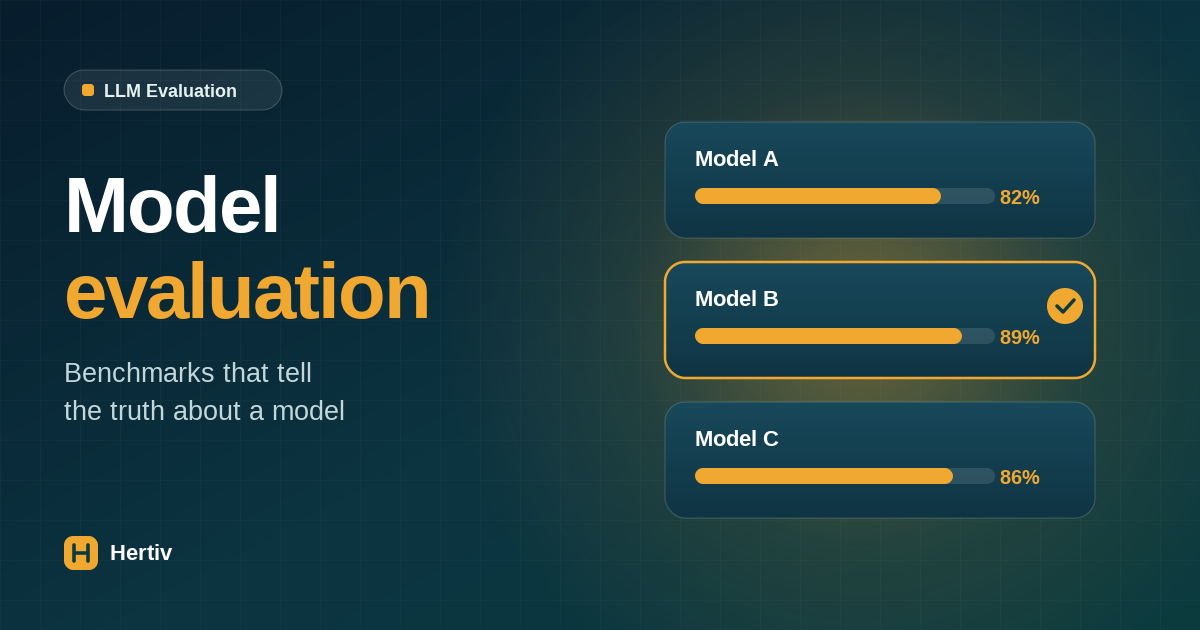
Model A gets 164 of the 200 totals right, which is 82%. Model B gets 178 right, which is 89%. Model C gets 172 right, which is 86%. On accuracy alone, Model B wins.
Then the team checks the cost and speed. Model B uses twice as many tokens per invoice as Model C, and takes 12 seconds per invoice against Model C's 5 seconds. The team processes 2,000 invoices a month, so Model B would take about 6.7 hours of model time against 2.8 hours for Model C.
The team picks Model C. It is three points behind on accuracy, but the gap is small, and the extra speed and lower token use matter more for a daily batch job. That trade-off only appears when quality, cost and speed are measured together on the same test set.
What are the common mistakes?
The most common LLM model evaluation mistakes are trusting one benchmark, testing with different prompts, and scoring your own favourite model by hand.
- One benchmark, one verdict. A single score hides what the model cannot do, and a leaderboard leader can still fail your task.
- Different prompts per model. If each model gets a different prompt, the test measures the prompts, not the models.
- Scoring your own favourite. Knowing which model wrote an answer biases the score, so score blind whenever a person is judging.
- Ignoring cost and speed. A model that is slightly better but far slower or pricier can be the wrong choice for production.
- Testing on leaked data. A test set the model has seen before gives a flattering score that collapses on fresh questions.
- No fixed test set. Changing the test between runs makes the scores incomparable, so nobody knows whether the model improved.
If you are building the product around the model, LLM development covers the design and evaluation work that follows the choice.
Key takeaways
- Model evaluation compares models on the same fixed tasks, so the choice rests on evidence
- Public benchmarks narrow the field; your own test set decides the winner
- Match the metric to the job, and always measure cost and speed alongside quality
- Score blind, fix the prompt, and keep the test set unchanged between runs
- A benchmark leader can still lose on your data, so test on your own questions
Frequently asked questions
What is LLM model evaluation?
It is the process of testing language models on the same fixed tasks and scoring the answers, so models can be compared fairly. It uses public benchmarks for broad capability and your own test set for your specific task, plus cost and speed.
How is model evaluation different from app evaluation?
Model evaluation compares models before you choose one, while app evaluation tests your finished product with real user questions. Model evaluation asks which model to build with; app evaluation asks whether the product works.
What is the best LLM benchmark?
There is no single best benchmark, because each one tests a narrow slice of ability. MMLU tests knowledge, HumanEval tests code, GSM8K tests maths, and Chatbot Arena tests human preference. Use several, then run your own tests.
How many test cases do I need?
Fifty to 100 real examples per task is enough for a first comparison, as long as they come from your real work and each one has a known correct answer. Grow the set with the cases the models get wrong.
Should I trust a vendor's benchmark scores?
Treat them as a starting point. Vendors report the benchmarks where their model leads, and the test method may favour their setup. Re-run the tests yourself on your own data before choosing.
Does a higher benchmark score mean a better model for me?
Not always. A model can lead a public leaderboard and still fail on your documents, your formats or your edge cases. The score that matters is the one on your own test set, with cost and speed included.


