Hyperledger Fabric Best Practices for Networks That Last
Hyperledger Fabric best practices cover endorsement policy, channel design, identity hygiene and upgrades. They keep a permissioned network running after launch.
On this page
Short answer
Hyperledger Fabric best practices are the habits that keep a permissioned network healthy after launch: an endorsement policy that survives an outage, channels that share only what must be shared, certificates rotated before expiry, and chaincode upgrades tested on a test network first. They matter because a Fabric network is harder to fix after launch than a normal database, so the decisions made shape how the network runs for years.
What are Hyperledger Fabric best practices?
Hyperledger Fabric best practices are the design and operating habits that keep a permissioned blockchain network reliable, private and maintainable over time. They cover how members agree on transactions, how data is shared, how identities are managed and how the network is upgraded.
Fabric differs from public blockchains in that the members are known and approved, which makes governance a first-class concern. A network with four companies needs rules for who endorses a transaction, who sees which data and who can approve a change, and those rules need to work when a member is offline or leaves.
The practices below assume you already know how to set a network up. For the step-by-step setup, see how to implement Hyperledger Fabric. This article is about the decisions that keep that network running well.
How do you design the endorsement policy?
You design the endorsement policy by choosing which organisations must sign a transaction before it is accepted, balancing safety against availability. The policy is the network's most important rule, because it decides what counts as a valid transaction.
A policy that requires every member to endorse every transaction is safe but fragile: one offline member stops the network. A policy that requires only one member is fast but weak: a single compromised member can push bad transactions through. Most networks start with a majority, such as 2 of 3 or 3 of 5 organisations.
| Policy | When it fits | Risk |
|---|---|---|
| 1 of N | Low-value data, fast reads | One bad member can push anything |
| Majority (2 of 3) | Most business networks | Needs a majority online |
| All members | High-value settlements | One offline member stops writes |
| Named orgs | Regulated steps, such as a bank sign-off | Named org becomes a bottleneck |
Write the policy down with the business rules it enforces, and test it with one member offline before launch. The test is cheap; discovering the problem in production is not.
How do you design channels and private data?
You design channels and private data by deciding which members see which transactions, and by sharing only what each member needs. A channel is a private ledger shared by a subset of members, and private data collections hide details from members who share a channel.
Start with one channel for the whole network and add more only when a real privacy need appears. Each extra channel is another ledger to maintain, another set of peers to run and another place where data can drift out of sync. Most networks need fewer channels than their designers first expect.
Use private data collections when members share a channel but some fields must stay between two of them, such as a price that only the buyer and seller should see. The ledger records a hash of the private data, so other members can verify that something happened without seeing what it was.
Document the data rules in plain language alongside the configuration, so a new member can tell what they will see and what they will not. If the rules only exist in config files, they will be misunderstood.
How do you keep identities and certificates healthy?
You keep identities and certificates healthy by treating them like production credentials: issued by a certificate authority you control, stored safely, rotated before they expire, and revoked quickly when someone leaves. In Fabric, identity is membership, so a lost or stolen certificate is a security incident.
Each organisation runs its own certificate authority, and each peer, orderer and user holds a certificate it issues. Keep the authority's keys offline or in a hardware module, and never share one identity across people or services. A shared admin identity makes it impossible to tell who did what.
Set expiry dates that force rotation, and rehearse the rotation before a certificate actually expires. An expired peer certificate stops that peer from joining the network, and fixing it under pressure is slower than rotating it on a schedule. Check what each identity can do with what is Hyperledger Fabric if the membership model is new to you.
How do you handle chaincode upgrades and ordering?
You handle chaincode upgrades by treating them as a governance event, not a deployment: agree the change with the members, test it on the test network, then approve it through the chaincode lifecycle so every organisation signs off before it goes live.
Chaincode holds the business rules, so a bad upgrade changes what the network accepts. Test the new version against the old ledger data, check that old transactions still validate, and keep the previous version available so you can roll back if the new one misbehaves. Never upgrade chaincode and change the endorsement policy in the same step; if something breaks, you will not know which change caused it.
For the ordering service, run enough orderers that one failure does not stop the network, and keep them spread across members so no single organisation controls the order of transactions. Monitor the orderers like any other production service: if blocks stop arriving, the network is down even though every peer looks healthy.
Example: a four-company trade network that survives a failure
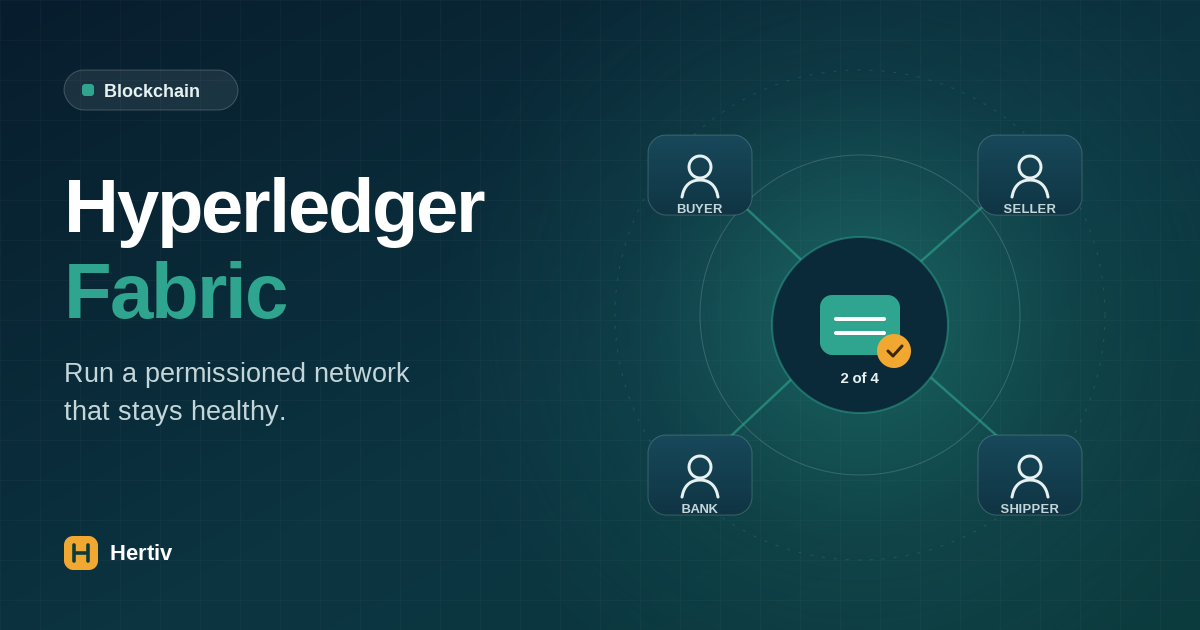
Example (hypothetical): four companies, a buyer, a seller, a bank and a shipper, run a Fabric network to track shipments. Each company runs two peers, so the network has 8 peers in total, plus three orderers shared between the members. The endorsement policy is 2 of 4 organisations.
The network handles 500 shipments a day, and each shipment creates 3 transactions: one when it leaves the seller, one when the shipper confirms receipt and one when the buyer confirms delivery. That is 1,500 transactions a day, and each transaction needs endorsements from 2 organisations, so the network performs 3,000 endorsement calls a day.
One morning the bank's two peers go offline for maintenance. Because the policy needs only 2 of 4 organisations, the buyer, seller and shipper keep endorsing, and the network keeps processing shipments. The bank's peers catch up when they return, and no shipment is lost. If the policy had required all four members, the network would have stopped until the bank came back.
What are the common mistakes?
The most common mistakes with Hyperledger Fabric are an endorsement policy that cannot survive an outage, channels added before they are needed, shared identities, and upgrades pushed without a test run.
- Requiring every member to endorse. One offline member stops all writes; start with a majority and name specific orgs only where the rules demand it.
- A channel for every pair of members. Each channel is another ledger to maintain; start with one channel and split only for a real privacy need.
- Shared admin identities. If several people use one identity, you cannot tell who approved a change or who to revoke.
- Certificates that expire unnoticed. An expired peer certificate takes the peer off the network; rotate on a schedule and rehearse it.
- Upgrading chaincode without a test run. Test on the test network with real ledger data first, and never change the policy and the chaincode at the same time. Compare tooling options in top Hyperledger Fabric tools before choosing what to run.
Key takeaways
- An endorsement policy that needs a majority survives an outage; one that needs everyone does not
- Start with one channel and add more only for a real privacy need
- Each organisation controls its own identities, and certificates must be rotated before they expire
- Chaincode upgrades are governance events: agree, test, then approve through the lifecycle
- Run enough orderers across members that no single failure stops block production
Frequently asked questions
What endorsement policy should a new Fabric network use?
Start with a majority, such as 2 of 3 or 3 of 5 organisations. It survives one member going offline while still needing more than one member to approve a transaction. Require all members only for high-value steps where the rules demand it, and test the policy with one member offline before launch.
How many channels should a Fabric network have?
As few as possible. Start with one channel for the whole network and add more only when a real privacy need appears, such as transactions that some members must not see. Each extra channel is another ledger to maintain, and too many channels make the network hard to operate.
What happens when a Fabric certificate expires?
The peer, orderer or user holding it can no longer join the network or sign transactions until it is renewed. That is why rotation must be scheduled and rehearsed: an expired certificate is a preventable outage, and fixing it under pressure takes longer than rotating it on time.
Can you change an endorsement policy after launch?
Yes, but it is a governance change, not a config edit. The members must agree the new policy, and the change goes through the channel configuration update process with the required approvals. Test the new policy on the test network first, and never change it together with a chaincode upgrade.
How do private data collections differ from channels?
A channel is a separate ledger shared by a subset of members. A private data collection hides specific fields from some members who share a channel, while the ledger records a hash of the hidden data so others can verify it. Use collections for field-level privacy inside a shared channel.
How do you monitor a Fabric network?
Watch the peers, the orderers and the ledger height. Key signals are block production rate, endorsement failures, certificate expiry dates and peer disk use. Set alerts for a peer falling behind the ledger and for an orderer that stops producing blocks, since either one can look healthy while the network is stuck.


