How to Implement a Stablecoin: Peg, Reserves and Minting
Implementing a stablecoin means building the token, the reserve and the minting system that keeps its peg. Here is the order of work, from peg model to pilot.
On this page
Short answer
Implementing a stablecoin means building the system that issues a token, holds the assets that back it, and lets people mint and redeem it at a fixed value. The work runs in a set order: choose the peg model, set up the reserve and its reporting, get legal advice, write the contracts with split access controls, audit them, and open minting in stages with limits.
What does it mean to implement a stablecoin?
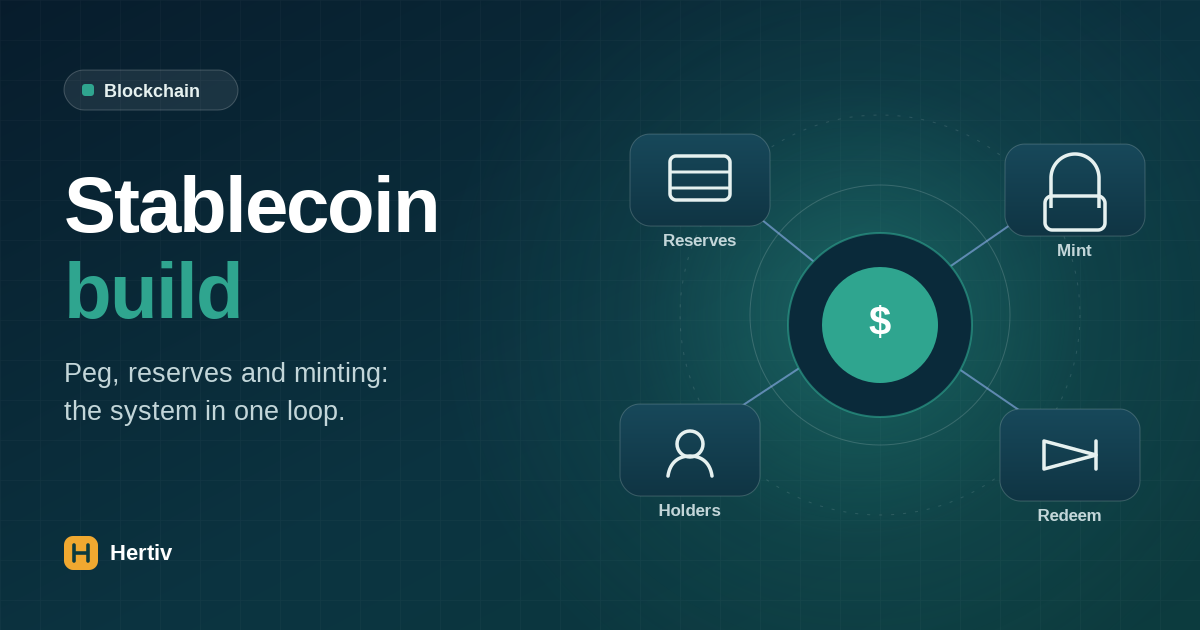
Implementing a stablecoin means building the system that issues a token, holds the assets that back it, and lets people mint and redeem it at a fixed value. It is not one contract but a small system: a token contract, a reserve, a minting and redemption process, and the controls that keep the peg honest.
The word 'implement' covers the building work, while launching covers taking it to market. A team can have a working stablecoin that nobody uses yet, and it can also have a launch plan with no working system behind it. This article covers the building work: the peg, the reserves, the contracts and the checks. The market side is covered in our guide to how to launch a stablecoin.
The stakes are high because a stablecoin is a promise. Every token in circulation claims a fixed value, and the system must be able to honour that claim at any time. That promise shapes every design choice that follows.
Which peg model should you choose?
The peg model decides what backs the token and what can break the peg. The table below sets out the four common models and the risk each one carries.
| Model | Backing | Main risk |
|---|---|---|
| Fiat-backed | Cash and short-term government bonds held in reserve | The reserve holder fails, or the reserve is not what it claims |
| Crypto-backed | Other crypto assets locked as collateral, over-collateralised | A price crash in the collateral |
| Algorithmic | No reserve; supply expands and contracts by rule | The rule fails under stress and the peg breaks |
| Commodity-backed | Gold or another commodity held in vaults | Storage, audit and redemption costs |
For most new issuers, a fiat-backed model is the simplest to explain and to audit, which is why it dominates the market. Crypto-backed models suit teams that want to stay on-chain, and they pay for that with over-collateralisation: locking up more value than the tokens issued.
Whatever the model, the choice should be made before any code is written. Changing the peg model later means rebuilding the reserve, the contracts and the redemption flow. Our guide to how stablecoin development works walks through the same decision from the build side.
How do reserves and redemption work?
Reserves are the assets that stand behind the token. For a fiat-backed stablecoin, the reserve is usually cash and short-term government bonds held in segregated accounts. The reserve must match the tokens in circulation, and the match must be checkable by someone other than the issuer.
Redemption is the process of swapping tokens back for the underlying asset. A user sends tokens to the issuer, the tokens are burned, and the issuer pays out the matching value. If redemption is slow or limited, the peg weakens, because the token is only worth its fixed value if it can be swapped for that value.
Regular audits and proof-of-reserves reports are how an issuer shows the match holds. An audit that happens once a year is not enough for a token people hold every day; the reporting should be frequent, and the auditor should be independent. Our guide to what a stablecoin is explains the basic types before the building work starts.
What does the minting and burning system need?
Minting creates new tokens when new backing arrives, and burning destroys tokens when backing leaves. The two must always move together: no token should exist without backing, and no backing should sit idle without a token to match it.
- Token contract with mint and burn functions that only authorised addresses can call.
- An oracle or price feed if the backing is priced in anything other than the peg currency.
- Access controls that separate who can mint, who can pause, and who can change the rules.
- A pause function for emergencies, with a clear rule for who can use it and when.
Access control deserves the most care. If one key can mint unlimited tokens, the whole peg rests on that key staying safe. Split the powers across roles, require more than one signer for large mints, and test the pause function before it is ever needed.
The contracts also need an audit by a firm that specialises in smart contracts, and the audit should cover the minting and redemption flow, not just the token code. A clean audit does not remove the risk, but an unaudited contract is a risk a team should not take.
How do you implement a stablecoin in six steps?
The order matters: the peg and the legal groundwork come before the code, and the code comes before any public minting.
- Choose the peg model and the asset that will back it.
- Set up the reserve accounts and the reporting that proves the match.
- Get legal advice on the rules that apply in each place the token will be used.
- Write the token, minting and redemption contracts with split access controls.
- Audit the contracts and run a closed pilot with a small group.
- Open minting in stages, with limits, monitoring and a tested pause.
Keep the pilot small and the limits low. A pilot with a few hundred users and a capped supply finds the problems in redemption, reporting and support before real money depends on them.
Costs vary widely by model and jurisdiction; our breakdown of stablecoin development cost sets out the main cost drivers.
Example (hypothetical): a remittance startup issues a stablecoin
Example (hypothetical): a remittance startup holds $500,000 in reserve and issues 500,000 tokens at $1 each. It keeps a 2% buffer, which is $10,000, so the reserve is $510,000 against 500,000 tokens in circulation.
In the first month, users redeem 50,000 tokens, and the startup pays out $50,000. The reserve falls to $460,000 and 450,000 tokens remain, so each token is still backed by $1.02. The buffer absorbed the outflow, and the peg never moved.
The lesson is that the buffer is not spare cash. It is the margin that lets redemptions happen without touching the peg, and the startup must top it up before the next wave of redemptions.
What are the common mistakes?
Stablecoin projects fail most often on the basics: the reserve, the access controls and the timing. The mistakes below are the ones to avoid.
- Choosing the peg model after the contracts are written.
- Minting tokens before the reserve is in place.
- Giving one key the power to mint unlimited tokens.
- Auditing once and never again after changes.
- Promising instant redemption without the cash flow to back it.
- Treating compliance as a launch task instead of a design input.
Key takeaways
- Implementing a stablecoin means building the token, the reserve and the minting and redemption system together.
- Choose the peg model before writing any code; changing it later means rebuilding.
- Reserves must match tokens in circulation, and the match must be checkable by an independent party.
- Split minting powers across roles and require more than one signer for large mints.
- Open minting in stages, with limits, monitoring and a tested pause.
Frequently asked questions
What is the difference between implementing and launching a stablecoin?
Implementing means building the system: the peg, the reserve, the token and minting contracts and the redemption flow. Launching means taking that system to market with users, partners and a distribution plan.
Which stablecoin peg model is simplest for a new issuer?
A fiat-backed model is usually simplest, because cash and short-term government bonds are easy to explain and to audit. Crypto-backed models need over-collateralisation, and algorithmic models carry the most risk under stress.
How do stablecoin reserves work?
The issuer holds assets that match the tokens in circulation, usually in segregated accounts. Regular audits and proof-of-reserves reports show the match holds, and redemption lets holders swap tokens back for the underlying value.
Why does minting need split access controls?
If one key can mint unlimited tokens, the whole peg rests on that key staying safe. Splitting powers across roles and requiring more than one signer for large mints means no single failure can create unbacked tokens.
How long does it take to implement a stablecoin?
The building work itself can take weeks, but the legal groundwork, reserve setup and audits usually take longer. Teams should plan for months from the peg decision to a staged public launch.
What happens if a stablecoin loses its peg?
Holders rush to redeem, the reserve drains, and the token trades below its fixed value. A buffer, honest reporting and a tested pause give the issuer time to respond before the gap grows.


