How Much Does Stablecoin Development Cost?
Stablecoin development cost depends on the model, the chain and the compliance load. This guide breaks down the build, audit and running costs.
On this page
Short answer
Stablecoin development cost is the total spend to design, build, audit and launch a stablecoin, plus the ongoing cost of running it. A simple fiat-backed coin on an existing chain can cost a small team a few months of work, while a custom algorithmic design with its own reserve system can cost several times more and take a year.
What is stablecoin development?
Stablecoin development is the work of designing, building and launching a token that holds a stable value, usually pegged to a currency such as the US dollar. It covers the token contract, the reserve or backing mechanism, the mint and redeem flow, and the systems that keep the peg honest.
A stablecoin is not just a token contract. The hard parts are off-chain: holding reserves, proving they exist, handling redemptions, and meeting the rules of the jurisdictions where the coin is used. The contract itself is often the smallest part of the build.
There are three common models. A fiat-backed coin holds dollars or short-term government debt in reserve and mints one token per dollar. A crypto-backed coin holds other crypto as collateral, usually more than the value issued. An algorithmic coin uses rules and incentives to hold the peg without full reserves, which is the riskiest design.
The model you choose decides the cost. A fiat-backed coin needs banking, custody and audits. A crypto-backed coin needs liquidation logic and price feeds. An algorithmic coin needs economic modelling and far more testing before anyone should trust it.
What drives the cost?
Stablecoin development cost is driven by five factors: the backing model, the chain, the compliance load, the audit scope, and how much of the surrounding product you build yourself. Change one and the budget moves.
| Cost driver | What it covers | Cost pressure |
|---|---|---|
| Token contract | Mint, burn, transfer, pause, allowlist | Low to medium |
| Reserve system | Custody, proof of reserves, reporting | Medium to high |
| Compliance | Licence, legal advice, KYC and AML | High |
| Security audit | Contract audit, re-audit after fixes | Medium |
| Price feeds | Oracles for crypto-backed designs | Low to medium |
| Operations | Monitoring, support, incident response | Ongoing |
Compliance is usually the largest line item, and it is the one teams underestimate most. A licence application, legal opinions and ongoing reporting can cost more than the engineering. Budget for it first, not last.
Fiat-backed, crypto-backed or algorithmic: what changes the bill?
Fiat-backed coins are the cheapest to build and the most expensive to run. The contract is simple, but you need bank accounts, a custodian, monthly attestations and a redemption desk. The ongoing cost is mostly legal, accounting and custody fees.
Crypto-backed coins cost more to build. You need collateral management, liquidation logic that works in a falling market, and reliable price feeds. If the feed fails or liquidation lags, the coin can lose its peg, so testing matters more than in a fiat-backed design.
Algorithmic coins are the most expensive to design and the riskiest to launch. The peg depends on incentives holding under stress, which needs economic modelling, simulations and long test periods. Several high-profile algorithmic coins have failed, and regulators now treat the model with suspicion.
For most teams, a fiat-backed coin on an established chain is the sensible default. It is the model regulators understand best, and it is the one users trust most easily. A useful starting point is the launch sequence in how to launch a stablecoin, which covers the order of decisions.
Build routes: in-house, agency or white-label
You can build a stablecoin in-house, hire an agency, or start from a white-label platform. Each route changes the cost profile and how much control you keep.
An in-house build gives you full control over the contract and the reserve logic, but it needs a team that understands both smart contracts and financial operations. Expect three to six months for a fiat-backed coin with a small senior team.
An agency build is faster if the agency has done it before. You pay for their experience and their audit relationships, but you still need someone in-house who can review the code and operate the coin afterwards.
A white-label platform is the cheapest way to start. You get a tested contract, a dashboard and a redemption flow, and you pay a setup fee plus a monthly charge. The trade-off is less control: the platform's design choices become yours, and migrating away later is work.
Whichever route you take, keep the audit independent. The team that wrote the contract should not be the team that signs off on it. For the engineering side, stablecoin development covers the build and audit pattern in more depth.
Running costs after launch
Running a stablecoin costs money every month, and the bill does not stop when the launch is done. The main recurring items are custody and banking fees, attestations, monitoring, support and the gas or transaction fees of minting and redeeming.
Custody and banking fees depend on the reserve size and the provider. Attestations are usually monthly and need an accounting firm. Monitoring covers the peg, the reserve balance, unusual minting and failed transactions, and someone must watch it around the clock.
Transaction fees are easy to miss in a budget. Every mint, burn and transfer costs gas on the host chain, and during congestion those fees rise. Some issuers cover the fee for users; others pass it on. Either way, it belongs in the running-cost line.
Plan for at least a year of running costs before the coin earns enough to cover them. Revenue usually comes from the yield on reserves, which is small at first and grows only as the supply in circulation grows.
Example (hypothetical): a small fiat-backed stablecoin
Example (hypothetical): a payments company builds a fiat-backed stablecoin on an existing chain for use in its own app. It hires a small agency for the build and keeps operations in-house.
The build costs $60,000 for the contract, dashboard and redemption flow. A security audit costs $25,000, and legal advice plus the licence application costs $40,000. That is $125,000 before launch.
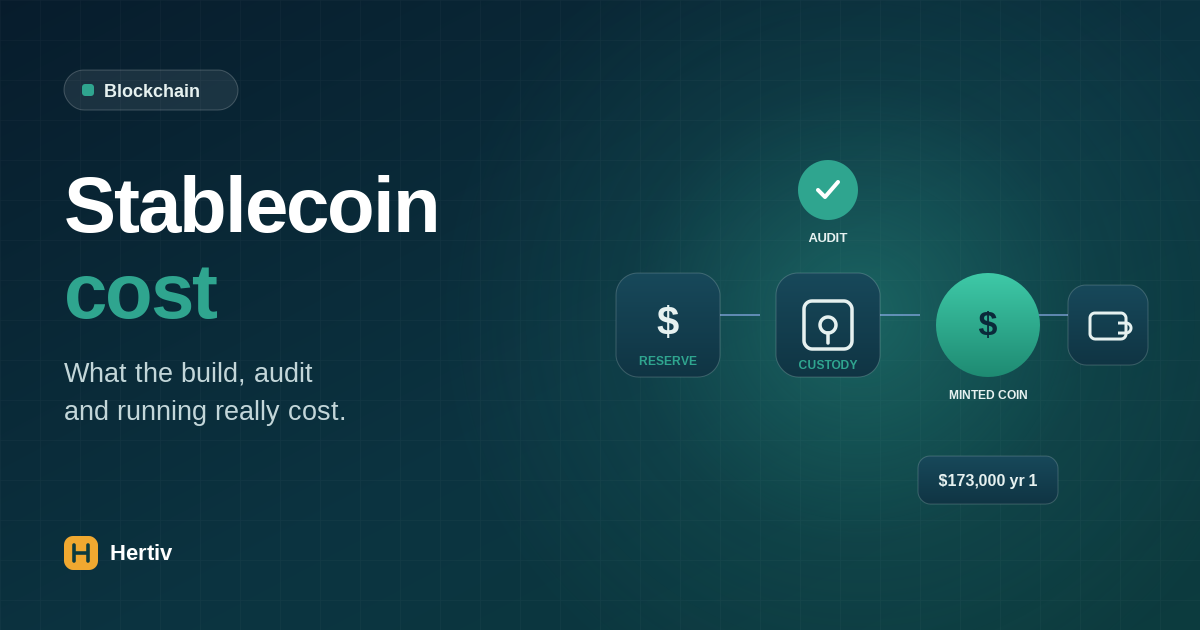
Running costs are $4,000 a month: $1,500 for custody and banking, $1,000 for the monthly attestation, $1,000 for monitoring and support, and $500 for transaction fees. Over the first year that is $48,000, so the first-year total is $173,000.
The coin earns from reserve yield. With $2 million in circulation and reserves earning 4% a year, the yield is $80,000 a year, which does not yet cover the $48,000 running cost plus the build. The team needs about $5 million in circulation before the coin pays for itself, which shapes the launch plan: distribution first, profit later.
What are the common mistakes?
The most common mistakes in stablecoin development are underestimating compliance, skipping the second audit, and launching with reserves that nobody can verify.
- Compliance as an afterthought. A licence application takes months; starting it after the build is finished delays launch by a quarter or more.
- One audit, no re-audit. Fixes after the first audit introduce new bugs. Budget for a re-audit of the changed code.
- Opaque reserves. If users cannot see proof of reserves, they will not trust the peg, and neither will exchanges.
- Cheap oracles. A crypto-backed coin that reads prices from a single feed can be manipulated or can fail when the feed stops.
- No redemption plan. A coin that cannot be redeemed at par is a promise, not a stablecoin.
- Ignoring gas costs. Minting and redeeming on a busy chain can cost more than the transaction is worth.
Key takeaways
- The backing model decides the cost: fiat-backed is cheapest to build, algorithmic is dearest
- Compliance is usually the largest line item and the most underestimated
- Keep the audit independent and budget for a re-audit after fixes
- Running costs continue after launch: custody, attestations, monitoring and gas
- A coin pays for itself only when reserve yield covers running costs
Frequently asked questions
How much does it cost to build a stablecoin?
A simple fiat-backed coin on an existing chain can be built by a small team in three to six months, with the contract, audit and legal work as the main costs. A crypto-backed or algorithmic design costs more and takes longer, because the collateral and liquidation logic need far more testing.
What is the cheapest type of stablecoin to develop?
A fiat-backed coin is usually cheapest to build, because the contract is simple and the reserves sit in a bank or with a custodian. It is more expensive to run, though, since custody, attestations and reporting continue every month.
Do stablecoins need a licence?
In most jurisdictions, yes, if the coin is offered to the public. The exact licence depends on the country and the model. Legal advice belongs at the start of the project, because the licence shapes the reserve setup, the redemption flow and the disclosures.
How long does stablecoin development take?
A fiat-backed coin typically takes three to six months from design to launch, including the audit and the licence application. A crypto-backed coin takes longer, and an algorithmic design can take a year or more of modelling and testing before it is safe to launch.
What are the ongoing costs of running a stablecoin?
The main recurring costs are custody and banking fees, monthly attestations, monitoring and support, and transaction fees for minting and redeeming. Revenue usually comes from the yield on reserves, which grows only as the supply in circulation grows.
Is an audit required before launching a stablecoin?
It is not always a legal requirement, but no serious exchange or partner will list an unaudited coin. Budget for an independent audit and a re-audit of any code changed after the first review, because fixes often introduce new issues.


