How to Implement Agile Development in Your Team
Implementing agile means moving a team to short cycles, a shared backlog and regular review. This guide covers the setup, the first sprint and keeping it working.
On this page
Short answer
Agile development is a way of building software in short cycles, with a shared backlog, regular planning and review at the end of each cycle. To implement it, a team picks one product area, sets up a backlog, agrees on a sprint length and starts delivering small working pieces every one or two weeks.
What does implementing agile development mean?
Agile development is a way of building software in short cycles instead of one long plan. A team keeps a prioritised list of work called a backlog, picks a small slice for each cycle, builds it, shows it and then plans the next slice. The cycle, usually called a sprint, lasts one or two weeks.
Implementing agile is less about buying a tool and more about changing how the team decides what to build next. The team needs a product owner who sets priorities, a way to break work into small pieces and a habit of reviewing finished work together. Without those three, the team is just holding more meetings.
It differs from the older waterfall approach, where a full plan is written before any code. Agile accepts that plans change, so it plans in small steps and learns from each one. Agile software development covers the ideas behind the method, while this guide covers putting it into practice.
What should be in place before you start?
Before the first sprint, the team needs a small set of basics in place. A backlog with the next few weeks of work, a person who can set priorities, and a shared definition of what finished means will carry the first sprint. Everything else can be added as the team learns.
Start with one team and one product area rather than the whole company. A pilot team can try the rhythm, find what works and show results before other teams adopt it. Trying to change every team at once usually spreads attention too thin.
| Item | What good looks like | Why it matters |
|---|---|---|
| Backlog | 20 to 30 small items, ordered by value | The team always knows what comes next |
| Product owner | One person who sets priorities | Decisions do not stall |
| Sprint length | One or two weeks, fixed | A steady rhythm builds trust |
| Definition of done | Written, agreed, visible | Finished means the same to everyone |
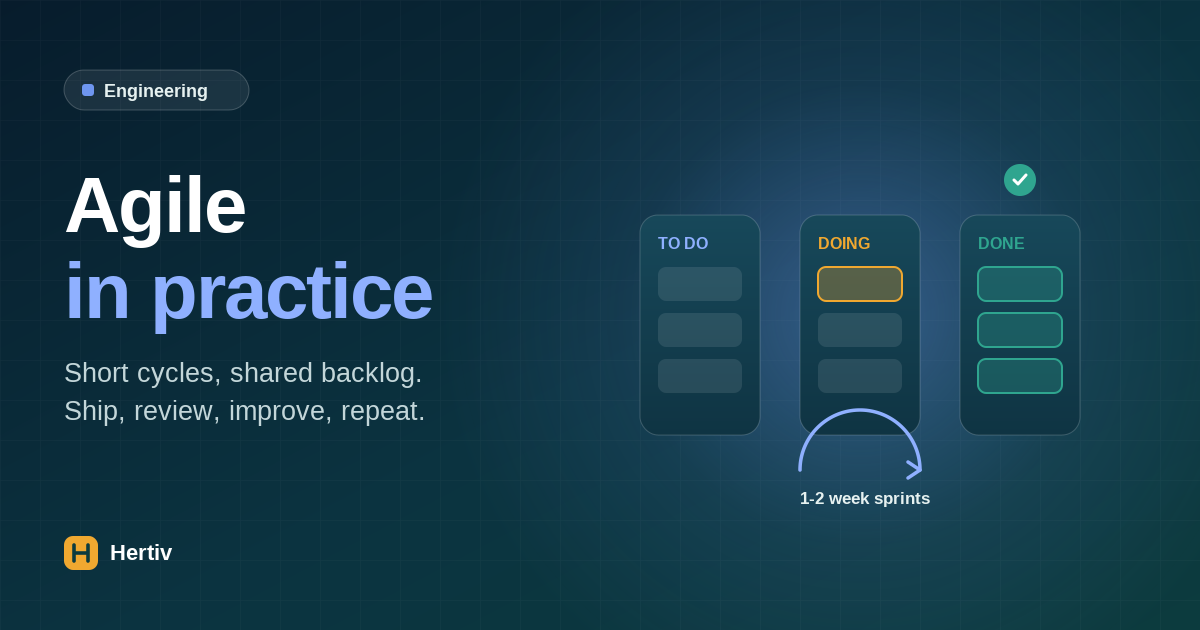
| Board | To do, doing, done | Work in progress stays visible |
How do you run the first sprint?
The first sprint should be small and safe. Pick work the team already understands, keep the scope modest and aim to finish something real that can be shown. A first sprint that ships a small working feature teaches more than a big sprint that stalls.
- Hold a planning meeting and pick the top backlog items that fit the sprint length.
- Break each item into tasks small enough to finish in a day or two.
- Meet briefly each day to share progress, plans and blockers.
- Show the finished work to stakeholders at the end of the sprint.
- Hold a short review of how the sprint went and pick one thing to improve.
Keep the daily meeting short, about 15 minutes, and focused on the work. Long status meetings drain the time the sprint is meant to protect. Agile versus Scrum explains how Scrum adds roles and events to this basic rhythm.
How do you keep the backlog honest?
A backlog only works if it is kept honest. Items at the top should be small, clear and ready to build, while items further down can stay rough. The product owner reviews the backlog each week, removes stale items and reorders it as priorities change.
Write each item as a user need with a clear outcome, not as a task list. An item such as 'a customer can reset their password by email' is easier to plan and test than 'work on login'. Small items also make estimates more honest, because a team can judge a day of work better than a month of it.
Limit work in progress. When a team starts ten items and finishes two, the board looks busy while nothing ships. Finishing one item before starting the next is the fastest way to learn whether the plan works.
How do you measure whether agile is working?
Measure delivery, not activity. The useful numbers are how often the team ships, how long an item takes from start to finish and how often planned work is actually completed. If those numbers improve, the method is working. If they do not, the team should change the process, not the numbers.
Ask the team and the users too. A short survey after each sprint can show whether the team feels the process helps or hinders, and whether users see value in what ships. Agile development costs rise when teams add meetings without cutting anything, so watch the meeting load as well.
Example (hypothetical): a first sprint for a small team
Example (hypothetical): a team of five builds a booking page for a small clinic. They pick a two-week sprint and a backlog of eight items, each estimated at one to three days. Planning takes two hours, and the daily meeting takes 15 minutes, which adds up to about two and a half hours of meetings per person over the sprint.
By day ten, the team has finished six of the eight items, including the booking form and the confirmation email. Two items are carried over because a payment step needed more work than expected. At the review, the clinic staff try the form and ask for a time-slot view, which becomes the top item for the next sprint.
The numbers tell the story: six of eight items done, about 75 percent of the plan, and one real feature in front of users after two weeks. The carried-over items are not a failure; they are the reason the next sprint is planned smaller and with a clearer payment step.
Common mistakes
The most common mistake is renaming the old process and calling it agile. Teams keep long planning documents and big releases, then add a daily meeting and wonder why nothing changes. Agile needs small batches and real feedback, not new labels on old habits.
Another mistake is skipping the review at the end of the sprint. Without a regular look at what worked, the team repeats the same problems every cycle. A short, honest review that changes one thing each sprint does more than any new tool.
Key takeaways
- Agile means short cycles, a shared backlog and review at the end of each cycle.
- Start with one team, one product area and a small first sprint.
- Keep the backlog honest: small, clear items at the top, stale items removed.
- Measure delivery, not activity: shipping frequency and lead time.
- A short review that changes one thing each sprint beats any new tool.
Frequently asked questions
Do we need Scrum to do agile?
No. Scrum is one framework for agile, with set roles and events, but a team can work in short cycles with a backlog and reviews without adopting all of Scrum. The core is small batches and regular feedback.
How long should a sprint be?
One or two weeks works for most teams. Shorter sprints give faster feedback but more planning overhead, while longer sprints delay feedback. Pick one length and keep it fixed for several sprints.
Who should be the product owner?
One person who understands the users and can set priorities. If two people share the role, decisions stall. The product owner should be available to the team during the sprint, not only at planning.
What if the team cannot finish the sprint?
Carry the unfinished items over and plan smaller next time. Unfinished work usually means items were too big or not ready, not that the team was slow.
How do we handle urgent work during a sprint?
Keep a small buffer for urgent fixes, or swap an item out and note the change. If urgent work arrives every sprint, the backlog is missing real work and needs a review.
When should we scale agile to more teams?
After one team has run several sprints and can show working software each cycle. Scaling before that spreads the problems instead of the benefits.


