How Much Does Agile Development Cost?
Agile development cost depends on team size, sprint length and product duration. Here is what drives the bill, what a typical team costs, and how to budget it.
On this page
Short answer
Agile development cost is the total spend on a cross-functional team working in short sprints, usually priced by team size and duration rather than by fixed scope. A small team of four to six people working for three months is the common starting point, and the cost rises with seniority, location and the number of sprints.
What is agile development cost?
Agile development cost is the amount a business spends to build software in short, iterative cycles called sprints, usually two to four weeks long. Instead of paying for a fixed specification up front, you pay for a team that delivers working software every sprint and reprioritises after each one.
The cost is driven by who is on the team, how long they work and where they are based. A typical agile team has a product owner, a scrum master, two to four developers and a tester or designer. The product owner sets priorities, the scrum master keeps the process moving, and the developers and testers build and check each increment.
Most agile budgets are quoted as a monthly team rate or a day rate per person. That rate covers salaries, tools and the ceremonies that keep the team aligned, such as planning, daily stand-ups and retrospectives. It does not usually cover hosting, licences or third-party services, which are billed separately.
Agile cost is different from fixed-price cost because the scope is allowed to change. You buy capacity and direction, not a finished list of features. That is why agile suits products where requirements are still being learned, and why it needs a different budgeting habit: fund the team, review value each sprint, and stop or continue based on results.
What drives agile development cost?
Agile development cost is driven by five factors: team size, seniority, location, sprint count and the complexity of the product. Team size is the biggest lever, because every extra person adds a full monthly rate, while seniority changes the rate itself.
| Cost driver | What changes it | Effect on budget |
|---|---|---|
| Team size | Number of developers, testers and designers | Each extra person adds a full rate |
| Seniority mix | Junior, mid-level and senior roles | Senior-heavy teams cost more per sprint |
| Location | Onshore, nearshore or offshore team | Rates vary widely by market |
| Sprint count | Weeks from first sprint to launch | More sprints mean a longer runway |
| Product complexity | Integrations, compliance, data work | Complex work needs more roles |
Location is the second-biggest lever. An onshore senior developer and an offshore mid-level developer do the same job at very different rates, but the cheaper rate only saves money if communication stays smooth. Time-zone gaps and language friction add meetings and rework, which eat the saving.
Complexity matters because some products need roles beyond the core team: a security review, a data engineer, or a compliance check. Those roles are often part-time, but they still add cost. A simple internal tool and a regulated payment product can use the same agile process and still cost very different amounts.
How much does an agile team cost per sprint?
An agile team costs whatever its people cost for the length of a sprint, and the honest way to estimate it is to price the team, not the feature list. Start with the day rate of each role, multiply by the sprint length in days, and add tools and overhead.
For a small team of one product owner, one scrum master, three developers and one tester working two-week sprints, the sprint cost is roughly the sum of six people for ten working days.
If the blended day rate is around $400 per person, one sprint costs about $24,000. That is a planning figure, not a quote: real rates vary by market and by seniority, so treat it as a way to compare options rather than a price.
A larger team of eight to ten people roughly doubles that figure, and a senior-heavy team pushes it higher again. The cheapest team is not always the cheapest product: a team that is too small moves slowly, so the product takes more sprints and the total rises. A team that is too large spends more time coordinating than building.
Some teams quote a fixed monthly rate per team, which makes budgeting simpler. Others bill time and materials, which is more flexible but harder to forecast. Either way, ask what is included: tools, cloud hosting, testing devices and the product owner's time are sometimes in the rate and sometimes extra.
Example (hypothetical): budgeting a three-month agile build
Example (hypothetical): a company wants a customer portal built in agile sprints over three months, with a team of five people working two-week sprints.
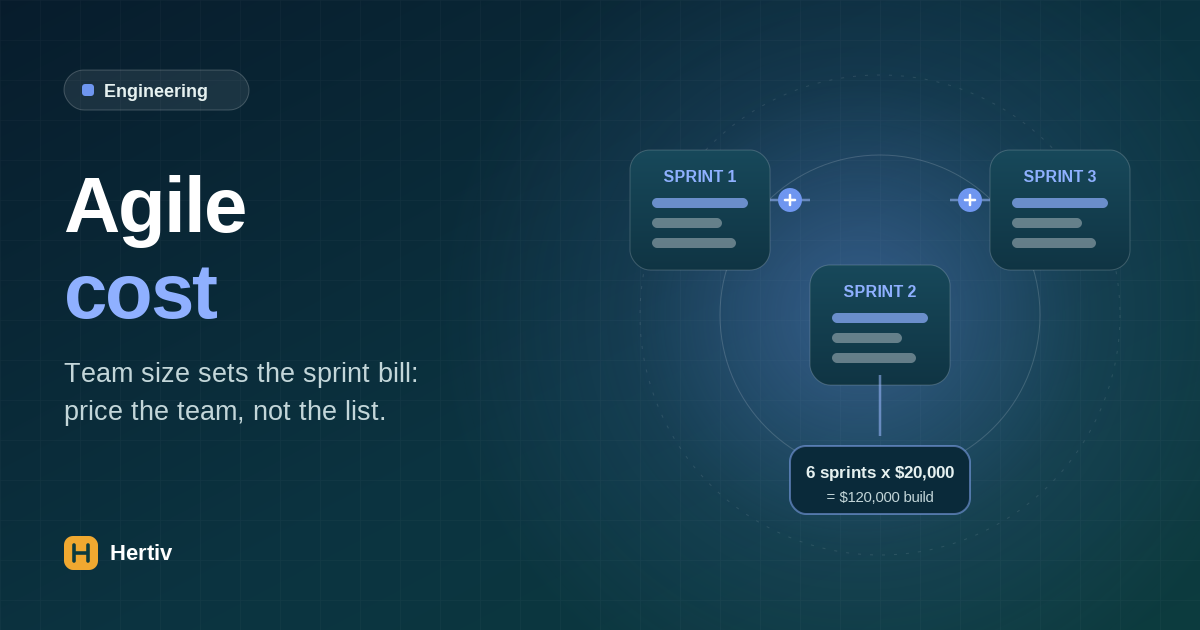
The team is one product owner, three developers and one tester. The blended day rate is $400 per person. Each sprint is ten working days, so one sprint costs 5 people x 10 days x $400 = $20,000. Three months gives six sprints, so the build costs 6 x $20,000 = $120,000.
On top of that, the team budgets $1,500 a month for tools and hosting, which is $4,500 over three months, and $6,000 for a security review before launch. The total budget is $120,000 + $4,500 + $6,000 = $130,500.
After three sprints the product owner reviews what has been delivered and decides the remaining scope. If the core portal works, the last three sprints can focus on polish and the integrations that matter most. If something is missing, the backlog is reprioritised without renegotiating the whole contract. That review point is the main financial benefit of agile: you can change direction after spending half the budget instead of all of it.
In-house, outsourced or hybrid: which costs less?
An in-house agile team costs more up front because you pay salaries, benefits, recruitment and the time to hire, but it costs less per sprint once the team is running and knows the product. An outsourced team costs less to start and can be scaled up or down, but you pay a margin on top of the developers' rates and you spend more time on handover and communication.
A hybrid model is common: an in-house product owner and a senior developer, with an outsourced team doing most of the build. This keeps product knowledge inside the company while using outside capacity for delivery. The risk is a split in ownership, where nobody feels responsible for quality, so the hybrid only works if the in-house lead reviews every sprint properly.
When comparing options, price the whole first year, not the first sprint. An in-house hire takes weeks to recruit and months to reach full speed, so the first sprints are slower. An outsourced team can start in days but may need more of your product owner's time. The cheapest option on paper is rarely the cheapest in practice if it needs more of your staff to manage it.
For teams weighing the trade-off, DevOps services can help keep delivery costs down once the team is running, by automating testing and deployment so sprints deliver faster.
How to budget agile development without surprises
You budget agile development without surprises by funding the team in tranches, reviewing value each sprint and keeping a reserve for the unknowns that always appear.
- Define the first release, not the whole product. Pick the smallest useful version and cost the sprints to reach it.
- Price the team, then add 15-20% reserve. The reserve covers integrations that take longer and requirements that change.
- Agree what is in the rate. Tools, hosting, licences and the product owner's time should be listed, not assumed.
- Review after every two or three sprints. Compare delivered value against spend and decide whether to continue, change scope or stop.
- Track cost per sprint, not cost per feature. Features vary in size; sprint cost is the stable number to manage.
The reserve matters because agile estimates are ranges, not promises. A feature estimated at one sprint can take two when an integration behaves badly. A reserve of 15-20% absorbs that without a budget crisis, and if it is not spent, it simply stays in the business.
One more habit helps: keep the backlog groomed. A backlog full of stale, half-described items leads to bad estimates and wasted sprints. A short, well-described backlog is the cheapest way to keep agile costs predictable.
What are the common mistakes?
The most common agile cost mistakes are underestimating the product owner's time, treating the first estimate as a fixed price, and letting the team grow faster than the work.
- Ignoring the product owner's cost. Someone has to write stories, answer questions and accept work. If that person is also doing a full-time job, sprints stall and costs rise.
- Treating an estimate as a quote. Agile estimates are ranges. A team that promises a fixed price for a changing scope is either padding heavily or planning to cut corners.
- Adding people to a late project. New members need onboarding and slow the team down before they speed it up.
- Skipping testing to save money. Untested increments create bugs that cost far more to fix after launch than they would have cost to prevent.
- No definition of done. Without it, work is marked complete before it is really finished, and the next sprint pays the debt.
- Forgetting running costs. Hosting, monitoring and support continue after launch and should be in the budget from the start.
When is agile worth the cost?
Agile is worth the cost when requirements will change, the product needs feedback from real users, or the business cannot afford to wait months for a first version. In those cases the ability to change direction after a few sprints is worth more than the apparent certainty of a fixed-price contract.
Agile is a poor fit when the scope is fully known, the requirements are fixed by regulation, and the price must be certain before work starts. A fixed-price contract is usually cheaper for that kind of work, because the supplier can plan it precisely and take no risk on change.
The deciding question is simple: how much will you learn in the first three sprints? If the answer is a lot, agile pays for itself. If the answer is almost nothing, a fixed scope is the better buy. What is agile development explains the method itself.
Agile vs scrum covers the two most common ways teams run it.
If you are scoping a first release, an MVP built in about ten weeks is a useful way to test agile cost and value on a small, bounded piece of work before committing to a longer programme.
Key takeaways
- Agile cost is team cost: size, seniority and sprint count set the bill
- Price the team per sprint, not the feature list, and add a 15-20% reserve
- A small team of five at a $400 blended day rate costs about $20,000 per two-week sprint
- Review value every two or three sprints and be ready to change scope or stop
- In-house, outsourced and hybrid teams cost differently over a full year, not one sprint
Frequently asked questions
How many sprints does a typical agile project need?
Most small products need four to eight two-week sprints for a first usable release, and larger products need more. The count depends on scope, team size and how much is already built, so cost it in tranches and review after every few sprints.
Does agile development cost more than waterfall?
It can cost more per month because the team is dedicated, but it often costs less overall because you can stop or change direction early. Waterfall looks cheaper up front and is harder to change once work has started.
What is included in an agile team rate?
Usually the people on the team, their tools and the agile ceremonies. Hosting, third-party licences, security reviews and the product owner's time are sometimes extra, so ask for the list before signing.
Can a small business afford agile development?
Yes, with a small team and a short first release. A team of three to four people working for two or three months is a common starting point, and the budget can be capped by fixing the number of sprints.
How do I reduce agile development cost?
Keep the team small, keep the backlog short and well described, automate testing and deployment, and review scope every few sprints. The biggest savings come from stopping work that no longer matters.
Is a fixed-price agile contract possible?
Some suppliers offer a fixed price per sprint or per release, with scope agreed for that period. A fixed price for the whole product with changing scope is not really agile, and usually hides a large padding.


