How to Develop a Compliant Stablecoin for Payments
A compliant stablecoin for payments and remittances needs full reserves, a licence or partner, audited contracts and AML controls. Here is the build, step by step.
On this page
Short answer
A compliant stablecoin for payments and remittances is a token pegged to a fiat currency, backed one-to-one by reserves, issued under a licence or through a licensed partner, and run with anti-money-laundering controls, audits and a clear redemption promise. Building one is mostly a legal and operations project with a smart contract attached, not the other way round.
What is a compliant stablecoin?
A compliant stablecoin is a digital token that holds a steady value against a fiat currency, such as the US dollar or the euro, and is issued and operated under the financial rules that apply in the markets where it is used. The word compliant does the heavy lifting: it means the issuer holds reserves, answers to a regulator, checks its users, and lets holders redeem the token for fiat.
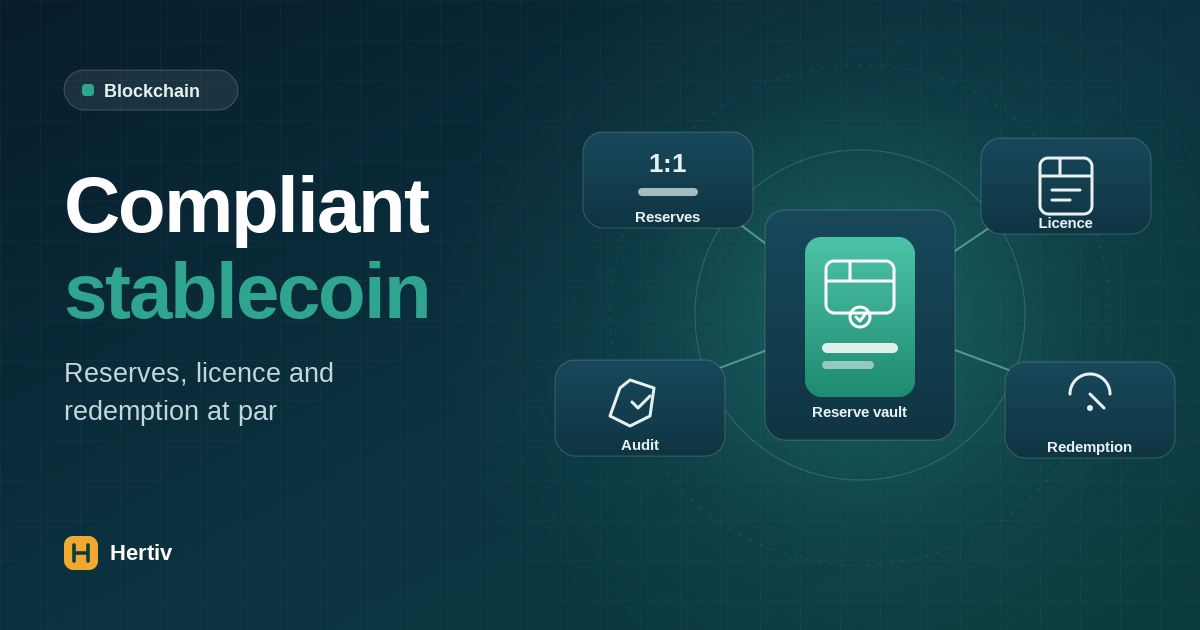
Three parts make a stablecoin compliant rather than merely pegged. First, reserves: the issuer holds cash or short-term government securities equal to the tokens in circulation, with those reserves checked by an independent auditor. Second, licensing: the issuer is registered or licensed where it operates, or works through a licensed bank or e-money institution. Third, controls: the issuer screens users, watches transactions, and can freeze tokens linked to crime.
For payments and remittances, compliance is the product. A business that pays suppliers or workers in stablecoins needs to know the token will still be worth a dollar tomorrow, that it can be redeemed, and that its own bank will not close its account for touching an unregulated token. A stablecoin that cannot answer those questions is not usable for business payments, however good its technology is.
Compliance also decides where the token can be used. A token that meets European rules may not meet American ones, and a token built for one corridor may not be legal in another. That is why the first decision in a stablecoin project is which markets it will serve, not which chain it will run on.
What rules apply to stablecoins?
Stablecoin rules differ by market, and the gap between them is the main reason a compliant build takes time. The European Union, the United States, the United Kingdom and Singapore each have their own framework, and a token that serves more than one needs to satisfy each of them or stay out of the ones it cannot meet.
| Market | Framework | Key requirements |
|---|---|---|
| European Union | MiCA, Regulation (EU) 2023/1114 | Stablecoin rules from 30 June 2024; e-money tokens issued only by banks or e-money institutions; full reserves; redemption at par; no interest paid to holders |
| United States | GENIUS Act, signed July 2025 | Federal rules for payment stablecoins, including reserve backing, audits and issuer licensing |
| United Kingdom | FCA regime | Final rules published 30 June 2026, with the regime applying from 25 October 2027 |
| Singapore | MAS stablecoin framework | Reserve, redemption and disclosure rules for single-currency stablecoins |
Two themes run through every framework. The first is reserves: the issuer must hold assets equal to the tokens issued, keep them separate from its own money, and prove it with audits. The second is redemption: a holder must be able to turn the token back into fiat at par, without delay or a discount.
Anti-money-laundering rules sit on top. Issuers must check who their users are, screen transactions against sanctions lists, and report suspicious activity. For remittances, the travel rule also applies: information about the sender must travel with the transfer. A project that treats these as an afterthought will be stopped by its banking partners before it reaches users.
Rules are still moving, so a build needs a lawyer who follows the market, not a one-off legal opinion. The framework that applies today may change before launch, and a token designed around one market's rules can be hard to adapt later.
How do you build one?
Building a compliant stablecoin follows a sequence, and the order matters: law and reserves come first, the smart contract comes later. A team that writes the contract first usually has to rebuild it once the lawyers have seen it.
- Choose the markets and the currency. Decide which countries the token will serve and which fiat currency it tracks. That choice decides the licence, the reserves and the banking partners.
- Set up the legal structure. Register or license the issuer, or partner with a licensed bank or e-money institution that issues on your behalf. Agree who holds the reserves and who is responsible if something goes wrong.
- Design the reserves. Decide what the reserves hold, usually cash and short-term government securities, where they are kept, and how often an auditor checks them. Publish the reserve reports on a schedule users can rely on.
- Write and audit the smart contract. Build mint, burn, transfer and redemption functions, plus pause and freeze functions for compliance. Get the contract audited by an independent firm and fix what it finds before launch.
- Build the compliance stack. Add identity checks, sanctions screening, transaction monitoring and reporting. For remittances, add the travel rule so sender information travels with each transfer.
- Arrange redemption. Set up the bank accounts and the process that turns tokens back into fiat at par, and test it end to end before any user depends on it.
- Launch small and prove it. Start with one corridor and a small group of users, publish reserve reports, and expand only when redemption, audits and monitoring all work in practice.
The smart contract is the smallest part of the budget. Legal work, audits, compliance tooling and banking relationships cost more and take longer, and they are the parts that decide whether the token survives its first year. For the cost side of a launch, see what a stablecoin launch costs.
How do payments and remittances work with it?
Payments and remittances with a stablecoin replace a chain of banks and agents with a token transfer and two conversions: fiat into the token, and the token back into fiat. The saving comes from cutting out the middle steps, not from the token itself.
A remittance starts with the sender paying fiat to an on-ramp, which mints or sells the token. The token moves to the recipient's wallet, usually in minutes, and the recipient converts it to local currency through an off-ramp. The whole trip can take minutes rather than days, and the cost is the two conversion fees plus a small network fee, rather than a chain of correspondent bank charges.
For business payments, the same flow works at larger size. A company can pay a supplier in another country with a stablecoin transfer, and the supplier converts it locally. Treasury teams use this to settle faster and to avoid holding balances in many currencies, though they still need to manage the conversion step and the tax treatment in each market. See stablecoin remittances for startups for how smaller teams use this flow.
The limits are practical. Liquidity in the destination currency decides whether a large payment can be converted without moving the price, and the off-ramp network decides which corridors actually work. A corridor with no reliable off-ramp is not a corridor at all, however good the token is.
Volatility is not the issue people expect. A well-run stablecoin holds its peg, so the risk is not price movement but the issuer: whether the reserves exist, whether redemption works, and whether the token stays legal in the markets it serves. That is why the compliance work in the previous section matters more than the chain choice.
What controls stop misuse?
Controls stop misuse by checking who uses the token, watching how it moves, and giving the issuer a way to act when something goes wrong. A compliant stablecoin without controls is a liability, not a product.
Identity checks come first. Users who mint, redeem or move large amounts go through checks that match them against identity documents and sanctions lists. Small peer-to-peer transfers may not need the same checks, but the issuer still needs to know who its direct customers are.
Transaction monitoring watches for patterns: sudden large flows, rapid movement through many wallets, or transfers to sanctioned addresses. Screening runs against sanctions lists in real time, and suspicious activity is reported to the authorities. These systems cost money and need staff, which is one reason compliant stablecoins are more expensive to run than unregulated ones.
The contract itself carries controls. Most compliant stablecoins include a freeze function that lets the issuer block tokens linked to crime, and a pause function for emergencies. Those powers need clear rules about who can use them and when, because a freeze power without rules is a trust problem of its own.
Finally, the issuer needs an incident plan. If reserves are questioned, if a hack hits, or if a regulator asks for information, the team needs to know who decides what, and how holders are told. A plan written during a crisis is usually a bad one. For the wider payments picture, see stablecoins in B2B payments.
Example (hypothetical): a remittance corridor
Example (hypothetical): a company sends $1,000 a month to a contractor in another country. Through a traditional agent, assume the fee is $35 and the exchange-rate markup is $20, so the total cost is $55 and the contractor receives $945 of value.
Through a compliant stablecoin, assume the sender pays $2 in network fees and the contractor pays $5 to convert the token to local currency, so the total cost is $7 and the contractor receives $993 of value. The saving is $48 on each $1,000 transfer.
Over a year of monthly transfers, the saving is $576, before the cost of setting up the wallets and the compliance checks. The arithmetic assumes the token holds its peg and the off-ramp works at the stated fee, which is why the corridor needs testing with small amounts before the company moves its whole payroll onto it.
The example also shows the limit. If the off-ramp fee rose to $30, the saving would shrink to $23 a month, and if the corridor had no reliable off-ramp at all, the stablecoin route would not work. Fees and liquidity decide whether a corridor is worth it, not the technology.
What are the common mistakes?
The most common mistakes are treating compliance as paperwork, underfunding reserves, and launching in too many markets at once.
- Compliance as an afterthought. A token built without licensing, reserves and AML controls will be cut off by banks and exchanges. Start with the legal structure, not the contract.
- Weak reserves. Reserves held in risky assets, mixed with company funds, or checked rarely will fail an audit and scare users. Keep reserves in cash and short-term government securities, separate and audited.
- No redemption plan. If holders cannot turn tokens back into fiat at par, the peg will break under stress. Test redemption end to end before launch.
- Too many markets at once. Each market has its own rules. Launch in one corridor, prove it works, then add the next.
- Ignoring the off-ramp. A token that cannot be converted to local currency where the recipient lives is useless for remittances, however good the chain is.
- Freeze powers without rules. A contract that can freeze tokens needs published rules about who can freeze, when, and how a user appeals. Without them, users will not trust the token.
Starting from an existing launch guide helps avoid the first mistakes. See how to launch a stablecoin for the general sequence, then add the compliance layer this article describes.
Key takeaways
- A compliant stablecoin is backed one-to-one by reserves, issued under a licence, and redeemable at par
- MiCA, the US GENIUS Act, the UK FCA regime and Singapore's MAS framework set the rules by market
- Law, reserves and banking come before the smart contract, which is the smallest part of the budget
- Remittances save money by cutting out middle steps, but only where off-ramps and liquidity exist
- Identity checks, sanctions screening and freeze rules are what make the token usable for business
Frequently asked questions
What makes a stablecoin compliant?
A compliant stablecoin is backed one-to-one by reserves, issued by a licensed entity or a licensed partner, audited regularly, and run with anti-money-laundering controls and a clear promise to redeem tokens for fiat at par.
Do I need a licence to issue a stablecoin?
In most major markets, yes, either directly or through a licensed partner such as a bank or an e-money institution. The exact requirement depends on the market, and a token that serves several markets may need more than one arrangement.
What should stablecoin reserves hold?
Reserves are usually cash and short-term government securities, held separately from the issuer's own money and checked by an independent auditor. Risky or illiquid assets in reserves are a common reason stablecoins fail under stress.
How do stablecoin remittances work?
The sender converts fiat to the token, the token moves to the recipient's wallet in minutes, and the recipient converts it to local currency through an off-ramp. The cost is the two conversion fees plus a small network fee, instead of a chain of bank charges.
What is the travel rule for stablecoins?
The travel rule requires information about the sender to travel with a transfer above a threshold, so that the receiving institution knows who sent the funds. Issuers building remittance products need to include it in their compliance stack.
How long does it take to launch a compliant stablecoin?
It depends on the market, but licensing, banking, audits and compliance tooling usually take many months, and the smart contract is the fastest part. Most teams launch in one corridor first and expand only after redemption and reporting work in practice.


