Global Stablecoin Regulations: How the Rules Differ
Stablecoin rules now differ by country: the US GENIUS Act, EU MiCA, Singapore, Hong Kong and the UAE each set their own licensing, reserve and disclosure duties.
On this page
Short answer
Global stablecoin regulations are the licensing, reserve, disclosure and anti-money-laundering rules each country applies to stablecoin issuers. The US GENIUS Act, EU MiCA, Singapore, Hong Kong and the UAE now run separate regimes, so a stablecoin sold in several markets must satisfy each one: full one-to-one reserves, regular audits and a licence or licensed partner in every market.
What are global stablecoin regulations?
Global stablecoin regulations are the licensing, reserve, disclosure and anti-money-laundering rules that different countries apply to issuers of stablecoins, the tokens designed to hold a fixed value against a currency such as the US dollar. There is no single global rulebook: each major market writes its own law, and a stablecoin that is legal in one country can be restricted in another.
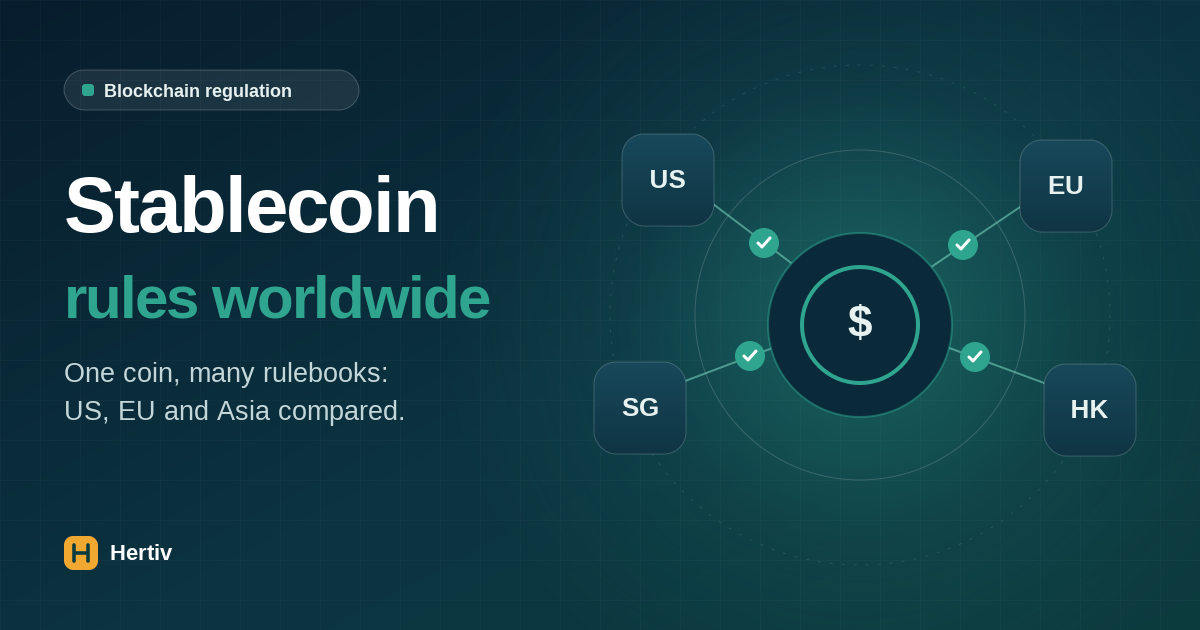
The rules share a common shape even where the details differ. Most regimes ask who may issue a stablecoin, what must back it, how reserves are checked, what issuers must tell the public, and how transfers are screened for crime. The table below compares the five regimes that matter most to teams issuing or accepting stablecoins today.
| Regime | Who licenses | Reserve rule | Key date |
|---|---|---|---|
| United States (GENIUS Act) | Federal or state regulator | One-to-one in dollars or low-risk assets | Signed 18 July 2025; in effect by early 2027 |
| European Union (MiCA) | National regulator under EU rules | One-to-one, segregated and redeemable | Stablecoin rules from 30 June 2024 |
| Singapore (MAS) | Monetary Authority of Singapore | One-to-one in the same currency | Framework finalised in 2023 |
| Hong Kong | Hong Kong Monetary Authority | One-to-one, segregated reserves | Ordinance in effect 1 August 2025 |
| United Kingdom | FCA under payments rules | One-to-one backing expected | Full rules still being written |
For a business, the practical question is not which regime is strictest but which ones apply to your coin. A dollar stablecoin issued in the United States and sold in Europe must satisfy both the US GENIUS Act and MiCA, and a Hong Kong dollar coin needs an HKMA licence even if the issuer sits elsewhere. Mapping that overlap before launch is cheaper than fixing it afterwards.
How does the US GENIUS Act regulate stablecoins?
The GENIUS Act is the first federal US law for payment stablecoins. Signed on 18 July 2025 as Public Law 119-27, it sets a licensing regime for issuers, requires one-to-one backing in US dollars or other low-risk assets, and bars issuers from paying interest or yield on the coins themselves.
Only permitted issuers may offer a payment stablecoin in the United States: a subsidiary of an insured bank, a federally licensed nonbank, or a state-licensed issuer operating under a regime certified as substantially similar. Foreign issuers must meet comparable standards and submit to US oversight before their coins can be offered to US customers.
Issuers must publish monthly reserve reports, undergo annual audits, and give holders a clear right to redeem at par. The Act takes effect on the earlier of 18 January 2027 or 120 days after regulators issue final implementing rules, so teams have a window to prepare — but the direction of travel is settled.
How does the EU MiCA framework regulate stablecoins?
MiCA, the EU Markets in Crypto-Assets Regulation, treats stablecoins as either asset-referenced tokens or e-money tokens, and applies its stablecoin rules from 30 June 2024, with the full framework in force from 30 December 2024. An issuer needs authorisation in an EU member state and must publish a white paper describing the coin, its reserves and its risks.
Reserves must be held one-to-one, segregated from the issuer's own funds, and invested only in safe, liquid assets. Holders have a right to redeem at par at any time, and issuers must publish regular reserve reports. Significant stablecoins face extra supervision, including limits on daily transaction volumes when used as a means of payment.
For teams outside the EU, the key point is reach: a stablecoin offered to EU customers falls under MiCA even if the issuer is based elsewhere. That is why many non-EU issuers now run a separate EU entity or work through a licensed partner.
How do Singapore, Hong Kong and the UAE compare?
Singapore's Monetary Authority finalised its stablecoin framework in 2023. Single-currency stablecoins that meet its conditions — one-to-one backing in the same currency, segregated reserves, and clear redemption rights — may be labelled MAS-regulated, while others are treated as ordinary digital payment tokens.
Hong Kong went further: its Stablecoins Ordinance took effect on 1 August 2025 and makes it an offence to issue a specified stablecoin in Hong Kong, or one referencing the Hong Kong dollar, without an HKMA licence. Applicants need at least HK$25 million in paid-up capital, segregated reserves, and a local presence.
The UAE splits supervision between Dubai's VARA and the ADGM's FSRA, both of which license fiat-referenced token issuers under one-to-one reserve rules. The pattern across all three hubs is the same: a licence, full backing, and regular checks — with the paperwork and the supervisor changing by city.
What do issuers have to do in every major market?
Whatever the jurisdiction, five duties show up in every regime. First, hold reserves equal to coins in issue, in the same currency, and keep them separate from company money. Second, prove it: monthly reserve reports and an annual independent audit are now the norm.
Third, publish clear disclosures — what backs the coin, where the reserves sit, and how redemption works. Fourth, screen transfers for money laundering and sanctions, and keep records regulators can inspect. Fifth, hold a licence or work through a licensed partner; unlicensed issuance is now an offence in the major hubs, not a grey area.
If you are planning an issuer, stablecoin development covers the reserve, custody and reporting systems these rules require. The engineering and the legal work have to move together: a reserve dashboard nobody audits is as useless as an audit of a system that cannot produce the numbers.
Example (hypothetical): a payments company goes global
Example (hypothetical): a payments company issues a dollar stablecoin and wants to sell it in the United States, the EU and Singapore. It holds $10 million in reserves for $10 million of coins in issue, so the backing ratio is exactly one-to-one, and it publishes a monthly reserve report in each market.
The company budgets for three licences, three reserve audits a year in each market — nine audits in total — and one disclosure document per regime. It also sets a 30-day window to answer a redemption request at par, even though most redemptions clear in one or two days. The point of the exercise is that compliance cost scales with markets, not with coins issued.
It also learns that the same coin needs different wording in each market: what counts as a permitted reserve asset in the United States is not identical to what MiCA allows, and Singapore's labelling rules differ again. The company keeps one reserve pool and three compliance checklists, and reviews all three every quarter.
What are the common mistakes?
The most common mistakes are assuming one licence covers everywhere, treating reserves as working capital, and publishing reserve reports nobody audits.
- Launching in a second market without a local licence or partner. Selling into a market is usually enough to trigger its rules, even if the issuer is based elsewhere.
- Holding reserves in a different currency from the coin, or mixing them with company funds. Segregation is a core duty in every regime, and auditors check it first.
- Promising instant redemption without a tested process for large redemptions. A redemption queue that works for ten holders can break for ten thousand.
- Ignoring the travel rule and sanctions screening on transfers. Payment flows need the same checks as the issuance itself.
- Writing marketing that promises yield on a payment stablecoin, which the US rules bar. Interest claims are one of the fastest ways to draw an enforcement letter.
Key takeaways
- There is no single global stablecoin rulebook; each major market writes its own law
- The US GENIUS Act and EU MiCA both demand one-to-one reserves, audits and redemption at par
- Singapore, Hong Kong and the UAE add their own licensing regimes with the same core duties
- Compliance cost scales with the number of markets, not with the number of coins issued
- Selling into a market usually triggers its rules, even if the issuer is based elsewhere
Frequently asked questions
Which stablecoin regime is the strictest?
No single regime is strictest on every point. The US GENIUS Act and EU MiCA are the most detailed on reserves and redemption, Hong Kong sets the highest capital bar for applicants, and Singapore's labelling rules are the most explicit. Compare the duties that apply to your coin rather than ranking whole regimes.
Do I need a licence to issue a stablecoin?
In every major market, yes — either your own licence or a licensed partner. The United States, the EU, Singapore, Hong Kong and the UAE all require authorisation for fiat-referenced stablecoins, and unlicensed issuance is now an offence in the main hubs rather than a grey area.
What reserves must a stablecoin hold?
Every major regime requires one-to-one backing in the same currency, held separately from the issuer's own funds and invested only in safe, liquid assets. Issuers must also publish monthly reserve reports and pass an annual independent audit in most markets.
Does MiCA apply if my company is outside the EU?
Yes, if you offer the stablecoin to EU customers. MiCA's reach follows the customer, not the issuer's address, which is why many non-EU issuers run a separate EU entity or work through a licensed partner for European distribution.
When does the US GENIUS Act take effect?
The Act takes effect on the earlier of 18 January 2027 or 120 days after regulators issue final implementing rules. The law itself was signed on 18 July 2025, so issuers have a preparation window, but the licensing, reserve and audit duties are already fixed.
Can one stablecoin be sold in the US, EU and Asia at once?
Yes, but it must satisfy each market's rules at the same time: a US licence or equivalent, MiCA authorisation, and the local regime in each Asian hub. Most issuers budget one licence, one audit cycle and one disclosure document per market.


