What Is the GENIUS Act, and What Does It Do?
The GENIUS Act is the US law that sets federal rules for payment stablecoins, from reserve backing to who may issue them. Here is what it covers and who it affects.
On this page
Short answer
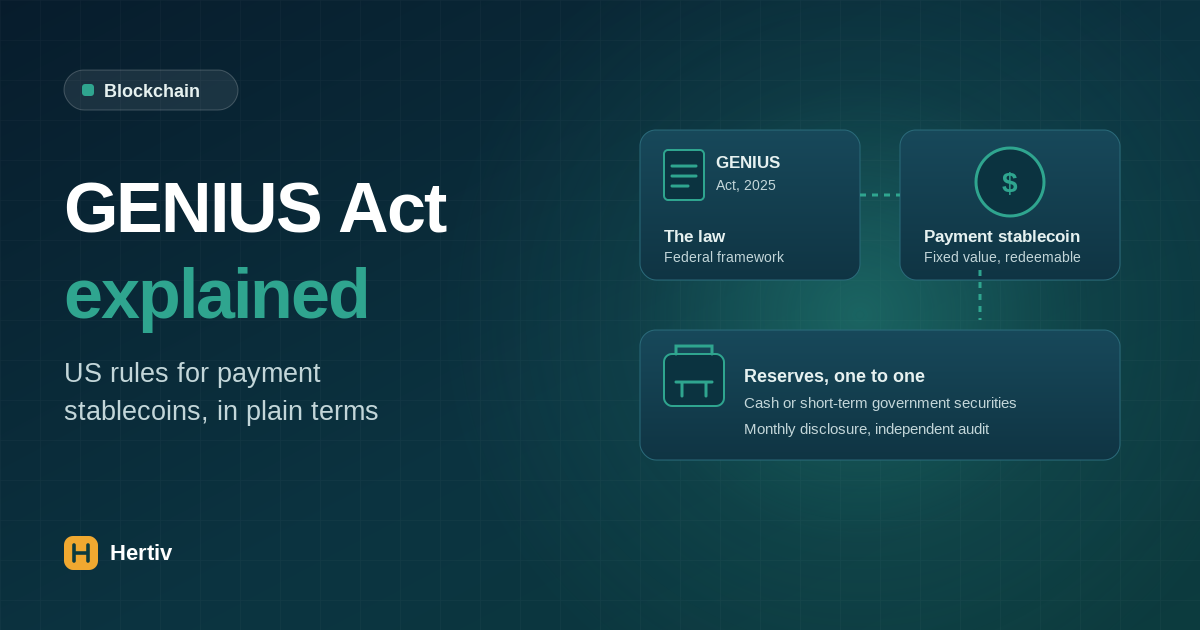
The GENIUS Act is a United States federal law that creates a legal framework for payment stablecoins, the digital tokens designed to hold a steady value against a currency such as the dollar. It sets rules for who may issue them, how reserves must be held and disclosed, and how issuers are supervised. It gives stablecoin businesses a clear federal path instead of a patchwork of state rules.
What is the GENIUS Act?
The GENIUS Act is a United States federal law that sets the rules for payment stablecoins. Its full name is the Guiding and Establishing National Innovation for U.S. Stablecoins Act, and it was signed into law in July 2025. It is the first federal law to give stablecoins a dedicated legal framework.
Before the Act, stablecoin issuers worked under a mix of state money-transmitter licences and general financial rules, with no federal standard for what a stablecoin had to be. That left banks, payment companies and crypto firms unsure which rules applied to them, and it left users unsure which tokens were backed by real reserves.
The Act answers that uncertainty for one kind of token: the payment stablecoin, a token designed to be used as a means of payment and redeemable at a fixed value, usually one dollar. It does not try to regulate every crypto asset. Its scope is the tokens that act like digital dollars, and the firms that issue them.
What does the Act cover?
The Act covers payment stablecoins and the firms that issue them. A payment stablecoin is a digital asset designed to hold a fixed value against a currency and to be used for payments or settlement, rather than as an investment.
Three things fall inside its scope. First, who may issue a payment stablecoin and under what licence. Second, how issuers must back the tokens, with reserves and regular disclosure. Third, how issuers are supervised, including anti-money-laundering duties and consumer protection rules.
Things outside its scope include most other crypto assets. A token that is not designed as a payment instrument, and a decentralised protocol with no issuer, are not payment stablecoins under the Act. Other laws and regulators still apply to those, and the Act does not replace them. For teams building in this space, the distinction between a payment token and other tokens is the first question to settle, and blockchain consulting often starts there.
Who can issue a payment stablecoin?
Under the GENIUS Act, a payment stablecoin may only be issued by a permitted issuer. The Act creates a federal path for issuers and a state path for smaller ones, with the federal standard setting the floor for both.
| Issuer type | What it is | Supervision |
|---|---|---|
| Insured bank or credit union | A bank or credit union issuing through a subsidiary or directly | Its existing banking regulator |
| Licensed nonbank issuer | A nonbank firm licensed at federal level | Federal regulator for stablecoin issuers |
| State-qualified issuer | A smaller issuer licensed by a state | State regulator, within a size limit |
| Foreign issuer | A firm issuing abroad and offering tokens in the US | Must meet comparable rules to sell in the US |
The state path matters because many stablecoin firms started under state licences. The Act lets smaller issuers stay with their state regulator, but only while they stay below a size limit and only if the state regime is comparable to the federal standard. Once an issuer grows past that limit, it moves to federal supervision.
What reserve rules does the Act set?
The Act requires payment stablecoins to be backed one to one by reserves held in cash or short-term United States government securities, or other low-risk assets the law allows. The reserves must be held separately from the issuer's own money, so they cannot be used for the firm's other business.
Issuers must also publish monthly disclosures showing the reserves that back the tokens in circulation, and larger issuers must have their reserves examined by an independent auditor. The point is that a holder can check, every month, that the tokens they hold are backed by real assets.
These rules are the core of the Act. A stablecoin that is not fully backed is not a payment stablecoin under the law, whatever its marketing says. The reserve rule is also what separates a regulated payment token from the unbacked or partly backed tokens that lost value in earlier market stress. Stablecoin development work now starts from these reserve and disclosure duties, not from the token code alone.
What does the Act mean for businesses?
For businesses, the Act means a stablecoin can now be issued, held and accepted under a clear federal framework, with duties that look familiar to anyone who has worked with regulated payments.
- Issuers must be licensed and supervised. A firm cannot simply launch a dollar token and call it a stablecoin. It needs a permitted issuer status and a regulator.
- Issuers may not pay interest or yield. The Act bars payment stablecoin issuers from paying interest or yield on the tokens themselves, so a stablecoin is a payment instrument, not a savings product.
- Anti-money-laundering rules apply. Issuers must run the same kinds of checks, records and reporting that other payment firms run, including screening and suspicious activity reporting.
- Holders get priority in failure. If an issuer fails, holders have a claim on the reserves ahead of other creditors, which is what makes the backing meaningful.
For companies that accept stablecoins, the Act brings clarity too. A payment stablecoin from a permitted issuer is a regulated instrument with known reserves, which makes it easier for a finance team to approve. Teams that accept them usually build on stablecoin payment infrastructure rather than handling tokens directly. That is the practical effect the law was written to produce: tokens that a business can treat as money, not as a bet.
Example (hypothetical): a fintech issuing a dollar stablecoin
Example (hypothetical): a fintech plans to issue a dollar stablecoin for online merchants. It expects 20,000 holders with an average balance of $500, so the total in circulation would be 20,000 times $500, which is $10,000,000.
Under the Act, the firm must hold $10,000,000 in reserves, in cash or short-term government securities, kept separate from its own funds. Each month it publishes a disclosure showing those reserves, and an auditor checks the figures.
If 2,000 holders redeem $500 each on the same day, the firm pays out 2,000 times $500, which is $1,000,000, and the tokens in circulation fall to $9,000,000. The reserves fall by the same $1,000,000, so the backing stays one to one. The numbers are invented to show the arithmetic, not a real launch. The point is that the reserve rule is a balance-sheet rule, not a marketing claim.
What are the common mistakes?
The most common mistakes around the GENIUS Act are treating it as a licence for all crypto, assuming interest is allowed, and ignoring the state rules that still apply.
- Calling any token a stablecoin. Only a payment stablecoin issued by a permitted issuer under the Act counts. Other tokens are governed by other rules.
- Promising yield. The Act bars issuers from paying interest or yield on payment stablecoins, so a product that promises returns on a stablecoin balance is not a payment stablecoin product.
- Forgetting anti-money-laundering duties. A licensed issuer still has to run checks, keep records and report suspicious activity, just like any other payment firm.
- Ignoring the state path. Smaller issuers may stay state-licensed, but only within the size limit and only under a comparable state regime.
- Treating disclosure as a formality. Monthly reserve disclosures are a core duty, and a firm that cannot produce them on time will draw regulator attention.
Key takeaways
- The GENIUS Act is the first US federal framework for payment stablecoins
- Only permitted issuers may issue a payment stablecoin, federally or state-licensed
- Tokens must be backed one to one by cash or short-term government securities
- Issuers must publish monthly reserve disclosures and face independent audits
- Issuers may not pay interest or yield on payment stablecoins
Frequently asked questions
Does the GENIUS Act cover all cryptocurrencies?
No. It covers payment stablecoins, which are tokens designed to hold a fixed value and be used for payments. Other crypto assets, such as tokens that are not payment instruments, fall under other laws and regulators. The Act does not create a general framework for all crypto, and it does not replace securities, commodities or tax rules.
What is a payment stablecoin under the Act?
It is a digital asset designed to be used as a means of payment and redeemable at a fixed value, usually one dollar. The token must be issued by a permitted issuer and backed one to one by reserves. A token that is not designed for payments, or that has no issuer, is not a payment stablecoin under the Act.
Can a stablecoin issuer pay interest to holders?
No. The Act bars payment stablecoin issuers from paying interest or yield on the tokens themselves. A stablecoin under the Act is a payment instrument, not a savings product. A firm that wants to offer returns on deposits needs a different licence and a different product.
What happens to holders if an issuer fails?
Holders have a claim on the reserves ahead of other creditors, because the reserves are held separately from the issuer's own money. That priority is what makes the one-to-one backing meaningful in a failure. It does not guarantee instant payment, but it puts holders first in line for the reserve assets.
Do small issuers need a federal licence?
Not always. The Act allows smaller issuers to stay licensed by a state, as long as they stay below a size limit and the state regime is comparable to the federal standard. Once an issuer grows past that limit, it moves to federal supervision. A firm should check which path fits its size before launching.
When did the GENIUS Act become law?
It was signed into law in July 2025, after passing Congress earlier that year. The law then set a timetable for regulators to write the detailed rules for licensing, reserves and supervision. A team building a stablecoin should check the current state of those rules, since the detailed requirements arrive in stages.


