GENIUS Act Timeline: From Bill to Law and What Comes Next
The GENIUS Act went from bill to law in about five months; its rules take effect on the earlier of 18 months after signing or 120 days after final rules.
On this page
Short answer
The GENIUS Act is a United States federal law that creates a legal framework for payment stablecoins. It was introduced in the Senate in February 2025, passed both chambers by July 2025, and was signed into law on 18 July 2025. Its rules take effect on the earlier of 18 months after enactment or 120 days after regulators publish final rules.
What is the GENIUS Act?
The GENIUS Act is a United States federal law that creates a legal framework for payment stablecoins, the digital tokens designed to hold a steady value against a currency such as the dollar. It sets rules for who may issue them, what reserves must back them, and how issuers must report to regulators.
The Act matters because stablecoins were used for years without a dedicated federal law. Issuers worked under a patchwork of state licences and money-transmitter rules, which left buyers unsure which coins were backed and who would check. The Act gives the market one set of federal rules to follow.
It does not cover every digital token. It targets payment stablecoins only, not other crypto assets, and it leaves securities and commodities law to the agencies that already handle them. For the full picture of what the law covers, see what is the GENIUS Act, and what does it do.
What is the timeline so far?
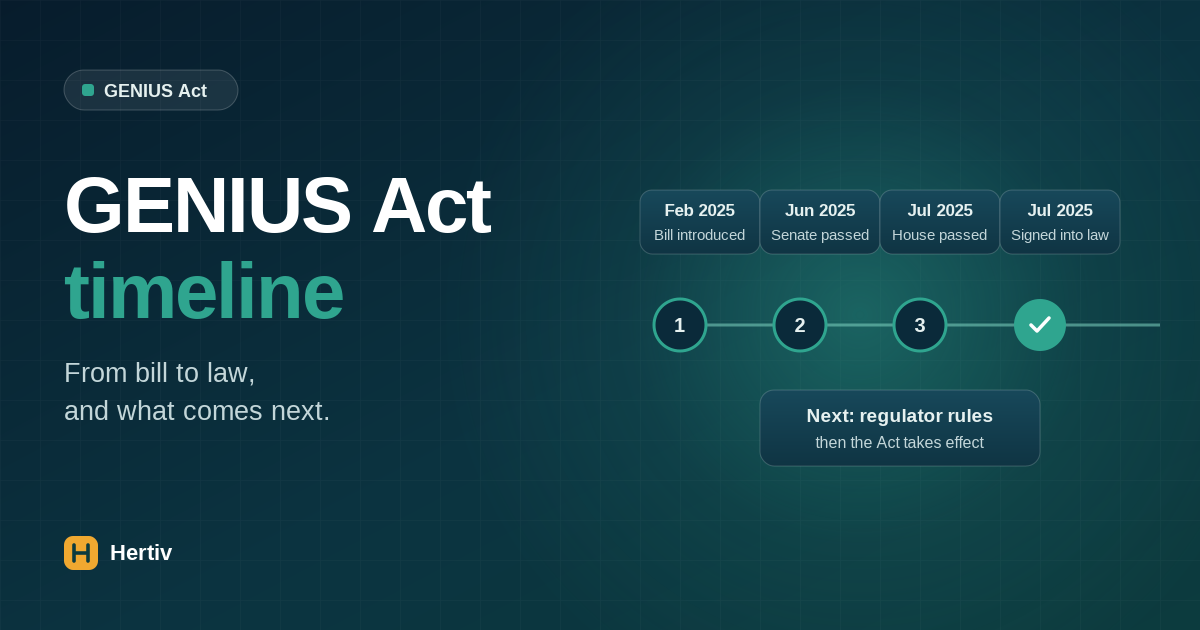
The Act moved from introduction to law in about five months, which is fast for financial legislation. Each step below changed what issuers could plan around, so the dates matter for any team with a launch in mind.
| Date | Milestone | What changed |
|---|---|---|
| 4 February 2025 | Bill introduced in the Senate | A draft framework for payment stablecoins existed |
| 13 March 2025 | Senate Banking Committee advanced the bill | The bill moved toward a full Senate vote |
| 17 June 2025 | Senate passed the bill | The framework had majority support in the Senate |
| 17 July 2025 | House passed the bill | Both chambers had agreed the same text |
| 18 July 2025 | Signed into law | The framework became federal law |
| After signing | Regulators write detailed rules | The practical requirements take shape |
The quick passage surprised many observers, because earlier stablecoin bills had stalled for years. The lesson for teams is that the law arrived sooner than most roadmaps assumed, so planning should have started at introduction, not at signing.
When does the Act take effect?
The Act does not switch on the day it is signed. It takes effect on the earlier of two dates: 18 months after enactment, or 120 days after the regulators publish their final rules. That means the real start date depends on how fast the agencies move.
If the agencies publish final rules quickly, the 120-day clock could bring the Act into force well before the 18-month backstop. If rulemaking drags, the 18-month date caps the wait. Either way, issuers should treat the earlier date as the planning deadline.
The gap between signing and taking effect is normal for financial law. It gives regulators time to write the detail and gives issuers time to change their reserves, reporting and licences before the rules bite.
What rules do regulators still have to write?
The Act sets the framework, but the detail sits with the regulators: the Treasury, the Federal Reserve, the Comptroller of the Currency and, for some issuers, state regulators. They must define how the rules work in practice.
The open questions include how reserve audits are carried out, what counts as a permitted reserve asset, how issuers report each month, and how foreign issuers are treated. Each answer changes what an issuer must build, and each one can add cost if the team has to rebuild a process it already shipped.
Teams should watch for draft rules and comment periods, because those drafts are the first chance to see the practical burden. A rule that looks simple in the Act can become demanding once the reporting format is fixed, and the comment period is the moment to push back on a format that does not fit how issuers actually work.
What should a stablecoin team do now?
A team planning a payment stablecoin should work to the Act's timeline, not wait for the final rules. The framework is law already, so the direction of travel is set even if the detail is not.
- Read the Act's issuer and reserve requirements and map them against your current setup.
- List every gap: reserves, audits, monthly reporting, licences and disclosures.
- Choose your regulator path: a federal route or a state route, and check which fits your size.
- Start the reserve and audit changes now, since they take months to put in place.
- Track draft rules and comment periods so you can react before they become final.
Teams that start early can shape their product around the rules instead of rebuilding it later. For how stablecoins already work for businesses, see stablecoin payments for business.
Example (hypothetical): a fintech plans around the timeline
Example (hypothetical): a small fintech wants to launch a dollar stablecoin for cross-border payments. It reads the Act in August 2025 and finds three gaps: its reserves sit in a mix of assets the Act may not allow, it has no monthly audit process, and it holds no licence that covers issuing.
The team works backwards from the earliest possible start date. It moves reserves into permitted assets over three months, hires an auditor for monthly checks, and starts a licence application that takes six months. By early 2026 the product is ready to meet the rules when they take effect, instead of scrambling after the final rules appear.
The point is not the exact dates. It is that the timeline rewards teams that start at signing, because the gap between law and effect is the only window for changing reserves, audits and licences without stopping the business.
What are the common mistakes?
Most mistakes come from treating the timeline as a single date. The Act has several dates that matter: introduction, passage, signing, rulemaking and the effective date, and each one changes what a team should do next.
- Waiting for final rules before starting reserve and audit changes
- Assuming the 18-month backstop is the real deadline, when the 120-day clock may come first
- Treating the Act as covering all crypto, when it targets payment stablecoins only
- Ignoring state regulators, who still play a role for many issuers
- Launching before the licence application is complete
- Forgetting that monthly reporting needs systems, not just a spreadsheet
Key takeaways
- The Act went from bill to law in about five months in 2025.
- It takes effect on the earlier of 18 months after signing or 120 days after final rules.
- Regulators still have to write the detailed rules on reserves, audits and reporting.
- Teams should start reserve and licence changes now, not wait for final rules.
- The Act covers payment stablecoins only, not all crypto assets.
Frequently asked questions
What is the GENIUS Act?
The GENIUS Act is a United States federal law that sets rules for payment stablecoins: who may issue them, what reserves must back them, and how issuers report. It was signed into law on 18 July 2025.
When did the GENIUS Act become law?
It was introduced in the Senate on 4 February 2025, passed the Senate on 17 June 2025, passed the House on 17 July 2025, and was signed into law on 18 July 2025.
When does the GENIUS Act take effect?
It takes effect on the earlier of 18 months after enactment or 120 days after regulators publish final rules. The exact date depends on how fast the agencies finish rulemaking.
Does the GENIUS Act cover all crypto?
No. It targets payment stablecoins only, the tokens designed to hold a steady value against a currency such as the dollar. Other crypto assets stay under existing securities and commodities law.
Who writes the detailed rules?
The Treasury, the Federal Reserve, the Comptroller of the Currency and, for some issuers, state regulators. They define reserve audits, reporting formats and how foreign issuers are treated, and their drafts are the first real look at the practical burden.
What should a stablecoin issuer do now?
Map the Act's requirements against your setup, fix reserve and audit gaps, start licence applications, and track draft rules. The gap between signing and taking effect is the window for those changes.


