Generative AI in Financial Reporting: Where It Helps
Generative AI can draft report narratives and summarise variances, but it cannot sign off the numbers. Here is where it helps in financial reporting.
On this page
Short answer
Generative AI in financial reporting is the use of language models to draft report text, explain variances, summarise results and check figures against source data. It speeds up the writing and review stages of the monthly close, but it does not replace the checks that make a report accurate. Every number it produces must be traced back to the ledger and approved by a person before the report goes out.
What is generative AI in financial reporting?
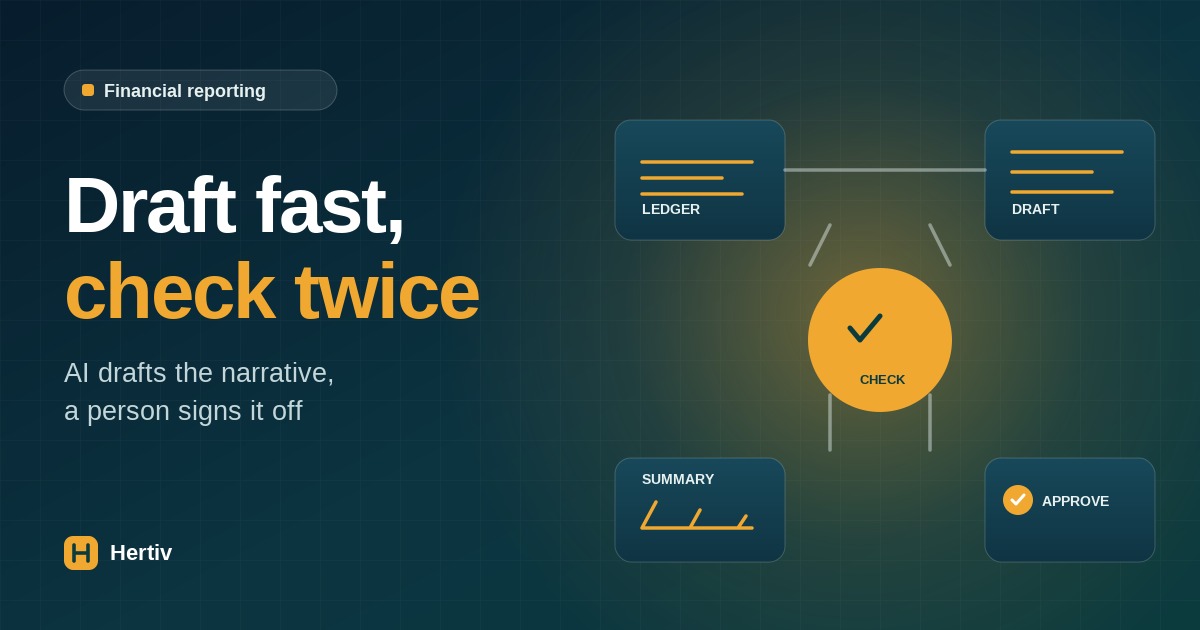
Generative AI in financial reporting is the use of language models to help produce the reports a finance team issues each month, quarter or year. The model reads the figures from the ledger and the reporting system, then drafts the narrative, explains the changes, and flags the numbers that look wrong.
The work it does is the writing and first-pass checking, not the accounting itself. The ledger stays the source of truth, and the model works from it. A report that the model drafts still goes through the same review and sign-off as a report a person wrote, because the numbers in it are the company's responsibility.
The reason teams are trying it is time. Writing the narrative for a monthly pack can take a finance team days, and much of that time goes on work the model can do: turning a table of variances into plain sentences, and turning a long report into a one-page summary for the board.
What can generative AI do in a monthly close?
The monthly close has a set of repetitive writing and checking jobs, and the model can take the first pass at most of them. The table below shows the main uses.
| Use | What the model does | What the person does |
|---|---|---|
| Draft narratives | Turns variance tables into sentences | Checks every figure and the tone |
| Explain variances | Suggests reasons from the data | Confirms the real cause |
| Summarise results | Compresses a long pack to one page | Decides what the board must see |
| Check figures | Flags numbers that do not add up | Investigates and fixes the source |
| Answer questions | Finds the figure in the pack | Judges whether the answer is right |
| Draft disclosures | Writes a first draft from templates | Reviews wording and compliance |
Drafting narratives is the biggest time saver, because it is the most mechanical part of the close. The model can turn a variance table into a paragraph in seconds, and the person then spends their time checking the figures instead of typing sentences. For the data the model reads from, finance data warehouse explains how finance data is gathered into one place.
Variance explanations are the use that needs the most care. The model can suggest a reason, such as a price rise or a volume fall, but it cannot know whether that reason is the real one. The person who owns the numbers must confirm the cause, because the model will happily invent a plausible reason when the data is silent.
Where does generative AI save the most time?
The biggest saving is in the first draft. A monthly pack that takes two days to write can often be drafted in half a day with a model, because the model does the mechanical part: turning tables into sentences and long reports into summaries. The review still takes the same time, but the writing does not.
The second saving is in questions. During the close, managers ask the same questions every month: why did costs rise, which product fell short, what changed since last quarter. A model that can read the pack can answer the easy ones in seconds, so the finance team only handles the questions that need judgement.
The smallest saving is in the final review, and that is by design. The review is where the accuracy lives, and it should not get faster just because the draft arrived faster. A team that cuts review time to match the drafting saving is the team that will send out a wrong number.
What are the limits and risks?
Generative AI has three limits in financial reporting, and all three come from the same fact: the model writes plausible text, not verified truth.
- It can invent figures. A model asked to explain a gap may fill it with a number that looks right but is not in the data. Every figure in a draft must be checked against the ledger, not against the model.
- It only knows what it is given. If the data fed to the model is stale or incomplete, the draft will be too, and it will sound just as confident. The data pipeline matters more than the model.
- It leaves no audit trail by itself. A report must show where each number came from and who approved it. The model does not keep that record, so the team must build it around the model.
- It cannot sign off. The person who signs the report is responsible for it, model or no model. The model is a drafting tool, not an approver.
The practical rule is to treat the model's output as a draft from a junior colleague: useful, fast, and always in need of checking. For the testing habits that catch model errors before they reach a report, how to test AI models covers the checks that matter most.
Example (hypothetical): a finance team closes the month faster
Picture a finance team of four that closes the month in 40 hours: 12 hours drafting the narrative, 10 hours checking the figures, 8 hours answering managers' questions, 6 hours building the board summary, and 4 hours on the final review.
With a model helping, the drafting falls from 12 hours to 4, because the model turns the variance tables into sentences and the team only checks them. Answering questions falls from 8 hours to 4, because the model answers the easy ones.
The board summary falls from 6 hours to 3, because the model drafts it from the pack. Checking stays at 10 hours, and the final review stays at 4 hours, because those are the accuracy steps.
The new total is 4 plus 10 plus 4 plus 3 plus 4, which is 25 hours, down from 40. That is a saving of 15 hours, or just over a third of the close. The team uses the saved time to investigate the two variances the model flagged, which is work the model cannot do.
The example shows the pattern: the model saves time on drafting and answering, not on checking and review. A team that expects the model to cut the whole close in half will be disappointed, and a team that cuts the checking to match will be in trouble.
What are the common mistakes?
The most common mistakes with generative AI in financial reporting are trusting the draft, feeding it stale data, and cutting the review to match the drafting saving.
- Trusting the draft. A model can write a confident paragraph with a wrong figure in it. Check every number against the ledger, and treat any number the model cannot source as wrong.
- Feeding it stale data. A model that reads last month's pack will write last month's story. The data it reads must be the same data the report is built from, refreshed for the period.
- Cutting the review. The draft arrives faster, so the temptation is to review faster too. The review is where the accuracy lives, and it should take the same time it always did.
- Letting it write disclosures alone. Disclosure wording has legal meaning, and a model does not know the rules. A person must review every disclosure the model drafts.
- No record of what the model did. If the report is questioned later, the team must be able to show which parts the model drafted and who checked them. Keep that record from the first month.
The safest way to start is with one report, one model, and a full review, so the team learns where the model helps and where it invents, before it touches anything the board will see.
How to start in 5 steps
Starting small is the right approach, because the risks are in the details: the data, the checks and the sign-off. The steps below take a team from nothing to a first model-assisted close.
- Pick one report. Choose the monthly pack or one section of it, not the annual report. A small scope makes the review manageable.
- Fix the data feed first. The model must read the same figures the report is built from, refreshed for the period. If the data is stale, stop and fix the feed.
- Draft, then check every figure. Let the model draft the narrative, then check each number against the ledger before anyone else reads it.
- Keep a record. Note which parts the model drafted, who checked them, and what was corrected. That record is the audit trail.
- Review after one month. Count the hours saved, the errors caught, and the errors that slipped through. Only widen the scope if the errors caught outnumber the errors missed.
The review after one month is the step that decides whether the model stays. If it saves time and the checks catch its mistakes, it earns a wider role. If the errors slip through, the team goes back to drafting by hand. For a related use of generative AI in business writing, generative AI in marketing shows where the same drafting help applies outside finance.
Key takeaways
- Generative AI drafts report narratives and summaries; it does not sign off the numbers
- The biggest saving is the first draft, not the review
- The model can invent figures, so every number must be checked against the ledger
- The hypothetical close falls from 40 hours to 25 hours, saving 15 hours
- Start with one report, fix the data feed first, and keep a record of what the model did
Frequently asked questions
Can generative AI write a financial report on its own?
No. It can draft the narrative and summarise the results, but every figure must be checked against the ledger and approved by a person. The model writes plausible text, not verified truth, and it can invent a figure that looks right.
What is the main benefit of generative AI in financial reporting?
Time. The model drafts narratives and summaries in minutes, so the finance team spends its hours checking figures and investigating variances instead of typing sentences. In the hypothetical example here, the monthly close falls from 40 hours to 25.
Is it safe to use AI for financial reporting?
It is safe if the team treats the output as a draft and checks every figure against the ledger. It is not safe if the draft goes out unchecked, because the model can invent figures and will sound confident while doing so.
What data does the AI need for financial reporting?
The same figures the report is built from, refreshed for the period: the ledger, the variance tables and the reporting pack. If the data is stale or incomplete, the draft will be too, and it will sound just as confident.
Will generative AI replace finance teams?
No. It replaces the mechanical writing, not the judgement. Someone must confirm the cause of a variance, decide what the board must see, and sign the report. The model cannot do any of those, because it cannot be responsible for the numbers.
How do I start using generative AI in financial reporting?
Pick one report, fix the data feed so the model reads the same figures the report is built from, and let it draft while a person checks every number. Review after one month, and only widen the scope if the checks catch the model's mistakes.


