What Are Fractional NFTs, and How Do They Work?
A fractional NFT is one token split into many fungible shares, so several buyers can own part of an expensive artwork, collectible or asset.
On this page
Short answer
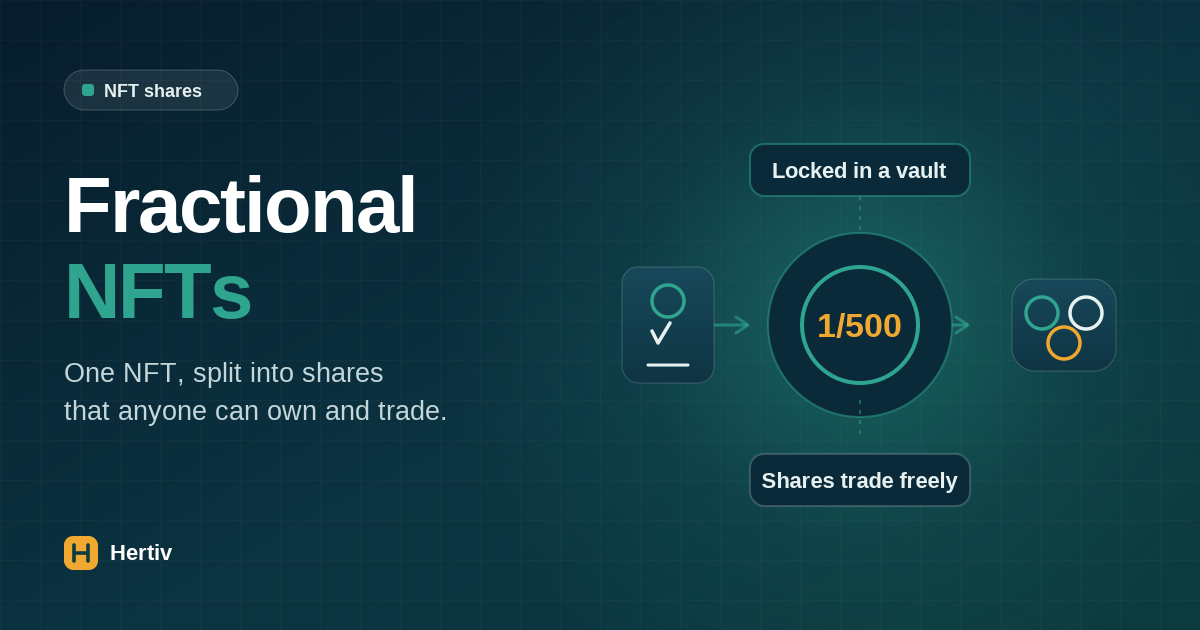
A fractional NFT is a single non-fungible token that has been split into many fungible shares, so several people can each own part of one expensive digital item. The original NFT is locked in a smart contract vault, the vault issues the shares, and each share can be bought, sold or held like any other token.
What is a fractional NFT?
A fractional NFT is a single non-fungible token that has been split into many fungible shares, so several people can each own part of one expensive digital item. The original NFT is locked in a smart contract vault, and the vault issues a fixed number of fungible tokens that stand for shares in it.
The idea exists because some NFTs cost far more than most buyers can pay for one item. A well-known artwork or collectible can change hands for sums that put it out of reach, so splitting it lets many buyers hold a small stake instead of one buyer holding the whole thing. Each share can be bought, sold or held like any other token.
Fractional NFTs are not the same as a print or a copy. The shares point to one specific NFT in the vault, and the number of shares is fixed when the split happens. If you hold 10 of 1,000 shares, you own one hundredth of that NFT, and the smart contract records your share.
How does fractionalization work?
Fractionalization follows a short sequence: the NFT goes into a vault, shares are minted, and the shares trade on a market. The vault contract holds the original and will only release it under rules the share holders agreed to, such as a buyout vote.
| Step | What happens | Who decides |
|---|---|---|
| Lock the NFT | The original goes into a smart contract vault | The owner |
| Mint shares | The vault issues fungible tokens for the NFT | The vault contract |
| Trade shares | Shares buy and sell on exchanges and marketplaces | The market |
| Buyout | One buyer offers a price for the whole NFT | Share holders vote |
| Release or pay out | The NFT goes to the buyer, or holders keep shares | The vote result |
Most fractional NFTs use the ERC-20 token standard for the shares, because those tokens trade on ordinary decentralised exchanges and work in wallets people already use. The vault contract is the part that needs care: it must be audited, because a bug in it could trap the original NFT or the shares.
Buyouts matter because shares alone do not let you hang the artwork on a wall. A buyout lets one buyer offer a price for the whole NFT, and share holders vote on whether to accept. If the vote passes, the buyer pays, the vault releases the NFT, and each share holder gets their part of the price.
Why would anyone buy a fraction of an NFT?
Buyers split into three groups: collectors who want a stake in a famous piece, traders who want a liquid way in and out, and fans who want a small part of something they care about. For all three, the share is cheaper than the whole item and easier to sell than the whole item, because a buyer for a 100-unit share is easier to find than a buyer for a 50,000-unit NFT.
Shares also open up moves the whole NFT does not allow. A holder can sell half their shares and keep the rest, or use shares as collateral in a lending pool where the whole NFT would be too large to pledge. Some holders treat shares as a way to spread a fixed budget across several expensive items instead of putting it all into one.
None of that makes shares a safe bet. A share is only worth what the next buyer will pay, and the market for shares in one specific NFT can be thin. The next section looks at where shares trade, and the risks section looks at what can go wrong.
Where do fractional NFTs trade?
Shares trade in two places: on decentralised exchanges, where anyone can list a buy or sell order, and on fractional NFT marketplaces, which show the vault, the share price and the buyout rules in one place. Marketplaces built for fractional NFTs also handle the vote when a buyout is proposed, which a general exchange does not.
Liquidity is the main thing to check before buying. A share with many holders and daily trades is easy to exit; a share with three holders and no trades in a month is not. Check the number of holders, the recent trade volume and the gap between the best buy and sell prices before you commit.
Some shares also trade on lending platforms, where holders deposit shares as collateral and borrow against them. That adds a second market, but it also adds a second risk: if the share price falls, the loan can be liquidated and the shares sold. Borrowing against a volatile share is a fast way to lose it.
What are the risks of fractional NFTs?
The biggest risk is price. Shares in one NFT can fall fast if interest in the collection fades, and a thin market makes the fall worse because there are few buyers at any price. A share that cost 100 units can trade at 40 units with no warning, and the holder has no way to sell the underlying NFT alone.
| Risk | What it means | How to reduce it |
|---|---|---|
| Thin market | Few buyers, so shares are hard to sell | Check holders and trade volume first |
| Vault bug | A contract flaw can freeze the NFT or shares | Use audited vaults only |
| Low buyout | Share holders vote to sell too cheaply | Read the buyout rules before buying |
| Legal status | Shares can count as securities in some places | Check the rules where you live |
| No income | Most NFTs pay nothing while you hold them | Do not count on a yield |
The vault is the second risk. If the smart contract has a bug, the NFT or the shares can be frozen or taken, and there is no company to call. Only use vaults whose code has been audited, and read the audit report yourself rather than trusting a badge on a website.
The third risk is legal. Shares in an NFT can look like a security in some places, which brings rules about who may sell them and what must be disclosed. The position differs by country and is still changing, so check the rules where you live before buying or issuing shares.
Example (hypothetical): splitting one artwork into 500 shares
Example (hypothetical): a collector owns one artwork NFT valued at 50,000 units and wants to sell part of it without finding one buyer for the whole piece. The collector locks the NFT in a vault and mints 500 shares at 100 units each, so 500 times 100 equals the 50,000-unit value.
A buyer who purchases 25 shares pays 2,500 units and owns 5 percent of the artwork. A year later, another collector offers 60,000 units for the whole NFT in a buyout. The share holders vote to accept, and each share is worth 60,000 divided by 500, or 120 units, so the buyer of 25 shares receives 3,000 units.
The gain came from the buyout price rising, not from the shares themselves. If the buyout offer had been 40,000 units, each share would be worth 80 units and the same buyer would receive 2,000 units, a loss of 500 units. Shares track the price of the whole NFT, up and down.
What are the common mistakes?
The most common mistakes come from treating a share like a whole NFT, or like a share in a company. A share gives you a slice of one digital item, not a claim on a business, and its value depends on a small market of buyers for that one item.
- Buying shares without checking how many holders trade them
- Trusting a vault that has never been audited
- Ignoring the buyout rules until a buyout is proposed
- Borrowing against shares that can fall fast in a thin market
- Assuming shares pay income, when most NFTs pay nothing
- Skipping the legal position where you live
Key takeaways
- A fractional NFT is one NFT locked in a vault, split into fungible shares.
- Shares are cheaper and easier to sell than the whole NFT, but the market can be thin.
- Buyouts let one buyer take the whole NFT if share holders vote to accept.
- The vault contract is the main technical risk: use audited vaults only.
- Shares track the price of the whole NFT, up and down, and most pay no income.
Frequently asked questions
What is a fractional NFT?
It is a single non-fungible token that has been split into many fungible shares. The original NFT is locked in a smart contract vault, and the vault issues the shares, so several people can each own part of one expensive digital item.
How are fractional NFT shares created?
The owner locks the NFT in a smart contract vault, and the vault mints a fixed number of fungible tokens, usually ERC-20 tokens, that stand for shares in it. The shares then trade on exchanges and marketplaces.
Can you buy back the whole NFT?
Yes, through a buyout. One buyer offers a price for the whole NFT, share holders vote on the offer, and if it passes the buyer pays, the vault releases the NFT, and each share holder gets their part of the price.
Are fractional NFTs a good investment?
They are a high-risk one. Shares can fall fast if interest in the collection fades, the market for shares in one NFT can be thin, and most NFTs pay no income while you hold them, so treat shares as a speculative stake, not a steady return.
What is the difference between fractional NFTs and NFT shares?
There is none in practice: both describe the same thing, fungible shares in one NFT held in a vault. The term fractional NFT usually describes the whole arrangement, while a share is one unit of it.
Do fractional NFTs fall under securities rules?
They can, in some places, because shares in an asset can look like a security. The position differs by country and is still changing, so check the rules where you live before buying or issuing shares.


