How to Create Your Own Fractional NFT Marketplace
A fractional NFT marketplace lets many people own shares of one NFT. This guide covers how it works, the features you need and the build cost.
On this page
Short answer
A fractional NFT marketplace is a platform where one non-fungible token is split into many fungible shares that people can buy, sell and trade. Instead of one buyer paying the full price of an expensive NFT, many buyers each own a small part of it, and the platform handles the splitting, trading and governance of the shared asset.
What is a fractional NFT marketplace?
A fractional NFT marketplace is a platform where one non-fungible token is split into many fungible shares that people can buy, sell and trade. Instead of one buyer paying the full price of an expensive NFT, many buyers each own a small part of it, and the platform handles the splitting, trading and governance of the shared asset.
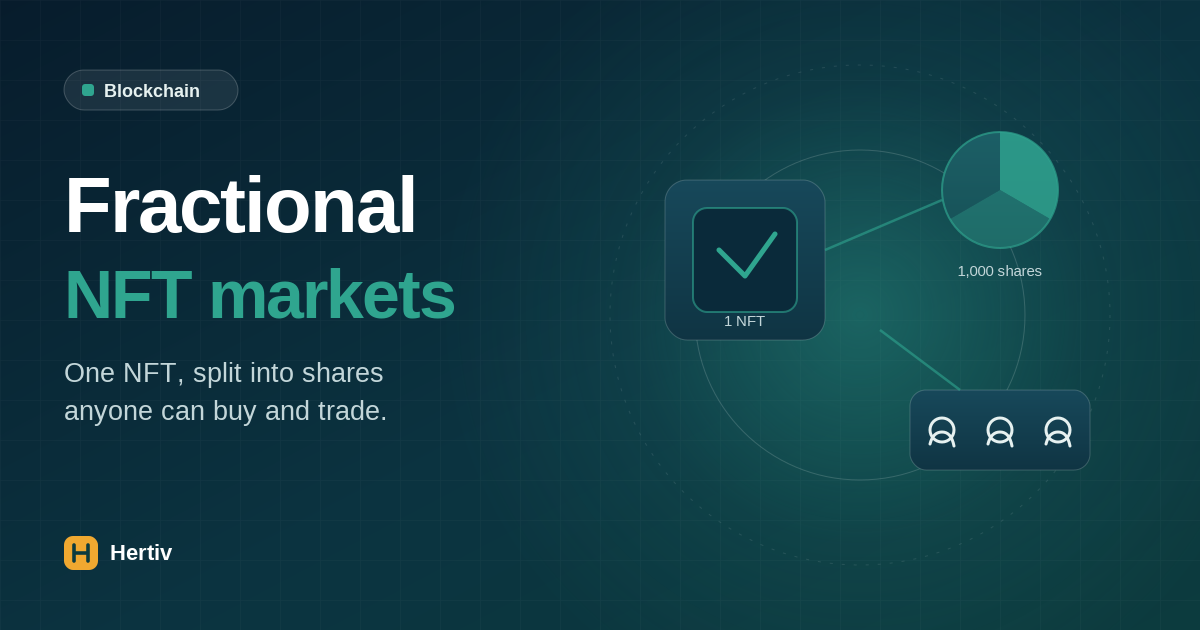
Fractionalisation works by locking the original NFT in a smart contract called a vault. The vault then issues fungible tokens that represent shares of that NFT. Each share token is identical and tradable, so owners can buy or sell their part without needing to find a buyer for the whole NFT.
The idea matters because high-value NFTs are out of reach for most buyers. A digital artwork priced at $100,000 has very few potential buyers, but 1,000 shares at $100 each have many. Fractionalisation turns a single illiquid asset into a market with many participants. A guide to how to develop an NFT marketplace covers the standard marketplace parts that a fractional version builds on.
How does fractional ownership work?
Fractional ownership works through a vault smart contract, share tokens and a buyout rule. The NFT is locked away, shares are issued, and owners vote on what happens next, including whether to sell the whole NFT.
| Step | What happens | Who decides |
|---|---|---|
| Deposit | Owner locks the NFT in a vault contract | The depositor |
| Split | Vault issues fungible share tokens | Smart contract |
| Trade | Shares trade on the marketplace | Buyers and sellers |
| Govern | Shareholders vote on offers and sales | Token holders |
| Buyout | One buyer can buy all shares at a set price | Contract rules |
| Exit | Vault releases the NFT or pays out proceeds | Smart contract |
The buyout rule is the part most new builders forget. Without it, an NFT can sit in a vault forever while shareholders disagree. A fair buyout rule lets any buyer offer to purchase all shares at a price, gives shareholders time to respond, and pays out automatically if the offer is accepted.
What features does a fractional NFT marketplace need?
A fractional NFT marketplace needs vault contracts, share trading, governance voting, price discovery and a clear buyout path. Without any one of these, the platform either cannot split assets or cannot let owners exit.
- Vault contracts. Lock the NFT, issue share tokens and enforce the rules. These contracts need a security audit before launch.
- Share trading. An order book or automated pool where share tokens trade, with fees shown clearly before each trade.
- Governance voting. Shareholders vote on offers to buy the whole NFT, on fees and on which assets to list.
- Buyout mechanism. A fair process for one buyer to purchase all shares, with a time window for shareholders to respond.
- Price and history. Live share prices, trading history and the vault contents, so buyers can see what they own.
- Wallet and identity. Wallet connection, plus identity checks where the law requires them.
Price discovery is harder than it looks. Shares of a rare NFT trade rarely, so the last traded price may be old. Showing the vault value, recent trades and open offers together gives buyers a fairer picture than a single price. The best white-label options are compared in best white-label NFT marketplaces.
How do you build a fractional NFT marketplace in 7 steps?
Building a fractional NFT marketplace follows the same sequence as most blockchain products, with extra work on the vault contracts and the buyout rules. Each step below has a clear output before the next one starts.
- Pick the asset class. Art, collectibles, real estate or music each have different buyers, prices and legal questions. Start with one.
- Design the vault and shares. Decide how many shares each NFT splits into, how voting works and how a buyout is triggered.
- Write and audit the contracts. Build the vault, share token and buyout contracts, then pay for an independent security audit.
- Build the trading layer. Add listings, share trading, price charts and order history.
- Add governance. Build voting so shareholders can accept or reject offers for the whole NFT.
- Handle legal checks. Get advice on whether the shares count as securities in the countries you serve, and add identity checks if needed.
- Launch with one asset. List a single well-known NFT, watch how trading and voting behave, then add more assets.
Launching with one asset is the safest path. It lets the team test the vault, the trading and the buyout flow with real users before the platform holds many assets. A single failed vault is a fixable problem; ten failed vaults are a crisis.
What does it cost to build a fractional NFT marketplace?
A first version of a fractional NFT marketplace typically costs $90,000 to $200,000 to build. A fuller product with governance, a buyout auction and multi-chain support typically costs $200,000 to $450,000. A multi-country product with legal review and compliance tooling typically costs $450,000 to $900,000. These are indicative ranges for planning, not vendor quotes.
| Version | What it includes | Indicative build cost | Time to build |
|---|---|---|---|
| First version | Vault, share trading, one chain | $90,000-$200,000 | 4-7 months |
| Full product | Governance, buyout auctions, analytics | $200,000-$450,000 | 7-12 months |
| Multi-country | Compliance tooling, legal review, multi-chain | $450,000-$900,000 | 12-18 months |
The audit is a major cost driver. Vault contracts hold valuable assets, so an independent audit is not optional, and fixing audit findings takes time. Legal advice is the other big cost, because share tokens can fall under securities rules in some countries. Budget for both before writing code.
Example (hypothetical): splitting one artwork into 1,000 shares
Example (hypothetical): a marketplace lists a digital artwork valued at $100,000. The vault splits it into 1,000 shares, so each share costs $100, because $100,000 divided by 1,000 is $100.
A buyer purchases 10 shares for $1,000. Later, the buyer sells 4 shares at $120 each, receiving $480 before fees. The platform charges a 2.5 per cent trading fee, which is $12 on a $480 trade, so the buyer keeps $468.
Then a collector offers to buy the whole artwork for $130,000. Shareholders vote to accept, and the vault pays out $130 per share, because $130,000 divided by 1,000 is $130. The buyer still holds 6 shares, so they receive $780, plus the $468 from the earlier sale, giving $1,248 in total against $1,000 paid.
The lesson is that fractional ownership only pays if the underlying asset gains value or trades actively. If the artwork falls to $50,000, each share is worth $50, and the same buyer loses money even with fees ignored.
What are the common mistakes?
The most common mistakes in fractional NFT marketplaces are skipping the audit, forgetting the buyout rule, and ignoring the legal status of share tokens. Each one is avoidable with planning before launch.
- Unaudited vault contracts. A bug in the vault can lock or lose the NFT it holds. Audit before launch, not after.
- No buyout mechanism. Without a fair buyout path, shareholders can be stuck with shares they cannot exit.
- Ignoring securities rules. Share tokens may count as securities in some countries, which changes what the platform must do.
- Thin trading. Shares that rarely trade have unreliable prices, which misleads buyers.
- Overpromising returns. Fractional ownership does not make an asset gain value; it only makes it easier to buy and sell.
If you are weighing fractional ownership against holding the whole NFT, the real question is liquidity. A whole NFT may be hard to sell, while shares trade more easily but carry fees and governance overhead. The potential of NFTs is explained in the real potential of NFTs.
Key takeaways
- A fractional NFT marketplace splits one NFT into many tradable shares held in a vault
- Shareholders trade parts of an asset instead of needing to buy the whole thing
- A fair buyout rule is essential so owners can exit when someone wants the whole NFT
- Vault contracts must be audited before launch because they hold valuable assets
- Share tokens may count as securities, so legal advice comes before the build
Frequently asked questions
What is the difference between a fractional NFT and a normal NFT?
A normal NFT is owned by one wallet and sold as a whole. A fractional NFT is locked in a vault that issues many identical share tokens, so many people can each own part of the same asset and trade their shares independently.
Who owns the original NFT after fractionalisation?
The vault smart contract holds the NFT. Shareholders own share tokens that represent a claim on it, and they vote on what happens to the NFT, including whether to accept an offer for the whole asset. No single shareholder owns the NFT directly.
How do shareholders sell their part?
They sell their share tokens on the marketplace, the same way any fungible token trades. The buyer of the shares becomes a shareholder. The original NFT stays in the vault until a buyout or a vote releases it.
Can fractional NFT shares be securities?
They can be, depending on the country and how the shares are marketed. If shares are sold as an investment with an expectation of profit, regulators may treat them as securities. Get legal advice for each country you serve before listing shares.
What happens if nobody wants to buy the shares?
Shares of a rare asset can trade rarely, which leaves holders with an illiquid position. A buyout mechanism gives shareholders an exit if one buyer wants the whole NFT, but it does not guarantee that a buyer appears.
Which chain should a fractional NFT marketplace use?
Use the chain where the NFTs you want to fractionalise already live, because moving assets between chains adds cost and risk. Ethereum has the most high-value NFTs, while other chains offer lower fees. Match the chain to the assets, not to the trend.


