Fine Wine Tokenization: How Bottles Become Tokens
Fine wine tokenization turns a bottle or case into digital tokens, so several buyers can own part of it. Here is how it works, where tokens trade, and the risks.
On this page
Short answer
Fine wine tokenization is the process of recording ownership of a bottle or case of fine wine as digital tokens on a blockchain, so the wine can be bought, sold or split into shares without moving the physical bottle. The wine stays in bonded storage while the tokens change hands, and each token represents a defined share of that wine.
What is fine wine tokenization?
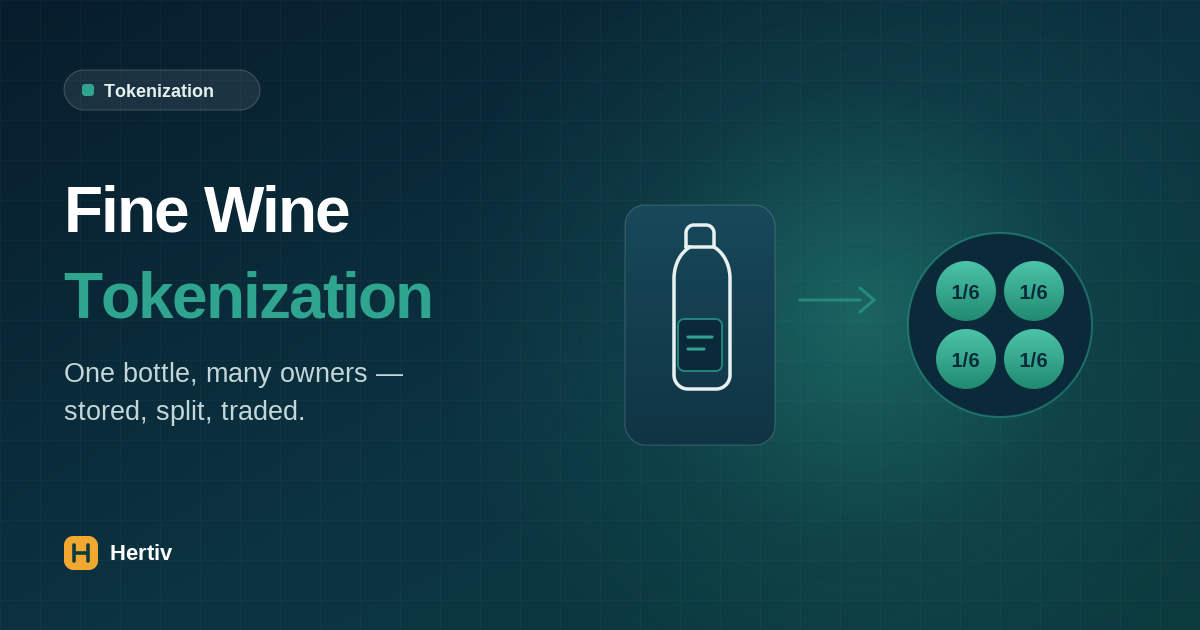
Fine wine tokenization is the process of recording ownership of a bottle or case of fine wine as digital tokens on a blockchain. Each token represents a defined share of that wine, so the wine can be bought, sold or split without moving the physical bottle.
A bottle of fine wine is a hard asset to trade. It is expensive, it needs proper storage, it is easy to fake, and selling a share of one bottle is normally impossible. Tokenization answers each of those problems: the bottle stays in a bonded warehouse, its identity is recorded, and ownership is split into tokens that can change hands in minutes.
The idea sits inside the wider tokenization of real assets, where physical goods are represented on a ledger so they can be traded in smaller parts. Wine is a natural fit because bottles are individually identifiable, they age in storage, and collectors already trade them without ever taking delivery. To see the pattern across asset types, how RWA tokenization works explains the shared mechanics.
How does a bottle become a token?
A bottle becomes a token through a short chain of checks: the wine is authenticated, stored, recorded on a ledger, and only then split into tokens. Each step exists to make sure the token is backed by a real bottle.
| Step | What happens | Why it matters |
|---|---|---|
| Authenticate | Experts check the bottle, label and capsule | Stops fakes entering the system |
| Store | The bottle goes into bonded, temperature-controlled storage | Keeps the wine in provable condition |
| Record | Ownership is written to a blockchain ledger | Creates a shared, checkable record |
| Split | The bottle is divided into fungible tokens | Lets several buyers own a share |
| Trade | Tokens change hands on a marketplace | Gives owners a way out |
| Redeem | Token holders claim the bottle or its sale value | Connects tokens back to the wine |
Authentication is the step that matters most. A token is only as good as the bottle behind it, so reputable platforms work with established merchants and warehouses, and they record the bottle's provenance before any token is issued. If that step is weak, everything built on top of it is weak too.
Why would anyone buy a token instead of a bottle?
People buy wine tokens for three reasons: lower entry cost, easier trading, and access to bottles they could not buy whole. Each reason is real, and each comes with a trade-off.
Lower entry cost is the main draw. A case of a well-known vintage can cost thousands of units, which puts it out of reach for most buyers. Split into tokens, the same case can be bought in small slices, so a buyer can own part of a case they could never buy outright.
Easier trading is the second reason. Selling a physical bottle means finding a buyer, shipping it, and proving it is genuine. Selling a token means listing it on a marketplace, where the buyer trusts the storage and provenance record instead of inspecting the bottle. The third reason is access: tokens let buyers hold a share of rare vintages that rarely appear on the open market at all.
None of this makes wine a safe investment. Wine prices move, storage and insurance cost money, and a token is only worth what the next buyer will pay for it. Buyers should treat wine tokens as a way to own wine, not as a guaranteed return. The same ownership pattern appears in other collectibles, as tokenization in the art world shows with paintings and prints.
Where do wine tokens trade?
Wine tokens trade on specialist marketplaces run by wine merchants and tokenization platforms, where buyers and sellers list tokens backed by stored bottles. The marketplace handles the listing, the payment and the transfer of the token.
Some platforms sell tokens directly when a new case is tokenized, and then run a secondary market where holders can list their tokens for sale. Others focus on the secondary market only, listing tokens that were issued elsewhere. In both cases, the wine itself stays in the same warehouse while the tokens move.
Fees vary by platform and by trade, so check the platform's own pricing page before buying; the brief here is to give the pattern, not the price. Liquidity also varies: tokens for famous producers and vintages trade more often than tokens for lesser-known wines. A token that cannot be sold quickly is not a liquid asset, whatever the listing page suggests.
Redemption is the other half of trading. Some platforms let a holder who owns all the tokens for a bottle claim the physical bottle, while others only allow a sale. Check the redemption rules before buying, because they decide whether you can ever hold the wine itself.
What are the risks of fine wine tokenization?
The risks of fine wine tokenization fall into five groups: authenticity, storage, platform, market and legal. A buyer should understand all five before spending money.
| Risk | What can go wrong | What to check |
|---|---|---|
| Authenticity | The bottle is fake or misdescribed | Who authenticated it, and how |
| Storage | Heat, damage or a warehouse failure | Bonded storage and insurance |
| Platform | The issuer closes or stops operating | What happens to the wine if it does |
| Market | Few buyers, so tokens are hard to sell | Trading volume for that wine |
| Legal | Token rights differ by country | What the token legally entitles you to |
The legal question deserves attention. In some places a token is a clear claim on a stored bottle; in others it may be treated as a security or as nothing more than a record. The platform's terms should state exactly what a token holder owns, and a buyer in doubt should ask before buying. Similar questions apply across tokenized assets, as real estate tokenization shows with its own ownership and redemption rules.
Example (hypothetical): splitting one case of wine
Example (hypothetical): a merchant holds one case of 12 bottles from a known vintage, valued at 6,000 units in total. The merchant tokenizes the case into 600 tokens, priced at 10 units each, so the full case is worth the same 6,000 units in token form.
A buyer purchases 60 tokens for 600 units. That is 10 percent of the case, which equals 1.2 bottles' worth of wine. The buyer does not receive a bottle; the case stays in bonded storage, and the buyer's 60 tokens are recorded on the ledger.
Two years later the case is valued at 7,200 units, and the buyer sells the 60 tokens at 12 units each, receiving 720 units. The gain is 120 units on a 600-unit purchase, before platform fees. If the case had fallen to 4,800 units instead, the same 60 tokens would sell for 480 units, a loss of 120 units. The arithmetic is simple; the hard part is judging whether the wine will hold its value.
What are the common mistakes?
The most common mistakes are trusting the token without checking the bottle, ignoring fees and redemption rules, and treating wine tokens as a safe investment.
- Skipping provenance. A token backed by an unauthenticated bottle is worth little. Ask who checked the wine and how.
- Ignoring storage. Wine kept outside bonded, temperature-controlled storage loses value fast. Check where it is held and whether it is insured.
- Forgetting fees. Issuance, storage, insurance and trading fees all eat into returns. Add them up before buying.
- Assuming liquidity. A token is only easy to sell if buyers want that wine. Rare does not always mean wanted.
- Missing the redemption terms. Know whether you can claim the bottle, sell only, or neither, before you buy.
- Treating it as a sure thing. Wine prices move with taste, supply and the wider market. Never put in money you cannot afford to lose.
Key takeaways
- Fine wine tokenization splits a bottle or case into tokens while the wine stays in bonded storage
- Authentication and storage are the foundation: a token is only as good as the bottle behind it
- Tokens lower the entry cost and make trading easier, but they do not make wine a safe investment
- Check fees, redemption rules and trading volume before buying any wine token
- The five risks are authenticity, storage, platform failure, thin markets and unclear legal rights
Frequently asked questions
What is fine wine tokenization?
It is the process of recording ownership of a bottle or case of fine wine as digital tokens on a blockchain. The wine stays in bonded storage while the tokens change hands, and each token represents a defined share of that wine.
Do I own the actual bottle if I buy a wine token?
It depends on the platform. Some let a holder who owns all the tokens for a bottle claim the physical bottle, while others only allow a sale of the tokens. Check the redemption terms before buying.
How is wine tokenization different from buying wine normally?
Buying normally means paying for whole bottles, storing them yourself and finding a buyer when you sell. Tokenization lets you buy a share, leaves storage to the platform, and lets you sell the token on a marketplace.
Is tokenized wine a good investment?
There is no guarantee. Wine prices move with taste, supply and the wider market, and fees for storage, insurance and trading reduce returns. Treat wine tokens as a way to own wine, not as a safe investment.
What happens if the tokenization platform closes?
It depends on the platform's structure and the legal claim the token gives you. Some arrangements keep the wine in independent bonded storage with clear owner rights; others do not. Check this before buying, not after.
Can any wine be tokenized?
In theory yes, but in practice platforms focus on fine wines with a track record, known producers and a resale market. Ordinary wine rarely justifies the cost of authentication, storage and issuance.


