Features of New Cryptocurrencies: What to Check First
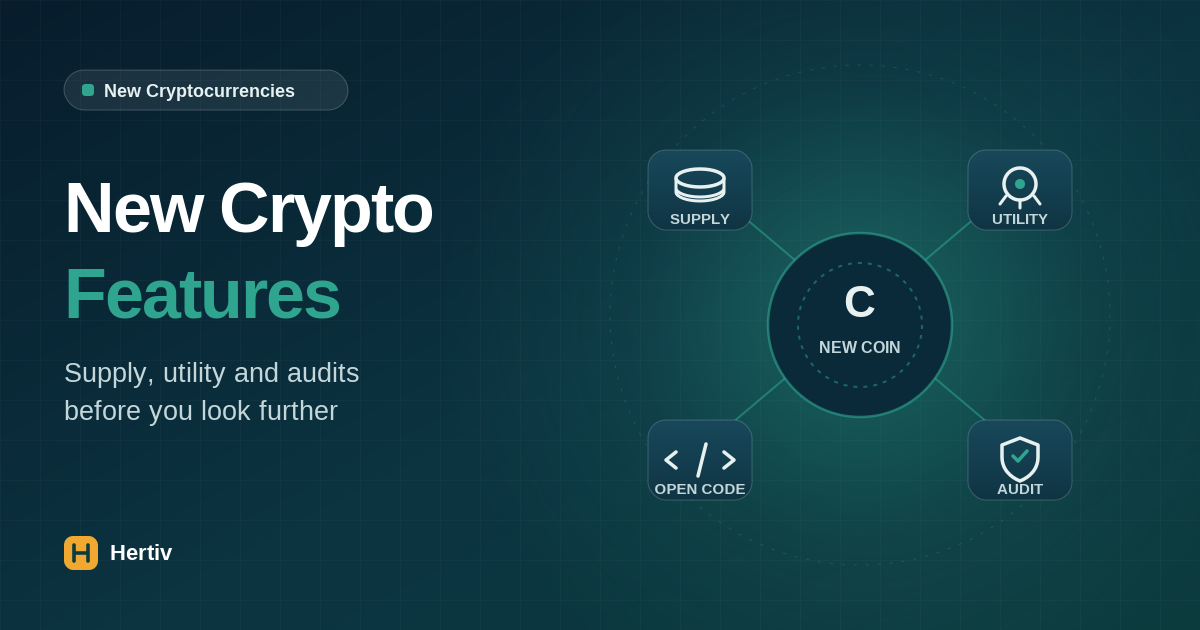
A new cryptocurrency is judged by its supply model, what it does, who builds it and whether its code is open and audited. Here are the features that matter.
On this page
Short answer
The features of a new cryptocurrency that matter most are its supply model, its utility, the team behind it, whether the code is open and audited, and how easily the coin can be bought and sold. A coin with a clear purpose, a capped or transparent supply, public code and independent audits is easier to judge than one that relies on promises and marketing.
What are the features of a new cryptocurrency?
A new cryptocurrency is a digital coin or token with a set of features that decide what it can do and how much it can be trusted. The features that matter are not the logo or the name, but the supply model, the utility, the team, the openness of the code and how the coin can be bought and sold.
New coins appear often, and most of them fail or fade away. The ones that survive usually share the same traits: a clear purpose, a written supply rule, code anyone can read, and a use for holders beyond trading. Checking those traits takes an hour and saves far more.
| Feature | What to check | Why it matters |
|---|---|---|
| Supply model | Fixed cap or clear issuance rule | Sets how scarce the coin can be |
| Utility | A real use: payments, access, governance | Gives the coin a reason to exist |
| Team | Named people with a track record | Shows who is accountable |
| Open code | Public code anyone can read | Lets others check the claims |
| Audits | Independent security review | Catches bugs before attackers do |
| Liquidity | Traded on known venues | Decides whether you can exit |
No single feature proves a coin is sound. The point of the checklist is to spot the gaps early: a coin with no clear use, no public code and no audit has three gaps worth noting. The five exchange types that list new coins differ in what they check, as five types of cryptocurrency exchanges explains.
How does the supply model work?
The supply model of a new cryptocurrency is the rule that decides how many coins exist and how new ones are created. It is usually written in the coin's code and documents, and it is one of the first things to check.
Fixed-supply coins have a cap that can never be passed, so no new coins can dilute existing holders. Bitcoin is the best-known example, with a fixed cap that is part of its design. Capped models suit coins meant to hold value, because the scarcity is predictable.
Other coins issue new coins on a schedule, for example to reward validators or fund development. That is not automatically bad, but the schedule must be public and the rate must be clear. A coin that can print new supply without a stated rule can dilute holders without warning.
Check three numbers: the total supply, the circulating supply and the issuance schedule. If any of them is missing or unclear, treat that as a gap. A coin that hides its supply rule is asking you to trust a promise instead of a mechanism.
What does the coin actually do?
A new cryptocurrency should do something concrete: pay for a service, give access to a network, let holders vote on changes or reward work that secures the network. That use is its utility, and it is what separates a coin from a pure trading token.
Payment coins are used to settle transactions, often across borders or inside an app. Access tokens pay for a service, such as storage or compute, and governance tokens let holders vote on protocol changes. Staking tokens are locked up to secure a network and earn rewards in return. Each use has its own risks, but each one is a real job the coin performs.
Be wary of coins whose only use is trading itself. If the white paper describes a future product but the coin is already trading, the utility is a promise, not a feature. Ask what the coin does today, who uses it and whether the use needs a coin at all.
Utility also decides demand. A coin that people need to use a service has a reason to be bought beyond speculation, while a coin with no use depends entirely on new buyers. That difference matters more than any short-term price move.
How do you judge the team and the code?
You judge the team and the code of a new cryptocurrency by what is public: named people, a track record, open code and independent audits. An anonymous team with closed code and no audit is a set of promises with no way to check them.
Start with the team. Named founders and developers with public histories in software or finance are easier to hold accountable than anonymous accounts. A team that has shipped before, even in a different project, is a better sign than a team with no record at all.
Then look at the code. Public code lets anyone read how the coin works, check the supply rule and spot back doors. A coin whose code is closed asks you to trust the team's word, and a coin whose code is public but never updated may be abandoned. Regular commits and responses to reported issues are a good sign.
Finally, check the audits. An independent security review by a known firm catches bugs before attackers do, and the audit report should be public with the findings addressed. A coin with no audit, or an audit that was never published, carries more risk than one that was reviewed and fixed. Building an exchange that lists new coins needs the same care, as crypto exchange development shows.
Example (hypothetical): comparing two new coins
Example (hypothetical): two new coins launch in the same month. Coin A has a fixed cap of 100 million coins, is used to pay for storage on its network, has a named team, public code and a published audit. Coin B has no stated cap, is described as a future payments coin with no working product, has an anonymous team and closed code.
On the checklist, Coin A scores on supply, utility, team, code and audits: five out of five. Coin B scores on none of them: its supply is unclear, its utility is a promise, its team is anonymous and its code cannot be checked. The comparison does not predict prices, but it shows which coin can be judged and which one cannot.
Suppose both coins list at the same price and a buyer puts 1,000 units into each. If Coin B later issues 50 million extra coins without a stated rule, the buyer's share of the supply falls by a third, even if the price does not move. Coin A's fixed cap means that dilution cannot happen by design. That is why the supply rule matters more than the launch price.
What are the common mistakes?
The most common mistakes with new cryptocurrencies are buying on hype, skipping the supply check and trusting unaudited code.
- Buying on hype. Social media attention is not a feature. Check the supply, utility, team and audits before looking at the price.
- Skipping the supply check. A coin with no stated cap can dilute holders at any time. Read the issuance rule first.
- Trusting unaudited code. Closed code and no audit mean nobody outside the team has checked for bugs or back doors.
- Ignoring liquidity. A coin traded on one small venue may be hard to sell. Check where it trades and how deep the market is.
- Confusing a roadmap with a product. A future use is a promise. Ask what the coin does today and who uses it.
Most of these mistakes come from deciding on price and marketing instead of features. A one-hour check of supply, utility, team, code and audits catches the weakest coins before any money moves. Stablecoins follow the same logic with a different anchor, as what a stablecoin is explains.
How do you check a new coin before buying?
You check a new coin before buying by working through the feature list in order, and walking away if the answers are missing or unclear.
- Read the supply rule: total supply, circulating supply and the issuance schedule, all in public documents.
- Name the utility: what the coin does today, who uses it and whether the use needs a coin at all.
- Check the team: named people with a public track record, not anonymous accounts.
- Read the code and the audit: public code with recent activity and a published independent audit with findings addressed.
- Check where it trades: known venues, enough liquidity to sell, and a wallet you control.
Score the coin on each step and compare it with the next coin on your list. A coin that passes all five is not guaranteed to succeed, but it is one you can judge on facts rather than promises. If any step has no answer, that is itself an answer. Launching a token has its own checklist, as how to launch a crypto token shows.
Key takeaways
- Judge a new coin by its features: supply model, utility, team, open code, audits and liquidity
- A fixed cap or a public issuance schedule makes dilution predictable; a hidden rule does not
- Utility means the coin does a job today, not a promised job in a future roadmap
- Public code and a published independent audit let others check the team's claims
- Work through the five-step check and walk away when the answers are missing
Frequently asked questions
What is the most important feature of a new cryptocurrency?
The supply model and the utility, taken together. A clear supply rule decides how scarce the coin can be, and a real use gives it a reason to exist. A coin missing either one is hard to judge on facts.
Does a fixed supply make a coin a good buy?
No. A fixed cap limits dilution, but it says nothing about demand, the team or the code. A capped coin with no use and no audit is still a weak coin; the cap is one feature among several.
How do I know if a coin's code is safe?
Look for public code with recent activity and a published audit by an independent firm, with the findings addressed. Closed code or an unpublished audit means nobody outside the team has checked for bugs or back doors.
What does utility mean for a cryptocurrency?
Utility is the job the coin does: paying for a service, giving access to a network, letting holders vote, or rewarding work that secures the network. A coin with no current use depends entirely on new buyers.
Why does liquidity matter for a new coin?
Liquidity decides whether you can sell. A coin traded on one small venue may be hard to exit at a fair price, so check where it trades, how deep the market is and whether you control your own wallet.
Should I buy a coin just because it is new?
No. Newness is not a feature. Work through the checklist first: supply rule, utility, team, code, audit and liquidity. If the answers are missing, that is itself a reason to wait.


