Five Types of Cryptocurrency Exchanges Explained
The five types of cryptocurrency exchanges are centralised, decentralised, hybrid, peer-to-peer and derivatives. Here is how each one works and who it suits.
On this page
Short answer
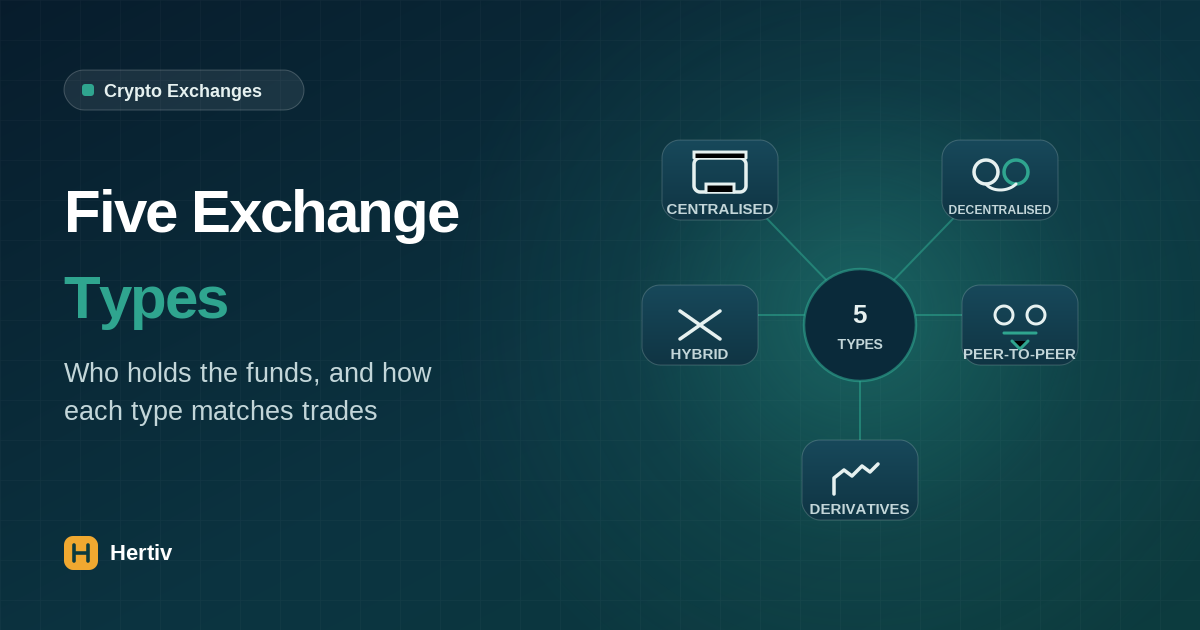
The five types of cryptocurrency exchanges are centralised exchanges, decentralised exchanges, hybrid exchanges, peer-to-peer marketplaces and derivatives exchanges. They differ in who holds the funds, how trades are matched and what can be traded, so the right type depends on whether you want speed, control, privacy or advanced trading products.
What are the five types of cryptocurrency exchanges?
A cryptocurrency exchange is a place where people buy, sell or swap digital assets. The five types differ in who holds the funds, how trades are matched and what can be traded, and each type suits a different kind of trader.
Centralised exchanges hold your funds and match orders on their own books. Decentralised exchanges let you trade from your own wallet through smart contracts. Hybrid exchanges mix the two, peer-to-peer marketplaces connect buyers and sellers directly, and derivatives exchanges trade contracts based on crypto prices rather than the coins themselves.
| Type | Who holds funds | How trades match | Best for |
|---|---|---|---|
| Centralised | The exchange | Order book run by the exchange | Beginners, fast trading |
| Decentralised | The trader's wallet | Smart contracts and pools | Self-custody, new tokens |
| Hybrid | Split between both | Order book plus on-chain settlement | Speed with some control |
| Peer-to-peer | Escrow until payment clears | Direct buyer-seller deals | Local payment methods |
| Derivatives | The exchange or contract | Futures and perpetual contracts | Experienced traders |
Most traders start on a centralised exchange because it feels closest to a normal app, then move to other types when they want more control, more tokens or more advanced products.
How do centralised exchanges work?
A centralised exchange is a company that runs the trading platform. You create an account, complete identity checks, deposit funds, and the exchange holds them while you trade. Orders are matched on the exchange's own order book, and the company settles the trade from its wallets.
The advantage is convenience. Deposits, trading and withdrawals happen in one app, support can help when something goes wrong, and liquidity is usually deep, so large orders fill quickly. Fiat on-ramps, such as buying crypto with a card or bank transfer, are a centralised exchange feature.
The trade-off is custody. The exchange holds your funds, so you rely on its security and its finances. If the exchange is hacked, freezes withdrawals or fails, your funds are at risk. That is why many traders keep only trading funds on an exchange and move the rest to their own wallet. See ways to secure a cryptocurrency exchange for the controls that matter.
How do decentralised exchanges work?
A decentralised exchange is software, not a company. You connect your own wallet, and trades run through smart contracts on a blockchain. No account, no identity check and no deposit: your funds stay in your wallet until the moment a trade settles.
Most decentralised exchanges use liquidity pools instead of order books. Traders swap against a pool of tokens supplied by other users, and the price is set by the ratio of tokens in the pool. Anyone can list a token by adding liquidity, which is why new tokens appear on decentralised exchanges first.
The trade-off is responsibility. There is no support desk, no password reset and no reversal if you send funds to the wrong contract. Network fees apply to every trade, and prices can move sharply on small pools. The control is real, but so is the need to check every detail yourself.
What are hybrid, peer-to-peer and derivatives exchanges?
Hybrid exchanges try to take the best of both designs. They match orders on a fast centralised engine but settle trades on-chain, so the exchange never holds your funds for long. The idea is speed without full custody, though in practice the design varies a lot between platforms.
Peer-to-peer marketplaces connect a buyer and a seller directly. The seller lists an offer with a payment method, such as a bank transfer or a mobile money service, and the platform holds the crypto in escrow until the buyer confirms payment. This suits regions where card payments are limited, but trades are slower and scams are more common.
Derivatives exchanges trade contracts based on crypto prices, such as futures and perpetual swaps, rather than the coins themselves. Traders can bet on prices rising or falling and can borrow to increase a position, which raises both gains and losses. These products suit experienced traders only, and they carry the highest risk of the five types. Teams building an exchange usually start from crypto exchange development to see which model fits their users.
Example (hypothetical): buying your first crypto
Example (hypothetical): a first-time buyer wants to buy 2 units of a token priced at 500 each. The cost is 2 x 500 = 1,000. On a centralised exchange, the buyer creates an account, completes the identity check, deposits 1,000 from a bank and places the order in the app.
A month later the token trades at 550. The buyer sells 2 units and receives 2 x 550 = 1,100 before fees. The gain is 1,100 - 1,000 = 100, and the exchange fee comes off that gain, so the buyer checks the fee schedule first; see vendor site for current fees.
On a decentralised exchange the same trade would skip the account and the identity check, but the buyer would pay a network fee on each step and would need a wallet already funded with the token used to pay that fee. The choice is between convenience and control.
What are the common mistakes?
The most common exchange mistakes are keeping large balances on one platform, trading derivatives without understanding them and ignoring fees and withdrawal limits.
- Keeping everything on one exchange. Move funds you are not trading to your own wallet.
- Trading derivatives as a beginner. Borrowed positions can lose more than the starting amount.
- Ignoring fees. Trading, withdrawal and network fees add up; check them before the trade.
- Skipping the security setup. Two-factor authentication and withdrawal address lists are the basics.
- Trusting a new token's price. Small liquidity pools move sharply, so check the pool size first.
Most of these mistakes are easy to avoid with a short checklist before the first trade. A trader who checks fees, security settings and withdrawal limits first will not be surprised later.
How do you choose the right type of exchange?
You choose the right type of exchange by matching it to what you actually want to do: buy once, trade often, use local payment methods or trade advanced products.
- Decide what you will trade. Mainstream coins are on centralised exchanges; new tokens are on decentralised ones.
- Choose custody or convenience. If you want control, pick a decentralised exchange; if you want support, pick a centralised one.
- Check fees and limits. Compare trading fees, withdrawal fees and daily limits; see vendor site for current numbers.
- Check security. Look for two-factor authentication, withdrawal address lists and a clear track record.
- Start small. Make one small trade and one small withdrawal before moving larger amounts.
Many traders end up using two types: a centralised exchange for buying with fiat and a decentralised one for tokens that are not listed elsewhere. That combination covers most needs without putting everything in one place. Developers comparing ready-made options often read top cryptocurrency exchange scripts to see what each model costs to build.
Key takeaways
- The five types are centralised, decentralised, hybrid, peer-to-peer and derivatives exchanges
- Centralised exchanges offer convenience and support but hold your funds
- Decentralised exchanges keep funds in your wallet but give you no support desk
- Peer-to-peer suits local payment methods; derivatives suit experienced traders only
- Start small, check fees and security, and move funds you are not trading to your own wallet
Frequently asked questions
Which type of crypto exchange is best for beginners?
A centralised exchange is usually the easiest start: account setup, card or bank deposits, support and deep liquidity in one app. The trade-off is custody, so move funds you are not trading to your own wallet.
Is a decentralised exchange safer than a centralised one?
It is safer from exchange failure, because the exchange never holds your funds. It is riskier in other ways: there is no support, no reversal for mistakes, and smart contract bugs can drain a pool. Safety depends on what you are protecting against.
What is the difference between a hybrid and a centralised exchange?
A hybrid exchange matches orders on a fast centralised engine but settles trades on-chain, so it holds your funds for a shorter time. In practice the design varies a lot, so check how each platform actually handles custody.
How do peer-to-peer exchanges protect buyers and sellers?
The platform holds the crypto in escrow while the buyer pays. The crypto is released only after the seller confirms the payment arrived. Escrow helps, but trades are slower and scams are more common than on centralised exchanges.
What are derivatives exchanges used for?
They trade contracts based on crypto prices, such as futures and perpetual swaps, rather than the coins themselves. Traders use them to bet on price moves or to hedge, and they can borrow to increase a position, which raises both gains and losses.
Do I need more than one type of exchange?
Many traders use two: a centralised exchange for buying with fiat and a decentralised one for tokens that are not listed elsewhere. That covers most needs without putting all funds in one place.


