Enterprise RWA Tokenization: Answers to the Questions Boards Ask
Enterprise RWA tokenization turns real assets into tokens an institution can hold and transfer. Here are the answers to the questions boards ask first.
On this page
Short answer
Enterprise RWA tokenization turns a real-world asset, such as a treasury, a loan, a fund share or a building, into digital tokens on a blockchain, so an enterprise can hold, transfer and settle it digitally while the law still treats it as the original asset. The questions boards ask first are about the law, custody, cost and risk, and this article answers each one.
What is enterprise RWA tokenization?
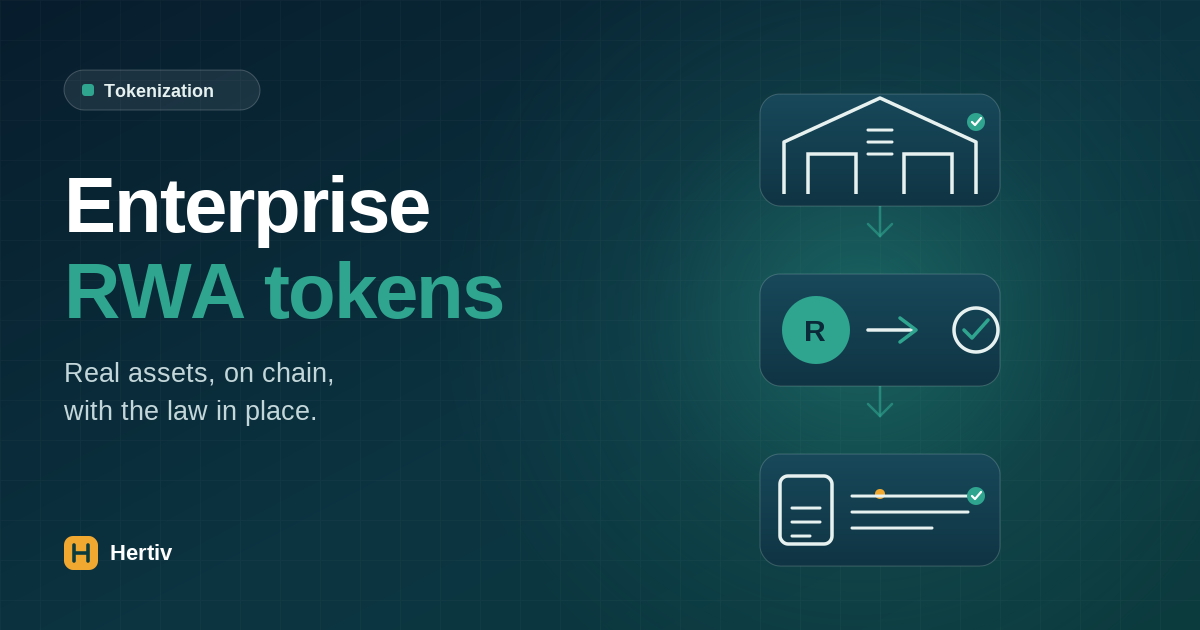
Enterprise RWA tokenization is the process of representing a real-world asset as a token on a blockchain, so that an enterprise can own, transfer and settle it digitally. The token stands for a legal claim on the asset: a share in a fund, a bond, a loan or a fraction of a building.
The asset itself stays where it is, held by a custodian or a legal company, while the token records who owns which part of it.
The enterprise angle is what makes this different from a retail token sale. An enterprise needs the token to fit its existing rules: its compliance team must be able to check who holds it, its auditors must be able to see the register, and its treasury must be able to settle it through its normal accounts. A token that cannot do those things is a demo, not a product.
The technology is the easy part. The hard part is the wrapper around it: the legal company that holds the asset, the identity checks on every holder, the custody of the tokens, and the rules that stop a token moving to someone who is not allowed to hold it. For the mechanics of how a token is created, see how RWA tokenization works.
Which assets make sense for an enterprise to tokenize?
The assets that make sense for an enterprise to tokenize are the ones it already holds, that are hard to split or slow to settle, and where the law allows a token to represent ownership. The list is shorter than the marketing suggests.
| Asset | Why tokenize it | Main constraint |
|---|---|---|
| Treasuries and money-market funds | Fast settlement, easy to value | Regulated issuer and custody |
| Private credit and loans | Split large loans into smaller pieces | Investor limits and reporting |
| Fund shares | Transfer between verified investors | Investor checks and holding caps |
| Real estate funds | Smaller pieces of large properties | Property law and valuation |
| Carbon credits | Traceable retirement and transfer | Registry rules and double counting |
| Commodities and gold | Ownership without moving the asset | Storage and audit of the reserve |
Treasuries and money-market funds are the usual first choice, because they are easy to value, easy to audit and already familiar to a treasury team. Real estate and private equity come later, because the legal work is heavier and the valuation is less certain. For the trends shaping these choices, see RWA trends enterprises should watch.
What does the law require?
The law requires that a tokenized asset follows the same rules as the asset it represents. Tokenizing a security does not make it stop being a security, and tokenizing a fund share does not remove the fund rules. The token is a new form, not a new asset.
Three legal points matter most. First, the issuer must be allowed to offer the asset to the investors it targets, which usually means a licensed issuer or an exemption that fits the investor type. Second, every holder must pass identity checks, and the token must be able to stop a transfer to someone who has not passed them.
Third, the asset must be held by a named custodian or legal company, so that a token holder has a real claim if something goes wrong.
The rules differ by country, and a token that is legal in one market may not be legal in another. An enterprise should get legal advice on each market it plans to operate in before writing any code, and it should expect the legal review to take longer than the technical build. Standards such as ERC-3643 build the identity and compliance checks into the token itself; see ERC-3643 tokenization for how that works.
What does enterprise RWA tokenization cost, and how long does it take?
Enterprise RWA tokenization costs depend on the asset, the legal work and the custody, not on the token itself. The token contract is the smallest part of the bill. The legal review, the audit, the custody setup and the ongoing compliance work are where the money goes, and they are also the parts that cannot be skipped.
The cost drivers are easy to list. Legal advice on the offering and the markets. A security audit of the token contracts and the registries. Custody, either with a licensed custodian or with the enterprise's own setup. Identity checks for every investor. And the ongoing work: managing the holder register, updating compliance rules, and reporting to regulators and auditors.
Timing follows the same pattern. A simple treasury tokenization with a licensed issuer and a ready custodian can move in months. A real estate fund or a private credit deal takes longer, because the asset itself needs valuation, legal structuring and investor checks.
Any vendor that promises a launch in days is selling a demo, not a regulated product. Pricing for any specific build is on the vendor site, and a quote should itemise legal, audit and custody separately from the development work.
The honest way to judge the cost is against the alternative. If the token saves settlement days, opens a new investor group or replaces a manual register, the saving is real. If it only adds a token to a process that already works, the cost is hard to justify.
How does an enterprise start with RWA tokenization?
An enterprise starts with RWA tokenization by picking one asset, one market and one use, and proving it end to end before expanding. The first project should be small enough to finish and useful enough to matter.
- Pick the asset and the use. Choose an asset the enterprise already holds and a clear benefit, such as faster settlement or a wider investor group. Write the benefit down in one sentence.
- Get the legal answer first. Ask a lawyer which rules apply, who may hold the token and what the offering must disclose. Do this before choosing a chain or a vendor.
- Choose the custody model. Decide who holds the asset and who holds the tokens, and how the two stay in step. Custody is a board decision, not a technical one.
- Build a small pilot. Tokenize a small slice of the asset, onboard a handful of verified investors, and run a full cycle: issue, transfer, settle and report.
- Measure and decide. Compare settlement time, cost and investor reach with the old process. Expand only if the pilot beats it on a measure the board cares about.
Keep the pilot inside one team and one market. A pilot that works in one place is easier to defend and easier to fix than a company-wide rollout, and it gives the board real numbers instead of a slide deck.
Example: a treasury team tokenizes its holdings
Example (hypothetical): a company holds 20 million units in short-term treasuries and wants to settle them faster between its own entities. Today a transfer takes two days and a manual reconciliation. The treasury team decides to tokenize a slice of the holding.
The team tokenizes 5 million units, split into tokens of 100,000 units each, which makes 50 tokens. Each token is held in a wallet controlled by a group entity, and every holder has passed identity checks. The token contract only allows transfers between verified wallets.
A transfer of 10 tokens, or 1 million units, now settles in minutes instead of two days, and the register updates on chain, so the finance team can see all 50 tokens and their holders at any time without asking for a spreadsheet. The team keeps the remaining 15 million units in the old process until the pilot has run for a full quarter and the auditors have signed off the new register.
What are the common mistakes?
The most common mistakes in enterprise RWA tokenization are treating the token as the product, skipping the legal work, and launching before custody and compliance are ready.
- Token first, law later. A token that cannot legally be held by its buyers is worthless. Get the legal answer before writing code.
- No named custodian. If nobody can say who holds the asset, the token is a claim on nothing. Name the custodian and the legal company in the offering documents.
- Weak identity checks. A token is only as compliant as the identity behind it. If verification is loose, the on-chain check means little.
- Skipping the audit. Token contracts hold real value. An audit is not optional, and the registries need review too, not just the token.
- Promising liquidity that is not there. A token does not create buyers. If there is no secondary market, the token is no more liquid than the asset it represents.
- Measuring the wrong thing. Counting tokens issued says nothing about value. Measure settlement time, cost per transfer and investor reach instead.
Key takeaways
- A token is a new form of the same asset — the law still applies in full
- Treasuries and fund shares are the usual first assets; real estate and private credit come later
- Legal advice, custody and identity checks come before the code, and audits before launch
- Start with one asset, one market and a small pilot, then measure settlement time and cost
- A token does not create liquidity — it only moves an asset that already has buyers
Frequently asked questions
What is RWA tokenization for an enterprise?
It is turning a real asset the enterprise already holds, such as a treasury, a loan or a fund share, into digital tokens on a blockchain, so it can be held, transferred and settled digitally. The asset stays with a custodian, and the token records who owns which part of it.
Which law applies to a tokenized asset?
The same law that applies to the asset itself. A tokenized security is still a security, and a tokenized fund share still follows fund rules. The issuer must be allowed to offer it, holders must pass identity checks, and the rules differ by country, so legal advice is needed for each market.
Who holds the asset behind the token?
A named custodian or a legal company set up to hold it. The token holder's claim is against that company, so the offering documents must name it and explain what happens if it fails. A token with no named custodian is a claim on nothing.
Does tokenization make an asset liquid?
Not on its own. A token can be transferred faster, but it does not create buyers. If there is no secondary market and no willing buyers, the token is no more liquid than the asset it represents. Liquidity comes from demand, not from the token.
What does enterprise RWA tokenization cost?
It depends on the asset, the legal work, the audit and the custody, and those are the largest parts of the bill. The token contract itself is the smallest part. Any quote should itemise legal, audit and custody separately, and pricing for a specific build is on the vendor site.
How long does a first RWA tokenization take?
A simple treasury pilot with a licensed issuer can move in months. A real estate fund or a private credit deal takes longer, because the asset needs valuation, legal structuring and investor checks. The legal review usually takes longer than the technical build.


