ERC-3643 Tokenization: How Compliant Tokens Work
ERC-3643 is the token standard for regulated assets: it checks each holder's identity before a transfer happens. Learn how it works and when to use it.
On this page
Short answer
ERC-3643 tokenization is the practice of issuing a regulated asset, such as a fund share or a bond, as a token that checks the identity of both parties before every transfer. The standard, also known as T-REX, pairs a token contract with an identity registry and compliance rules, so only verified holders can receive the token.
What is ERC-3643 tokenization?
ERC-3643 tokenization is the process of representing a regulated asset, such as a fund share, a bond or a share in a company, as a token on a blockchain that only verified investors can hold. The token itself enforces the rules: if a transfer would break them, the transfer does not happen.
The standard is also known as T-REX, short for Token for Regulated EXchanges, and it was developed by Tokeny. It builds on the familiar ERC-20 token pattern, so wallets and exchanges that handle ERC-20 tokens can work with it, but it adds an identity check that ERC-20 does not have.
The idea is simple. In a normal token, anyone with the token can send it to anyone. In a regulated asset, the law says only certain people may hold it: investors who passed checks, who live in allowed countries, or who hold a valid claim. ERC-3643 moves that check onto the chain, so the token cannot land in the wrong hands by accident.
How does an ERC-3643 transfer work?
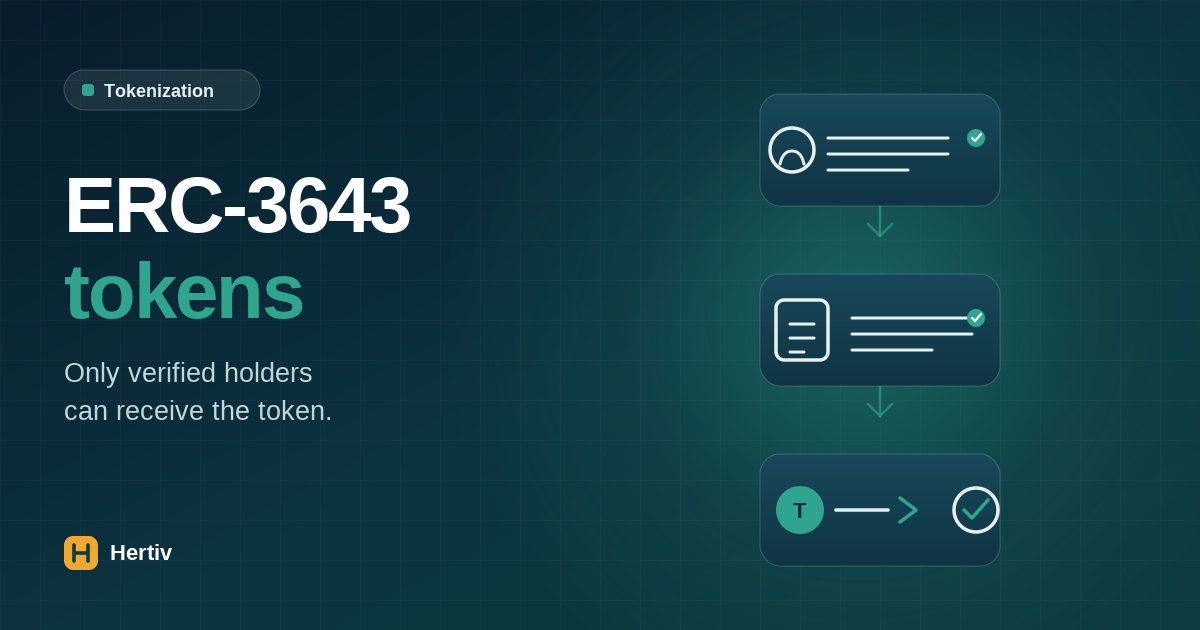
An ERC-3643 transfer works by checking both parties before the tokens move. The token contract asks the identity registry whether the sender and the receiver are verified, then asks the compliance rules whether this transfer is allowed. Only if both answers are yes does the transfer happen.
- Investor is verified. Before buying, the investor completes identity checks with a trusted issuer, who records a claim on the investor's on-chain identity.
- Transfer is requested. The sender asks to move tokens to the receiver, as with any token transfer.
- Identity is checked. The token contract looks up both identities in the registry and confirms each one holds a valid claim.
- Compliance is checked. The compliance module applies the rules for this token: allowed countries, holding limits, lock-up periods, or a cap on the number of holders.
- Tokens move or the transfer fails. If every check passes, the tokens move. If any check fails, the whole transfer is rejected and no tokens change hands.
Because the check happens in the transfer itself, the token cannot be sent to an unverified wallet even by mistake. The issuer does not need to chase the tokens after the fact.
What are the parts of an ERC-3643 token?
An ERC-3643 token is made of four parts that work together: the token contract, the identity registry, the trusted issuers registry and the compliance module. Each part has one job, and the token contract ties them together.
| Part | Job | Who controls it |
|---|---|---|
| Token contract | Holds balances and runs transfers | Issuer |
| Identity registry | Links wallets to verified identities | Issuer |
| Trusted issuers registry | Lists who may verify investors | Issuer |
| Compliance module | Applies transfer rules | Issuer, can be swapped |
| ONCHAINID | Investor identity with signed claims | Investor, verified by issuer |
The identity used is called ONCHAINID: a smart contract that represents one investor, holding claims signed by trusted issuers, such as a proof of identity or a proof of residence. The investor controls the identity contract, while the issuers sign the claims on it. For a comparison with the other permissioned standard, see ERC-3643 vs ERC-1400.
What can you tokenize with ERC-3643?
You can tokenize any regulated asset with ERC-3643 where the law limits who may hold it. The most common cases are fund shares, bonds, shares in private companies and real estate funds, where the investor base is restricted and the issuer must know who holds the asset.
Fund shares are the classic case. A fund that is only open to professional investors can issue tokens that only verified professionals can receive, and the compliance module can enforce a cap on the number of holders or a minimum holding. Bonds work the same way, with the added need to pay interest to the right holders on the right dates.
Real estate funds and private equity use the standard to split a large asset into smaller pieces without losing control of who holds them. The token can also carry rules such as a lock-up period after purchase, which the compliance module enforces automatically.
ERC-3643 is not the right choice for an open token anyone may hold. If there are no transfer restrictions, a plain ERC-20 token is simpler and cheaper to run. The standard earns its complexity only where compliance is part of the product.
How do you issue an ERC-3643 token?
You issue an ERC-3643 token by setting up the identity system first, then the token, then the compliance rules, and finally the sale. The identity work comes first because no transfer can happen until investors are verified.
- Define the rules. Write down who may hold the token, which countries are allowed, any holding limits and any lock-up periods. Get legal advice on this before writing code.
- Set up identity. Choose trusted issuers to verify investors and issue ONCHAINID identities with the claims the token will check.
- Deploy the token. Deploy the token contract with its identity registry, trusted issuers registry and compliance module, then test transfers on a test network.
- Audit the contracts. Have the contracts reviewed by a security auditor before any real value moves through them.
- Onboard investors. Verify investors, record their claims, and only then open the sale.
After launch, the issuer keeps managing the registries: adding trusted issuers, updating compliance rules and handling investor changes. The compliance module can be replaced without moving the token, which lets the rules change as the law changes. For the wider process, how to launch a security token covers the steps around the token itself.
Example: a fund tokenizes its shares
Example (hypothetical): a fund with 40 professional investors wants to tokenize its shares so investors can transfer them between each other. Each share is worth 10,000 units, and the fund issues 1,000 shares, so the total value is 10 million units.
The fund sets two rules: only verified professional investors may hold the shares, and no investor may hold more than 100 shares. An investor who holds 60 shares asks to buy 50 more from another investor. The transfer would take them to 110 shares, which breaks the cap, so the compliance module rejects the whole transfer and the tokens stay put.
The same investor then buys 40 shares instead, taking them to exactly 100. The identity check passes and the cap is met, so the transfer goes through. The fund's register updates on chain, and the fund manager can see all 1,000 shares and their 40 holders at any time without asking anyone for a spreadsheet.
What are the common mistakes?
The most common mistakes with ERC-3643 are treating it like a normal token, skipping the audit, and forgetting that the identity system needs ongoing care. Each one can leave a regulated token that does not actually enforce its rules.
- Skipping the legal review. The compliance rules are law, not code preferences. Write them with a lawyer before deploying anything.
- Weak identity checks. A token is only as compliant as the identity claims behind it. If verification is loose, the on-chain check means little.
- No audit. Token contracts hold real value. An audit is not optional, and the registries need review too, not just the token.
- Forgetting ongoing management. Investors change, claims expire and rules change. Someone must own the registries after launch.
- Using it for open tokens. If anyone may hold the token, ERC-3643 adds cost and friction for no benefit. Use a plain token instead.
- Ignoring the user experience. Investors must complete identity checks before they can buy. A slow or confusing process will put them off.
Key takeaways
- ERC-3643 checks holder identity on chain before every transfer
- The token, identity registry, trusted issuers and compliance module work together
- Use it for fund shares, bonds and other regulated assets — not open tokens
- Identity and legal rules come before the code, and audits before launch
- The compliance module can be swapped without moving the token
Frequently asked questions
What is the difference between ERC-3643 and ERC-20?
ERC-20 is a plain token standard: anyone can hold and transfer the token. ERC-3643 builds on ERC-20 and adds an identity check before every transfer, so only verified holders can receive it. That makes ERC-3643 suited to regulated assets and ERC-20 suited to open tokens.
What is T-REX?
T-REX stands for Token for Regulated EXchanges, and it is the original name of the ERC-3643 standard, developed by Tokeny. The two names refer to the same standard: a permissioned token with on-chain identity and compliance checks.
What is ONCHAINID?
ONCHAINID is a smart contract that represents one investor's identity on chain. It holds claims signed by trusted issuers, such as a proof of identity or a proof of residence. The token contract checks those claims before allowing a transfer.
Can ERC-3643 tokens be traded on an exchange?
Only on an exchange that checks identity the same way. A normal exchange that lets anyone deposit tokens would break the rules, because the token would reject transfers to unverified wallets. Regulated exchanges built for security tokens can list them.
Does ERC-3643 work on chains other than Ethereum?
Yes. The standard is written for Ethereum-compatible chains, so it can be deployed on any chain that runs the same virtual machine, including layer 2 networks and private chains. The identity and compliance logic travels with the contracts.
How much does it cost to issue an ERC-3643 token?
Costs depend on the chain, the audit and the legal work, so there is no fixed figure. The main costs are legal advice, contract development, a security audit and ongoing registry management. For an estimate on a real project, see the vendor site or ask a development team.


