Did Zcash Have an ICO? How Its Launch Really Worked
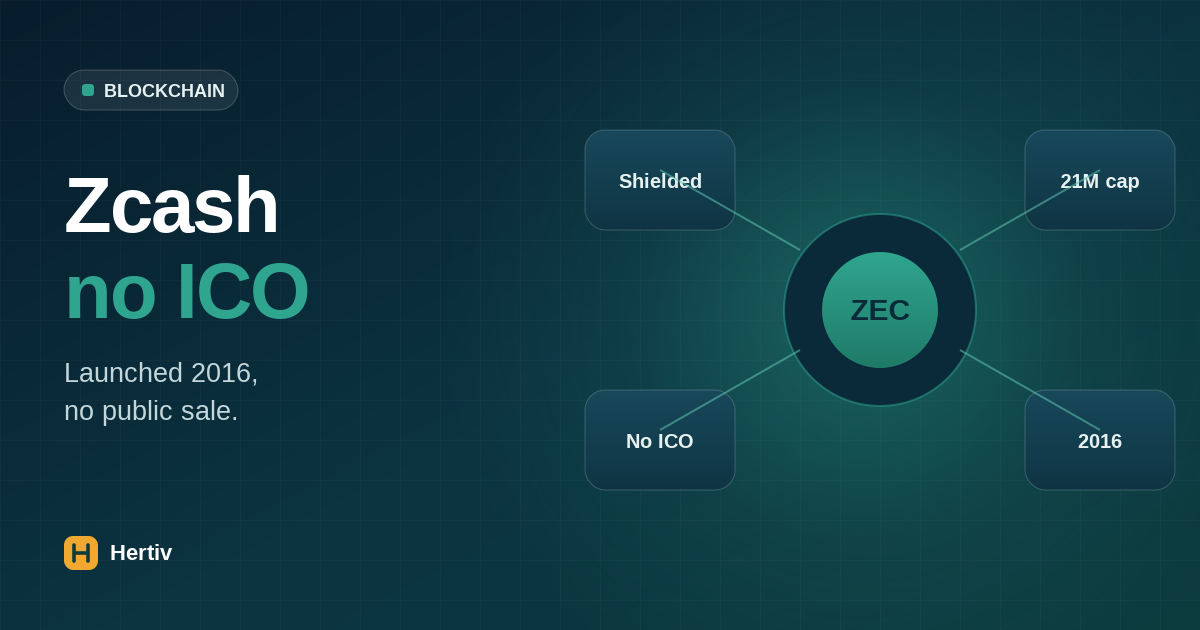
Zcash never held an initial coin offering. It launched in October 2016 as a privacy-focused fork of Bitcoin's code, funded by a share of block rewards.
On this page
Short answer
No, Zcash never held an initial coin offering, and no coins were sold to the public before launch. Zcash went live on 28 October 2016 as a new blockchain built from Bitcoin's code, with privacy features based on zero-knowledge proofs. Its early development was funded by the founders' reward: a share of the new coins created in each block during the first four years.
What is Zcash?
Zcash is a cryptocurrency that lets users hide the sender, receiver and amount of a payment while the network still proves the payment is valid. It is built from Bitcoin's code, keeps the same 21 million coin limit, and adds a privacy layer based on zero-knowledge proofs called zk-SNARKs.
Users choose between two kinds of address. Transparent addresses work like Bitcoin: the amounts and the addresses are visible on the public ledger. Shielded addresses hide the details, so an outside reader can see that a transaction happened but not who paid whom or how much moved. The network checks a short proof that the hidden transaction followed the rules.
Zcash grew out of academic research. A 2013 paper proposed Zerocoin, a way to break the link between coins, and a 2014 paper proposed Zerocash, a fuller design for private payments. A company, first called the Zerocoin Electric Coin Company and later the Electric Coin Company, turned that research into a working network.
Did Zcash have an ICO?
No. Zcash never held an initial coin offering, and there was no public sale of coins before the network went live. The network launched on 28 October 2016 from its own first block, and new coins have been created by mining ever since, the same way Bitcoin creates new coins.
The confusion is easy to understand. Zcash launched during the years when many crypto projects raised money by selling tokens first, and some articles describe its launch as a big funding event. But the two things are different: Zcash raised money from private investors for the company building the software, while the coins themselves were never sold in advance.
The launch also needed a one-time setup ceremony. The first version of the proof system needed secret random numbers that had to be created and then destroyed, because anyone who kept them could forge coins. Six people in different locations ran the ceremony in 2016, each destroying their part of the secret.
How was Zcash funded instead?
Zcash was funded by the founders' reward, a share of the new coins created in each block. During the first four years, 20 percent of each block reward went to the founders, early investors, employees and the Zcash Foundation, while miners received the other 80 percent. Because this applied only in the first half of the planned issuance, it came to 10 percent of all ZEC that will ever exist.
That design was a deliberate choice. Instead of selling coins before launch, the team took a cut of future mining rewards. The company that built the software was paid from those rewards, and the Zcash Foundation, a non-profit set up to support the protocol, received part of them as well.
The arrangement changed over time. After the first four years, a new funding plan split a share of block rewards between grants for independent developers, the company behind the software, and the foundation. The exact split has been decided by community votes since then, and it is written into the network's rules rather than decided by any single company.
What does a successful ICO usually mean?
A successful ICO usually means a project sold tokens to the public before launch and raised the money it planned to raise. The team publishes a paper, opens a sale for a fixed period, and buyers pay in an existing coin such as Bitcoin or Ether. The money funds development, and buyers receive tokens they can trade later.
| Feature | Typical ICO launch | Zcash launch |
|---|---|---|
| Public token sale | Yes, before launch | No sale at all |
| Coins at launch | Pre-created and sold | None; mined from block one |
| Team funding | Sale proceeds | Share of block rewards |
| Supply limit | Set by the team | 21 million, like Bitcoin |
| New coins | Issued on a schedule | Mined, halving about every four years |
The two models carry different risks. A token sale gives the team money up front but puts buyers at risk if the team never delivers. A block-reward model pays the team only as the network runs, which ties its income to the network staying alive. For how zero-knowledge proofs work in other projects, see zero-knowledge proof use cases.
Example (hypothetical): two launches, two funding models
Example (hypothetical): two projects launch in the same year. Project A runs an ICO and sells 10 million tokens at $1 each, raising $10,000,000 before launch. The team holds the money in a bank account and spends it over three years, which is $10,000,000 / 3 = about $3,333,333 a year.
Project B follows the Zcash model. It launches with a block reward of 12.5 coins per block, a block every 2.5 minutes, and a 20 percent founders' reward. There are 60 / 2.5 = 24 blocks an hour, or 24 x 24 = 576 blocks a day, so the network creates 576 x 12.5 = 7,200 coins a day.
The founders' share is 20 percent of that, so 7,200 x 0.20 = 1,440 coins a day go to the team and its backers. If each coin trades at $10, that is $14,400 a day, or about $5,256,000 a year. But if the coin trades at $1, the same share is only $1,440 a day, or about $525,600 a year.
The point is the difference in risk. Project A has its money whatever happens to the coin price. Project B is paid only if the network keeps running and the coin keeps value. That is why the founders' reward is not the same as an ICO, even though both pay the team that built the project.
How should you judge a coin launch?
Judge a coin launch by asking where the coins came from, who was paid, and what buyers received. The answers tell you more than the word "ICO" on a headline.
- Was there a public sale? Check whether coins were sold before launch, and at what price. If not, it was not an ICO, whatever the launch is called.
- Who gets new coins? Read how block rewards are split between miners, the team and any foundation, and for how long.
- Is there a fixed supply? A fixed cap and a halving schedule limit how many coins can ever exist, which affects long-term value.
- What does the proof system need? Some privacy coins need a setup ceremony or trusted parameters; check whether that step was done in public and how it was audited.
- Who builds the software now? A launch is only the start. Check whether development is run by one company, a foundation, or several independent teams.
These questions work for any launch, not only Zcash. A project that answers them clearly in its own documents is easier to trust than one that hides behind marketing. For the basics of how these networks are built, see what blockchain is.
What are the common mistakes?
The most common mistake is assuming every coin from 2016 and 2017 had an ICO. Many did, but Zcash is a clear exception: it launched with mining and a founders' reward, and no public sale. Calling its launch an ICO gets the funding model wrong.
Another mistake is confusing the founders' reward with a premine. A premine creates coins before launch and hands them to the team. Zcash created no coins before launch; the founders' reward was a share of coins mined after launch, over four years.
People also assume shielded transactions are invisible to everyone, including the user. They are not: the sender and receiver can see the details, and a user can share a viewing key with an auditor or a tax adviser. Privacy in Zcash means the public cannot see the details, not that the details do not exist.
Finally, do not treat the 2016 launch as the whole story. The proof system, the funding plan and the shielded pools have all changed since then, and older articles describe a network that no longer exists in that form. Check the current rules before writing about it. The proof technology behind it is covered in what a ZK rollup is.
Key takeaways
- Zcash never held an ICO: no coins were sold to the public before launch.
- It launched on 28 October 2016 as a Bitcoin-code fork with shielded transactions.
- Early work was funded by a founders' reward: 20 percent of block rewards for four years.
- A founders' reward is not a premine: no coins existed before launch.
- Judge any launch by the sale, the reward split, the supply cap and who builds it now.
Frequently asked questions
What is Zcash?
Zcash is a cryptocurrency built from Bitcoin's code that lets users hide the sender, receiver and amount of a payment while the network still proves the payment is valid. It keeps Bitcoin's 21 million coin limit and adds a privacy layer based on zero-knowledge proofs called zk-SNARKs.
Did Zcash have an ICO?
No. Zcash never held an initial coin offering and no coins were sold to the public before launch. The network went live on 28 October 2016, and new coins have been created by mining ever since. The company building the software raised money from private investors, which is different from a public token sale.
What is the founders' reward?
The founders' reward was a share of new coins in each block during Zcash's first four years. Twenty percent of each block reward went to the founders, early investors, employees and the Zcash Foundation, while miners received 80 percent. Over four years that came to 10 percent of all ZEC that will ever exist.
What is a shielded transaction?
A shielded transaction hides the sender, receiver and amount on the public ledger, while a short proof shows the network that the transaction followed the rules. Users can choose shielded addresses for privacy or transparent addresses that work like Bitcoin. The sender and receiver can still see the details of their own payments.
Is Zcash the same as Bitcoin?
No. Zcash shares Bitcoin's code base, supply limit and mining model, but it adds optional privacy through shielded transactions. Bitcoin transactions are fully public by default, while Zcash lets users hide the details. The two networks are separate and have never shared a ledger.
Who funds Zcash development now?
Development is funded by a share of block rewards set by community decisions, split between grants for independent developers, the company behind the software and the Zcash Foundation. The split has changed over time and is written into the network's rules rather than decided by one company.


